Live data from Hacker News

Tesla will not be able to scale its manufacturing capacity

bloomberg.com

111–120 of 131 posts

Re: Tesla will not be able to scale its manufacturing capacity

#111

Earlier quoted context omitted.

> That actually is anecdotal evidence. If it happened ONCE its anecdotal evidence. If it happens repeatedly to different reporters around the world? That's a statistic. The Model S drive unit is not reliable. Period. It doesn't matter how "simple" an electric motor theoretically is, in practice, the Model S motor has clear drive unit issues. > Anyway, the Model S was explicitly the stepping stone project to get to th…

Tesla's are generally reliably. I bought an original one in 2012, then I upgraded to AWD when that came out. Never had a problem other than "slight amount of moisture in my tail light" which they fixed. There have been a number of reporters who appear to have an anti-tesla bias, notable the NY Times report Broder. His name has become an adjective ("That guy brodered you"). They are physical objects, they can fail of…

On the other hand, THIS is anecdotal evidence.

Look man, I have a Seagate 3TB hard drive. It hasn't failed on me and I bought it damn cheap. But when the statistics come in...

https://www.backblaze.com/blog/wp-content/uploads/2014/09/bl...
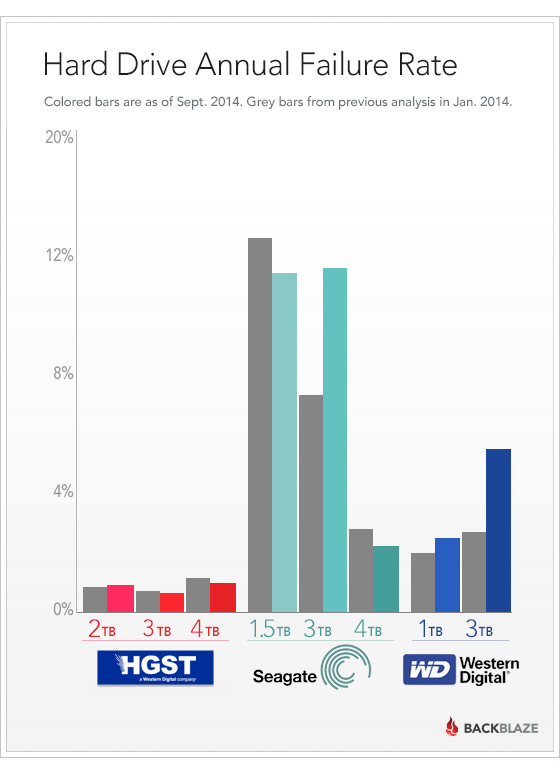
I'm not going to argue against them. Consumer Reports (survey methodology) and Edmund's (single case study) have demonstrated the issue. Tesla cars are NOT reliable, compared to Toyota Camry or Corollas or whatever else is normal out there.

Re: Tesla will not be able to scale its manufacturing capacity

#112

Earlier quoted context omitted.

Then why did Edmund's car need FOUR drive units in two years? http://www.edmunds.com/tesla/model-s/2013/long-term-road-tes... That's the FOURTH drive unit (3rd replacement) their Model S needed. The fact of the matter is, my Ford Focus (and most people's Toyota Camry from the 90s) has needed less maintenance than than the two-year test Edumnds did on the Model S. Unless you like paying $90,000+ for a car that dies in…

Does that include the episode on Top Gear that was scripted into breaking their Tesla down in the middle of a test run? According to your logic, 3 percent of scientists deny global warming, so that is a statistic we should take seriously as well. I don't care what denialists say because I can appreciate the fundamental science behind global warming. You seem to lack the vision to see that simplicity in design always…

> Does that include the episode on Top Gear that was scripted into breaking their Tesla down in the middle of a test run?

Edmunds is a serious car site, and not an entertainment show like Top Gear.

The statistics include Consumer Reports, who surveyed over 1400 Tesla S owners and have come to the same reliability issue as Edmunds. http://www.consumerreports.org/cars/tesla-reliability-doesnt...

---

And unlike Top Gear, which seems to be an anti-Tesla idiotic entertainment show. Consumer Reports was pro-Tesla until the survey came in.

http://www.cnbc.com/2015/08/27/teslas-p85d-is-the-best-car-c...

Unfortunately, Consumer Reports does not do long-term reliability tests (see Edmunds for that sort of stuff). Instead, Consumer Reports has a very robust survey methodology. They rely upon a survey conducted at a later date. So when their survey results came in that documented the large number of Tesla problems, they had to retreat from their superb rating.

A 103 out of 100 by Consumer Reports (initially). And even then, the Consumer Reports guys could not refute the reliability concerns.

Re: Tesla will not be able to scale its manufacturing capacity

#113
post #95

Earlier quoted context omitted.

> That actually is anecdotal evidence. If it happened ONCE its anecdotal evidence. If it happens repeatedly to different reporters around the world? That's a statistic. The Model S drive unit is not reliable. Period. It doesn't matter how "simple" an electric motor theoretically is, in practice, the Model S motor has clear drive unit issues. > Anyway, the Model S was explicitly the stepping stone project to get to th…

Tesla reliability not unlike other performance vehicles that are version 3, 4 or 20. That tesla has achieved what it has on v1 is amazing. Consumer Reports: "The Tesla wasn’t the only high-performance vehicle that fell below average in reliability. Others include the BMW X5 and 5 Series, and the Chevrolet Corvette."

Yes. Lets compare Tesla with the worst cars on the market in terms of reliability. And then demonstrate that other cars can have problems too.

Or you know, as a smart consumer, I'll be looking at a workhorse car like a Honda Accord, Ford Focus, Toyota Camry, etc. etc. and not have to worry about reliability issues.

Or if I'm actually going to buy on Luxury + reliability: the highly reliable Lexus ES looks like a good pick at half the price of a Tesla.

Re: Tesla will not be able to scale its manufacturing capacity

#114

Earlier quoted context omitted.

Then why did Edmund's car need FOUR drive units in two years? http://www.edmunds.com/tesla/model-s/2013/long-term-road-tes... That's the FOURTH drive unit (3rd replacement) their Model S needed. The fact of the matter is, my Ford Focus (and most people's Toyota Camry from the 90s) has needed less maintenance than than the two-year test Edumnds did on the Model S. Unless you like paying $90,000+ for a car that dies in…

In the early days of Tesla Model S, they strived to get people back on the road quickly, and they replaced entire subsystems when they didn't really need to. If you search the news group "tesla motors club", you'll find discussion of how telsa found a number of tiny tweaks that they could use to adjust some of these minor issues. They were not drive train failures really. I have driven about 40k miles, no drive train…

Even if they weren't technically drive unit failures, it is clear that a number of Tesla Model S cars have failed in some form. They were forced to be taken back to the shop and "fixed".

The reports are clear: Tesla has excellent consumer service and warranties. Owner satisfaction is EXTREMELY high, despite the issues. So Tesla is doing everything they can to address the issue, and this is commendable.

However, if you actually compare the reliability scores on pure numbers, it is clear that the Tesla Model S has a problem. It may not necessarily be drive unit related, but there is clearly a problem that affects a huge swath of people.

Re: Tesla will not be able to scale its manufacturing capacity

#115

Earlier quoted context omitted.

Funny thing is, Tesla Model S isn't your best value for money as a track car either. Its 4500lbs minimum, the P85D is even heavier (larger batteries I guess?). Its got a skidpad turn of .85g, while the good high-performance cars are .95g or higher. A $25,000 Subaru WRX achieves 5-star safety rating and gets 1:45 Laguna Seca lap time. The Tesla Model S "Performance Edition" gets a 1:48 Laguna Seca lap time. https://fo…

Heavier cars also wear through tires faster and put more stress and heat on the tires/brake pads/rotors.

Speaking of heat, I hear that Tesla's motors and brakes heat up a lot more on a track. To the point where the brakes and engine start throttling the car down a bit after a lap or two.

Which is fine. My personal car of choice apparently overheats its brakes on the Laguna Seca under stock settings (Ford Focus, although the recent "RS" edition looks to have significantly better specs for a track). Its a challenging track. So the Tesla Model S isn't the only car that is unable to sustain high-performance throughout an entire course.

But lets not pretend that the Model S is a real performance car or anything, not until it starts placing somewhere impressive on a track somewhere (Laguna Seca, Nürburgring, or whatever)

--------------

http://jalopnik.com/heres-what-a-tesla-model-s-can-do-around...

> "The lap itself was around 10 minutes Bridge to Gantry (in heavy traffic) but unfortunately the car went into a reduced power mode about 3 minutes in due to excess battery heat (at least, that's my guess)."

So there's probably some heat issue with regards to Tesla Model S on serious test tracks.

All in all, the Tesla isn't a "performance" car, although it "isn't slow" by any stretch of the imagination.

Re: Tesla will not be able to scale its manufacturing capacity

#116

So Tesla has two problems, according to the article: - They can't ramp up production fast enough to keep up with the demand indicated by pre-orders. - Pre-orders are likely to be overstating demand substantially, since they are refundable and therefore vulnerable to speculation. ...Either one of these problems by itself could be a threat, but both together seem somewhat less worrying.

If you interpret "can't ramp up" as "can't ramp up without extreme cost/risk," one could envision both being a problem. They could go all in and fail to see the demand they were expecting.

Re: Tesla will not be able to scale its manufacturing capacity

#117

Earlier quoted context omitted.

Does that include the episode on Top Gear that was scripted into breaking their Tesla down in the middle of a test run? According to your logic, 3 percent of scientists deny global warming, so that is a statistic we should take seriously as well. I don't care what denialists say because I can appreciate the fundamental science behind global warming. You seem to lack the vision to see that simplicity in design always…

> Does that include the episode on Top Gear that was scripted into breaking their Tesla down in the middle of a test run? Edmunds is a serious car site, and not an entertainment show like Top Gear. The statistics include Consumer Reports, who surveyed over 1400 Tesla S owners and have come to the same reliability issue as Edmunds. http://www.consumerreports.org/cars/tesla-reliability-doesnt... --- And unlike Top Gear…

+1 for sticking to the engineering arguments and ignoring the ad hominem.

Re: Tesla will not be able to scale its manufacturing capacity

#118
post #20

Earlier quoted context omitted.

Those statements are all still largely true, they haven't been "cycled through." There are a lot of good things happening in the world of electric cars, but right now, for most people, they're too expensive and they require sacrifices in utility and convenience that aren't seen in ICE vehicles.

The Model X has 250 mile range. But you think it's "largely true" that electric cars have a range problem? There are ~600 charging stations worldwide, and that's increasing to 1200 during 2016. But you think it's "largely true" that there's no charging infrastructure?

EVs have a range problem. 250 miles is fine for day to day driving, but most Americans routinely need to travel farther than that. Travel to nearby major cities, visiting relatives, vacations, etc. The supercharger network is a long way from being about to support travel for most people, and even once it is the charge time (30 minutes for 170 miles range) is a significant inconvenience on any trip long enough to require recharging.

The bottom line is that even if an EV meets your daily needs, it isn't going to be good enough to be your only car. That really isn't going to be the case until EVs regularly have a 350-400 mile range, the supercharger network is reasonably dense, and a supercharger can top off your car in 10-15 minutes, tops.

Re: Tesla will not be able to scale its manufacturing capacity

#119
post #20

Earlier quoted context omitted.

Those statements are all still largely true, they haven't been "cycled through." There are a lot of good things happening in the world of electric cars, but right now, for most people, they're too expensive and they require sacrifices in utility and convenience that aren't seen in ICE vehicles.

The Model X has 250 mile range. But you think it's "largely true" that electric cars have a range problem? There are ~600 charging stations worldwide, and that's increasing to 1200 during 2016. But you think it's "largely true" that there's no charging infrastructure?

I love electric cars but I totally agree that it's largely true that _most_ electric cars on the market have a range problem (eg cars that are priced in a way that they are _almost_ accessible for the general population).

Re: Tesla will not be able to scale its manufacturing capacity

#120
post #20

Earlier quoted context omitted.

Those statements are all still largely true, they haven't been "cycled through." There are a lot of good things happening in the world of electric cars, but right now, for most people, they're too expensive and they require sacrifices in utility and convenience that aren't seen in ICE vehicles.

The Model X has 250 mile range. But you think it's "largely true" that electric cars have a range problem? There are ~600 charging stations worldwide, and that's increasing to 1200 during 2016. But you think it's "largely true" that there's no charging infrastructure?

They do have a range problem, but not in the way that you probably think.

If you take a look at the affordable EV segment, in the 2011 to 2016 era, it has been represented only by Nissan Leaf.

People are reporting anywhere between 15-30% of capacity loss within the first 45,000 miles. The problem with battery powered vehicles is that there's a guaranteed loss of capacity after N charge cycles, which currently seems to be ~600-800 charges (77 miles of range x 600 charges = 46,200 miles)

Teslas have obviously not run into this problem yet, because their range is 200+, so you'd only start seeing significant capacity losses at 120,000 miles driven, which I'm guessing not many people have done since 2012.

But for smaller range vehicles this presents a significant problem: the commute you are able to make in the beginning of ownership may suddenly become impossible in just 3-4 years of driving. And how do you get more range? You need more batteries.

In fact the first vehicle to solve this and have a decent enough capacity buffer at an affordable price will be Tesla 3.

On the other hand, this will put the nail in the coffin of the "not being able to scale" argument. In fact, Tesla 3 will be successful ONLY if they're able to scale.

Post reply on HN