This analysis lacks graph for railroad shipping, which is important in Chinese context.
The Shipping News Suggests Economic Weakness
91–100 of 125 posts
Re: The Shipping News Suggests Economic Weakness
#92The dry index is a poor predictor of future economic health or stock market returns http://greyenlightenment.com/economics-myths-part-7-the-balt... The index was flat in the 80' and 90's yet the global economy boomed. Not sure why stories that are sensationalist hyperbole get voted to the front page anyway
The best indicator for anything transportation is utilization and how much stuff is actually being moved. Not just the price of moving something from A --> B. Yes, the presence of more movers, as the article points out, suppresses the price because people are competing to offer the lowest possible price to get the business. And, shippers did start investing in new builds extensively when it looked like the economy wa…
I came here to ask about whether or not we could see more than just Volvo's numbers? Apple releases numbers quarterly no? How are those doing?
And then Volvo is obviously not raw goods, but this article talks a lot about raw goods which I would presume to slowing with China's economic slow down (for how long can one build ghost cities).
My layman's analysis is that the US is in a pretty decent spot right now with a decently diversified economy but lots of other nations around the world are going to have to pull some smart moves if they'd like to sustain decent growth, but economics is a vast vast field with a seemingly unending number of indicators, so I may be totally off.
Excuse me if my questions aren't sophisticated to someone with a better understanding, I do literally plead ignorance here.
Re: The Shipping News Suggests Economic Weakness
#93The world economy is dominated by people in governments who believe that printing money, burying it and paying people to dig it up again will increase the amount of trucks built and goods shipped. No amount of failure of this theory will be enough for it to be abandoned, because it has a certain amount of truthiness to it, and it excuses profligate and wasteful behaviour. Both these things are fun and buy votes. The…
Central banks are the problem. They have destabalised the global economy by constantly lowering interest rates and creating asset bubbles to promote the illusion of growth. Central bankers are politically appointed in many cases so they have no interest in cooling an economy. It messes up the business cycle and creates the conditions for even bigger booms and busts. Alternative currencies like Bitcoin will rise in po…
Central banks and automatic stabilizers are what have avoided a bigger crisis this time.
That doesn't mean that monetary policy is the right solution. The right solution is fiscal policy (government spending) but this is not happening because politics is dominated by crazy ideas about austerity and fiscal balances.
Re: The Shipping News Suggests Economic Weakness
#94The very charts used in the article seem to disprove the hypothesis.
Ex. http://assets.bwbx.io/images/iDUeUG9Br9mI/v1/-1x-1.jpg
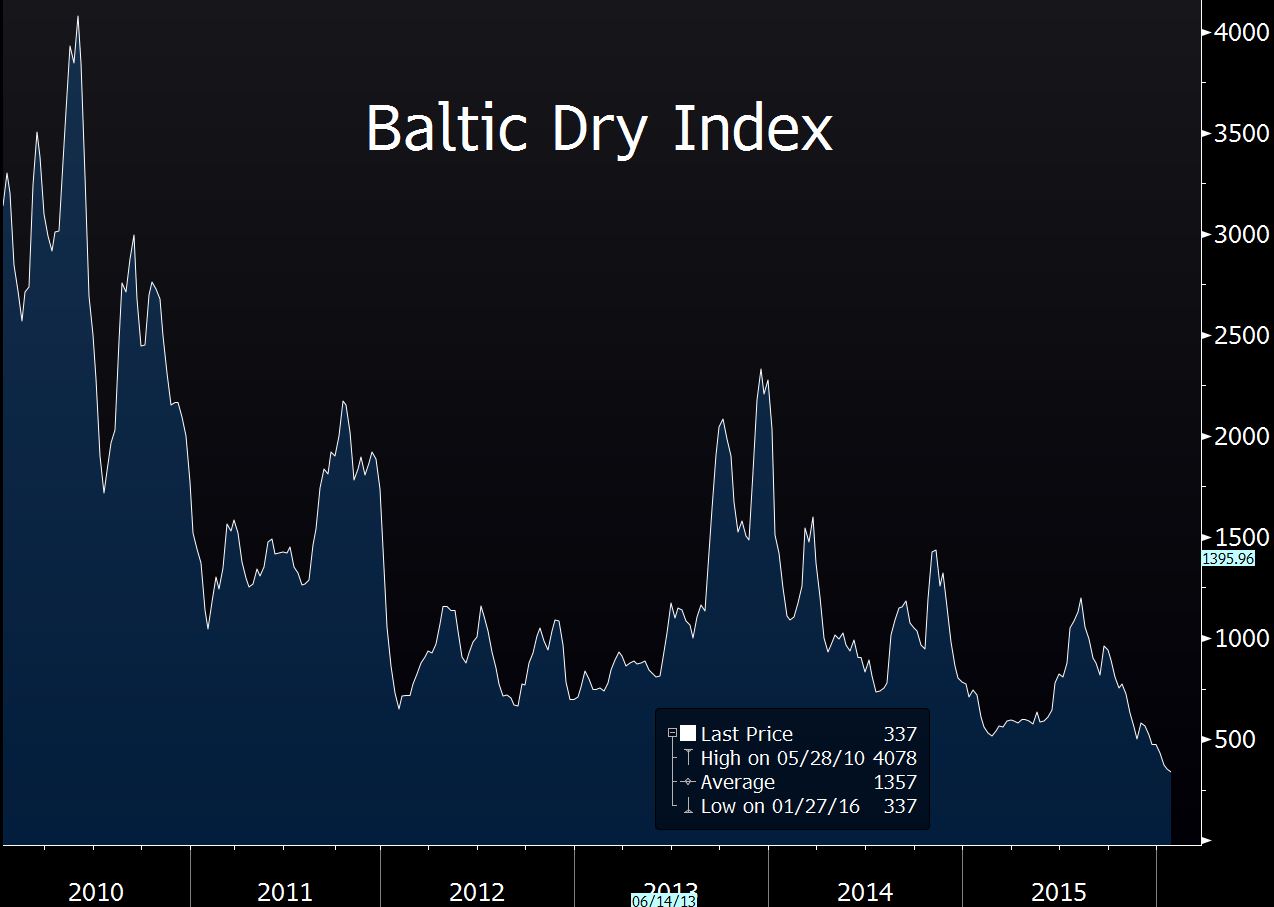
According to that chart, the beginning of 2012 would have been a horrible time to an invest and the market was about to enter a massive correction. Except the S&P is actually up >50% from 2012.
Re: The Shipping News Suggests Economic Weakness
#95Earlier quoted context omitted.
The best indicator for anything transportation is utilization and how much stuff is actually being moved. Not just the price of moving something from A --> B. Yes, the presence of more movers, as the article points out, suppresses the price because people are competing to offer the lowest possible price to get the business. And, shippers did start investing in new builds extensively when it looked like the economy wa…
I came here to ask about whether or not we could see more than just Volvo's numbers? Apple releases numbers quarterly no? How are those doing? And then Volvo is obviously not raw goods, but this article talks a lot about raw goods which I would presume to slowing with China's economic slow down (for how long can one build ghost cities). My layman's analysis is that the US is in a pretty decent spot right now with a d…
Volvo makes freight/shipping trucks, I assume that the author is using those numbers as a proxy for shipping capacity.
Re: The Shipping News Suggests Economic Weakness
#96Earlier quoted context omitted.
The best indicator for anything transportation is utilization and how much stuff is actually being moved. Not just the price of moving something from A --> B. Yes, the presence of more movers, as the article points out, suppresses the price because people are competing to offer the lowest possible price to get the business. And, shippers did start investing in new builds extensively when it looked like the economy wa…
I came here to ask about whether or not we could see more than just Volvo's numbers? Apple releases numbers quarterly no? How are those doing? And then Volvo is obviously not raw goods, but this article talks a lot about raw goods which I would presume to slowing with China's economic slow down (for how long can one build ghost cities). My layman's analysis is that the US is in a pretty decent spot right now with a d…
Volvo's order book (future orders) is indicative of how shippers see demand for new capacity. If I see demand increasing, I increase my purchase of capital assets (trucks in Volvo's case) to capture the business. If I see demand decreasing or holding constant, I withhold my large capital expenditures and ride my existing fleet as long as possible. It's already a sunk cost and all I'm paying for, at that point, is maintenance/overhead which get included in the rate for the truck.
At a macro level, when we see demand for future transportation assets decreasing that gives us insight into the transportation market and how people who provide the services see it going. They won't buy massive quantities of new goods if they don't see any business. Yes, companies like Apple release quarterly numbers, and we have to examine them in the context of their industry. Apple focuses on consumer electronic goods. As their numbers adjust and change, that gives us insight into (past) demand for consumer electronic goods and the state of the general consumer's purchasing power. You get leading insight into what Apple thinks demand will be, to some extent, by looking at their suppliers. Watch Samsung/TSCM when they announce big contracts from Apple. That gives you an inference as to what Apple thinks demand will be for a product. Same thing with shipping and transportation. Look at the industries that supply the goods and services transportation companies have to make capital expenditures to acquire and you'll get a rough idea of what the companies are thinking the market looks like.
Economy wise, yes, it's complicated to get a finger on the pulse of an economy and a lot of what goes into it. Technology and information travels over cables and electromagnetic waves and we've increased the efficiency of the manufacturing process to such an extent that we can use less people to sustain a higher rate of output than previous generations. However, there are fundamental factors that go into any economy you can measure to get an idea of what's happening and that usually takes the form of commodities. We need raw resources like food, energy, precious metals, and manufactured consumer goods to sustain the economy and most of those goods require special transport equipment to get from the suppliers and manufacturers to the consumers. Monitor that and you get a pulse on the overall health of the economy. The more facets you can monitor (trucks, rail, ships) the better your understanding.
Edit: Fixed wording
Re: The Shipping News Suggests Economic Weakness
#97Isn't this just a modern application of the Dow theory?
Re: The Shipping News Suggests Economic Weakness
#98The author says "tons of goods shipped per mile" and "tons per kilometer" when the charts are clearly measuring ton-miles and ton-kilometers.
A disregard for being accurate with units makes me suspicious of any conclusions this author might reach.
Re: The Shipping News Suggests Economic Weakness
#99The dry index is a poor predictor of future economic health or stock market returns http://greyenlightenment.com/economics-myths-part-7-the-balt... The index was flat in the 80' and 90's yet the global economy boomed. Not sure why stories that are sensationalist hyperbole get voted to the front page anyway
The best indicator for anything transportation is utilization and how much stuff is actually being moved. Not just the price of moving something from A --> B. Yes, the presence of more movers, as the article points out, suppresses the price because people are competing to offer the lowest possible price to get the business. And, shippers did start investing in new builds extensively when it looked like the economy wa…
You can also infer how much is being moved (on a very broad scale) in the US by the on-time record of Amtrak. They do not own the rails, and yield to any freight trains. When less freight is being moved, their on-time records improve.
Re: The Shipping News Suggests Economic Weakness
#100Earlier quoted context omitted.
No economists believe that ridiculous straw man nor is it relevant to this article.
"If we discovered that, you know, space aliens were planning to attack and we needed a massive buildup to counter the space alien threat and really inflation and budget deficits took secondary place to that, this slump would be over in 18 months," he said. "And then if we discovered, oops, we made a mistake, there aren't any aliens, we'd be better--" http://www.huffingtonpost.com/2011/08/15/paul-krugman-fake-a...
Except that you are left with a fleet of militarized space craft that provide no economic value and a pile of debt that was used to finance the fleet.
At that point somebody has to pay for that malinvestment through reduced future consumption. Make work projects are not a free lunch. They work by pulling demand from the future into the present via issuance of new debt.
How those costs are allocated in the future are delicate social issues with entrenched interests. In many cases these make work projects are themselves politically palatable ways to socialize losses by transferring bad debt from private balance sheets (households and corporations) to public balance sheets (government).
It could be argued that all economic cycles can be explained through malinvestment and then working through allocating losses.
My concern is that with activist central banks and fiscal policies that prefer to kick the day of reckoning into the future we have created a situation where allocating losses may lead to significant social and military confrontation (i.e. Revolutions and war).