Earlier quoted context omitted.
Interestingly, there are a lot of places near me in northern New England where I genuinely am surprised to find electricity (or plumbing, for that matter) in a house. Some places are just that hard to get to.
IMHO, if you can string a copper wire for power (and POTS) you can string a fibre. It's just a matter of us deciding to wire things up like was done in the 20th century.
EE is working with Qualcomm to add Wi-Fi 7 to consumer broadband hubs
81–90 of 124 posts
Re: EE is working with Qualcomm to add Wi-Fi 7 to consumer broadband hubs
#82Earlier quoted context omitted.
> What annoys me is this: I have a TMobile iPhone 15 Pro and three Erro Pro 6 units, all with wired backhaul. Over the wire, my fast.com results repeatedly reach ~1.2 Gigs. Over Wifi, from a foot away, my results are around 650Mbps. I have an iPhone 12 talking to a Sagemcom 5689E that gets about the same. Want faster? Get gear that's designed to go faster, i.e./e.g., both ends support 802.11ax (Wifi 6E). If I upgrade…
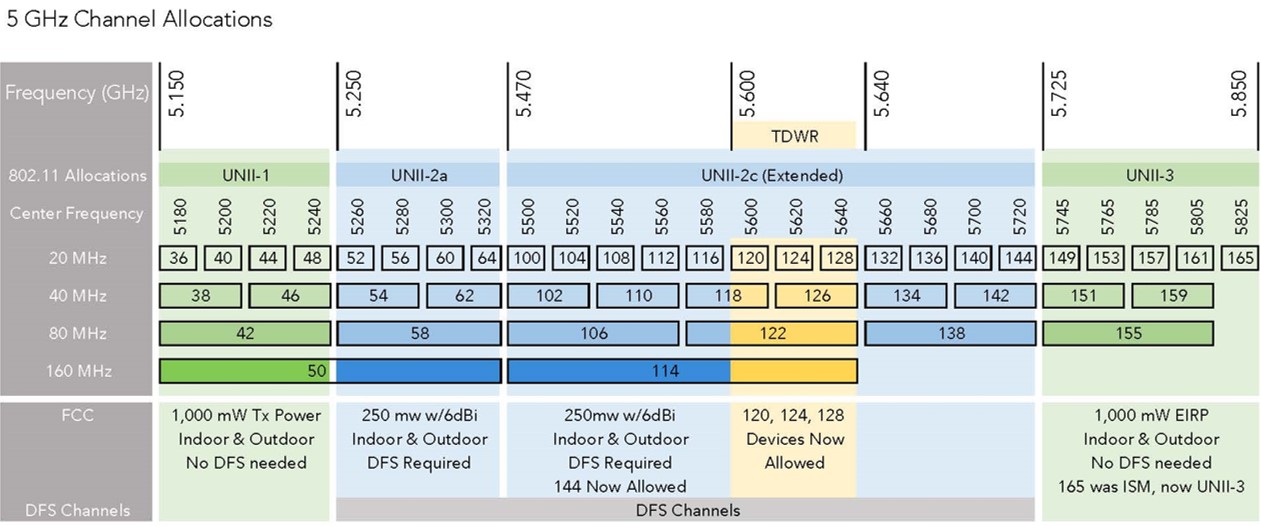
650 Mbps is a very good result for Wi-Fi 6. 2x2 MIMO and 80 MHz channel yields a link rate of 1200 Mbps. Throughput of half the link rate is typical. iPhones don't support 4x4 MIMO or 160 MHz wide channels needed to go significantly faster (2400 Mbps with one enabled or 4800 Mbps with both features).
I don't think any new MCSes were added for 6E. Though, AFAICT, there will be for 802.11be/Wifi 7, 12-15:
* https://scdn.rohde-schwarz.com/ur/pws/dl_downloads/premiumdo...
Re: EE is working with Qualcomm to add Wi-Fi 7 to consumer broadband hubs
#83What annoys me is this: I have a TMobile iPhone 15 Pro and three Erro Pro 6 units, all with wired backhaul. Over the wire, my fast.com results repeatedly reach ~1.2 Gigs. Over Wifi, from a foot away, my results are around 650Mbps. The local church recently had T-Mobile install a 5G antenna array around it. I'm about two blocks away. Over 5G, I get 1.4Gigs down, though my walls, through an entire house between us. But…
Re: EE is working with Qualcomm to add Wi-Fi 7 to consumer broadband hubs
#84What annoys me is this: I have a TMobile iPhone 15 Pro and three Erro Pro 6 units, all with wired backhaul. Over the wire, my fast.com results repeatedly reach ~1.2 Gigs. Over Wifi, from a foot away, my results are around 650Mbps. The local church recently had T-Mobile install a 5G antenna array around it. I'm about two blocks away. Over 5G, I get 1.4Gigs down, though my walls, through an entire house between us. But…
>But my Wifi router only gets 650 down with the phone using it as a stand. I cant speak to WiFi, but on the long range wireless stuff I work with the hardware does almost as poorly with signal levels that are too high as signal levels that are too low. Putting your phone literally on top of the WiFi router is likely not going to be a best case test scenario.
Re: EE is working with Qualcomm to add Wi-Fi 7 to consumer broadband hubs
#85> Wi-Fi 6's comparable maximum rate is 9.6Gbps. There is no consumer problem of today, no domestic use case imaginable, where 50Gbps works where 10 will not. iphone has just 2x2 MIMO antena so even with WiFi 6 can get only max 2.4Gbps (1.2Gbps per antena - someone correct me if I'm wrong). And those are only max speed in labs in perfect conditions. So there is definitely use case for WiFi 7 in consumer devices e.g. V…
I'm honestly struggling to come up with a use case for a single iPhone to need more than 300 megabytes per second (2.4Gbps) of bandwidth at any given time. (Noting that 8K video, in fairly un-optimized scenarios, appears to need about 96Mbps—just 12 megabytes per second, or 4% of that "low" bandwidth.) What are you doing, streaming raw, uncompressed video from multiple sources to a single iPhone? If you've got that m…
TCP throughput is about half of the link rate. iPhones before the 15 Pro maxed out at 1200 Mbps link rate because they are 2x2 MIMO with 80 MHz max channel banwdidth.
Re: EE is working with Qualcomm to add Wi-Fi 7 to consumer broadband hubs
#86Earlier quoted context omitted.
650 Mbps is a very good result for Wi-Fi 6. 2x2 MIMO and 80 MHz channel yields a link rate of 1200 Mbps. Throughput of half the link rate is typical. iPhones don't support 4x4 MIMO or 160 MHz wide channels needed to go significantly faster (2400 Mbps with one enabled or 4800 Mbps with both features).
I'm curious to know if going to 6GHz (Wifi 6E) would help at all, or does that band simply allow for more channels that have less noise? I don't think any new MCSes were added for 6E. Though, AFAICT, there will be for 802.11be/Wifi 7, 12-15: * https://scdn.rohde-schwarz.com/ur/pws/dl_downloads/premiumdo...
Re: EE is working with Qualcomm to add Wi-Fi 7 to consumer broadband hubs
#87Earlier quoted context omitted.
> The fact that most use cases are currently download-heavy Is it still true? I am happy with whatever I got but I thought a big consumer use case is multiplayer gaming, which requires low latency bidirectionally.
I think ten minutes of 4K video probably uses more bandwidth than a multi-hour gaming session: game coders are probably very efficient about what they send over the wire.
As you point out, for most types of online games, most limitations are due to latency, not bandwidth.
Re: EE is working with Qualcomm to add Wi-Fi 7 to consumer broadband hubs
#88> Wi-Fi 6's comparable maximum rate is 9.6Gbps. There is no consumer problem of today, no domestic use case imaginable, where 50Gbps works where 10 will not. iphone has just 2x2 MIMO antena so even with WiFi 6 can get only max 2.4Gbps (1.2Gbps per antena - someone correct me if I'm wrong). And those are only max speed in labs in perfect conditions. So there is definitely use case for WiFi 7 in consumer devices e.g. V…
>Higher bandwidth should also make connection more robust Nope. Higher bandwidth could mean two things: Larger channel size: larger channels have a higher noise floor and are are therefore less robust Faster throughput: Faster throughput generally means larger channels (as above) or various techniques to get more bits/Hz (such as more complex modulation), both of which are less robust
To increase throughput (i.e. bitrate ) we can either increase the channel bandwidth or the SNR (and use that SNR for higher modulation formats). Increasing the channel bandwidth does increase the noise power (assuming matched filtering) but we typically also assume that the psd of the signal stays the same => signal power increases and SNR stays the same.
If we mean by "robust" that the signal is not as susceptible to fluctuations of the noise, than increasing the bandwidth could help. Assuming we want the same bitrate, we could use the larger bandwidth to reduce the modulation format and thus the required SNR while keeping the bitrate the same. However a larger bandwidth typically also increases probabilities of impairments (interferers, filtering...) but this is typically still a win, because capacity throughput is linearly proportional to bandwidth but only logarithmically to SNR.
Re: EE is working with Qualcomm to add Wi-Fi 7 to consumer broadband hubs
#89I would rather have ethernet in every room and a less sophisticated/powerful wifi. It seems ethernet is fairly rare even in new construction.
20 years ago when we renovated an old house, while the electrician was digging chases into the walls i asked him to add an extra empty pipe for ethernet next to each cable pipe. it barely cost any extra work, and later i ran the ethernet cable myself with the help of a friend. i don't live in that house any more, but my usage patterns with a laptop moving around frequently make wifi a far more practical experience. t…
Re: EE is working with Qualcomm to add Wi-Fi 7 to consumer broadband hubs
#90Earlier quoted context omitted.
Emotive language such as "eccentrically" is strange considering the decline in landline subscribers, and even less usage of an actual landline. If you want to have a functioning "landline", why would you choose to use one bundled with your internet provider compared to a much more competitive independent voip provider? This is a good summary of the decline: https://www.wrappz.com/blog/decline-of-the-landline/
Yes Daviey, those of use using a telephone in the traditional way are a diminishing number. Hence passively becoming eccentric... Not as much as the person riding a penny farthing but slowly heading that way. To the other questions in the UK yes you can move your landline telephone number to a third party open standard sipp voip service, but setting up a voip adapter to pretend to be a landline is fiddly for many and…
I find the need to configure a router or VoIP adapter to be a strange, over-engineered concept when it comes to replacing POTS. We're already authenticated by virtue of being physically connected. The exchange should be able to pass through the identity of the connecting line and no authentication or manual configuration is a fundamental requirement. In PPP, authentication is optional, but BT/OpenReach require it and complicate everything for consumers for no good reason. Since nearly every line has only one provider, they should keep track of that at their end, and then routers wouldn't need PPP configuration in the common case. Everything could be negotiated automatically, and the protocol already supports this!
We do have TR069 but that adds even more unnecessary complexity.
The same goes for a POTS replacement. Authentication is not fundamentally necessary. They could autodiscover, and then the identity of your physical line could be passed through. There isn't an obvious protocol here, but it's trivial to achieve technically as long as it isn't overengineered (see for example uPnP IGD vs. NAT-PMP). If this is a real problem, it can be addressed.
I don't think it's part of most consumer's threat models that it matters if their line identity is intercepted and used by an adversary, since we all use higher level protocols to establish higher level authentication anyway. But if it were, then TOFU together with an out-of-band update mechanism (eg. "call customer service to activate your new phone and/or router" or just "scan the QR code on the side of your phone and/orrouter with our app to activate it") would be all that's needed to deal with that. Client side authentication still wouldn't be needed, and can't address that threat model directly anyway.