Will adobe products still work?
Apple announces it will switch to its own processors for future Macs
751–760 of 1001 posts
Re: Apple announces it will switch to its own processors for future Macs
#752Earlier quoted context omitted.
> By hand Not using automation isn’t “badass”, it’s a sign of a deeply screwed up engineering culture. It’s on par with forcing software developers to program exclusively in machine code. Luckily, Apple uses the standard EDA tools pretty extensively so I don’t really think this applies to them. I also agree that Apple hardware engineers are generally extremely good.
Toe-May-Toe, Toe-Mah-Toe. Some site that does tear downs (not iFixit) tore open one of their chips, once, and defecated masonry. They said the chip design was obviously hand-designed, and stood head and shoulders above other ARM architectures. They have done OK. Sorry if I offended you. None was meant. I’ll edit that out.
The article likely meant they did a custom implementation of the architecture, not that they didn’t use automation during the design process. At least that’s what I’d assume without reading it (I’d be interested to read if you have link). It’s basically the difference between optimizing your application by rewriting the performance critical parts (good idea) and never using a compiler (bad idea).
Also, I don’t think what you wrote is offensive in any way - no need to edit unless you feel compelled to.
Re: Apple announces it will switch to its own processors for future Macs
#753Earlier quoted context omitted.
Agreed on all points. I saw speculation elsewhere that this change, along with AWS's addition of Graviton-based (their own ARM processors) instances at much more competitive price points relative to x86, are bound to spearhead the change to "ARM by default." If your devs are already using ARM, and ARM's notably cheaper in the cloud, that's a compelling case. If you're already using Kubernetes / Docker heavily, you're…
This claim doesn't really hold up. The problem here is the vast majority of non-Apple laptops & desktops that are in use. THOSE will still all be x86 for the foreseeable future as ARM CPUs not made by Apple all have terrible per-core performance. Graviton2 compensates by just throwing 64 cores at the problem, but that's not going to do anything for your Electron-based text editor that struggles to use 2 CPU cores in…
> Graviton2 compensates by just throwing 64 cores at the problem, but that's not going to do anything for your Electron-based text editor that struggles to use 2 CPU cores in the first place. Or for a typical webpage, which struggles to use more than a single CPU core.
More cores will help your typical developer who's running 8+ apps at once, along with several browser tabs that are all running in separate processes.
Re: Apple announces it will switch to its own processors for future Macs
#754Earlier quoted context omitted.
Yeah, I tried out a Raspberry Pi 4 as a desktop replacement and pretty much everything is supported except for proprietary stuff like games.
Eh... that was not my experience: https://www.jeffgeerling.com/blog/2020/i-replaced-my-macbook... (Unless you're speaking almost entirely of webapps, which mostly run fine even on the measly 1.5 GHz 4-core Pi ARM processor.)
You are stating in step #2 that the Pi4 cannot output 4k at 60Hz. Could you please insert a footnote that it actually can?
https://www.raspberrypi.org/documentation/configuration/hdmi...
Re: Apple announces it will switch to its own processors for future Macs
#755For me as a developer by far the biggest concern is definitely technical alignment with production infrastructure. It has been such a boon in the last few years to be able to fire up docker and run to such a large extent the exact stack that ships to production. It's very unclear to me how close an alignment it will now be possible to have on future MacBook Pro's in this way. Between that and lack of nVidia support, it's definitely going to give me a significant push towards a non-Apple laptop for my next purchase.
Re: Apple announces it will switch to its own processors for future Macs
#756Docker and Linux virtualization. Fat binaries to make it easy to update Mac apps. iPhone and iPad apps. Rosetta to run Intel apps that aren’t updated. Apple is gonna knock this out if the park.
I wonder what this will do to Electron. If the iOS apps are really 1:1 on macOS, then the need to maintain an electron app will probably diminish. As long as they both support the same OS APIs I can see devs that can learn a new language (Swift) ditch Electron.
The processor architecture is not that relevant if you are working at the abstraction level that electron or swift-ui or similar provides.
Re: Apple announces it will switch to its own processors for future Macs
#757Earlier quoted context omitted.
> So, I’m predicting an MBP 13 - 16 range with an extra three hours of battery life+, and 20-30% faster. I'm predicting the opposite: you won't actually see any difference. Once you look closely at power profiles on modern machines you'll see that most energy is going into display and GPU. CPUs mostly run idle. Even if you had a theoretical CPU using zero energy, most people are not going to get 30% battery life gain…
I fully expect any reduction in costs for Apple will get sent to their shareholders, not the consumers.
Buy shares. That’s what I’m doing.
Re: Apple announces it will switch to its own processors for future Macs
#758Commenters here seem dubious. I’ll take the contra-position. This feels to me like it’s going to be great; a big win for consumers and developers. Current A12z chips are highly performant; Apple is roughly one chip cycle ahead on perfomance/watt from any other manufacturer. I presume their consumer hardware will launch with an A13Z, or maybe an A14 type chip. Apple has consistently shipped new chip designs on time; I…
> One interesting question I think is outstanding - from parsing the video carefully, it seems to me that devs are going to want ARM linux virtualized, vs AMD64.
Hahaha, look for a user-agent at 1:44:26 :) They use old Intel Mac for a virtualization demo.
Re: Apple announces it will switch to its own processors for future Macs
#759Earlier quoted context omitted.
> What happens to GPU? Having their own GPU for iMac and Mac Pro as well? Dual GPU options where Apple GPU for power efficiency? This feels like additional complexity. I think GPU scaling will be much harder than CPU, so whereas Apple can surpass Intel CPUs for all but the highest segments, putting together a standalone GPU will be hard and very interesting to see. For an entry-level GPU? No issues. But what about a…
And what happens if China marches into Taiwan? This is a plausible consideration that must be one of Apple's worst nightmares.
China can bomb TSMC, no doubt.
But landing troops (they can't march, it's an island, and the difference between amphibious and land based operations matters a lot) would be extremely difficult, and not obviously in the PLA's favor. See, for example:
https://foreignpolicy.com/2018/09/25/taiwan-can-win-a-war-wi...
Re: Apple announces it will switch to its own processors for future Macs
#760Commenters here seem dubious. I’ll take the contra-position. This feels to me like it’s going to be great; a big win for consumers and developers. Current A12z chips are highly performant; Apple is roughly one chip cycle ahead on perfomance/watt from any other manufacturer. I presume their consumer hardware will launch with an A13Z, or maybe an A14 type chip. Apple has consistently shipped new chip designs on time; I…
Apple chips are fast mostly because they have a lot of cache to spare. Take for example the A12Z. It has 8MB of L2 (not L3, it's L2!) cache. An Intel Core i7-1068NG7 present in the latest Macbook Pros (that performs akin to the A12Z according to Geekbench) has only 2MB of L2 cache. No other ARM CPU has this level of L2 cache. Apple chips are not "magical", Apple just can afford packing up lots and lots of cache becau…
> Take for example the A12Z. It has 8MB of L2 (not L3, it's L2!)
It's not really that clear cut. You could also argue that the A12Z has 8MB of L3 and 0MB of L2. The L2 in the A12Z is shared while the L2 in the Intel CPU is not.
Similarly the latency of the A12Z's L2 is a lot higher than the latency of Intel's L2, but also then still lower than Intel's L3. https://images.anandtech.com/doci/13661/A12X-lat.png & https://images.anandtech.com/doci/14664/ICLlat.png

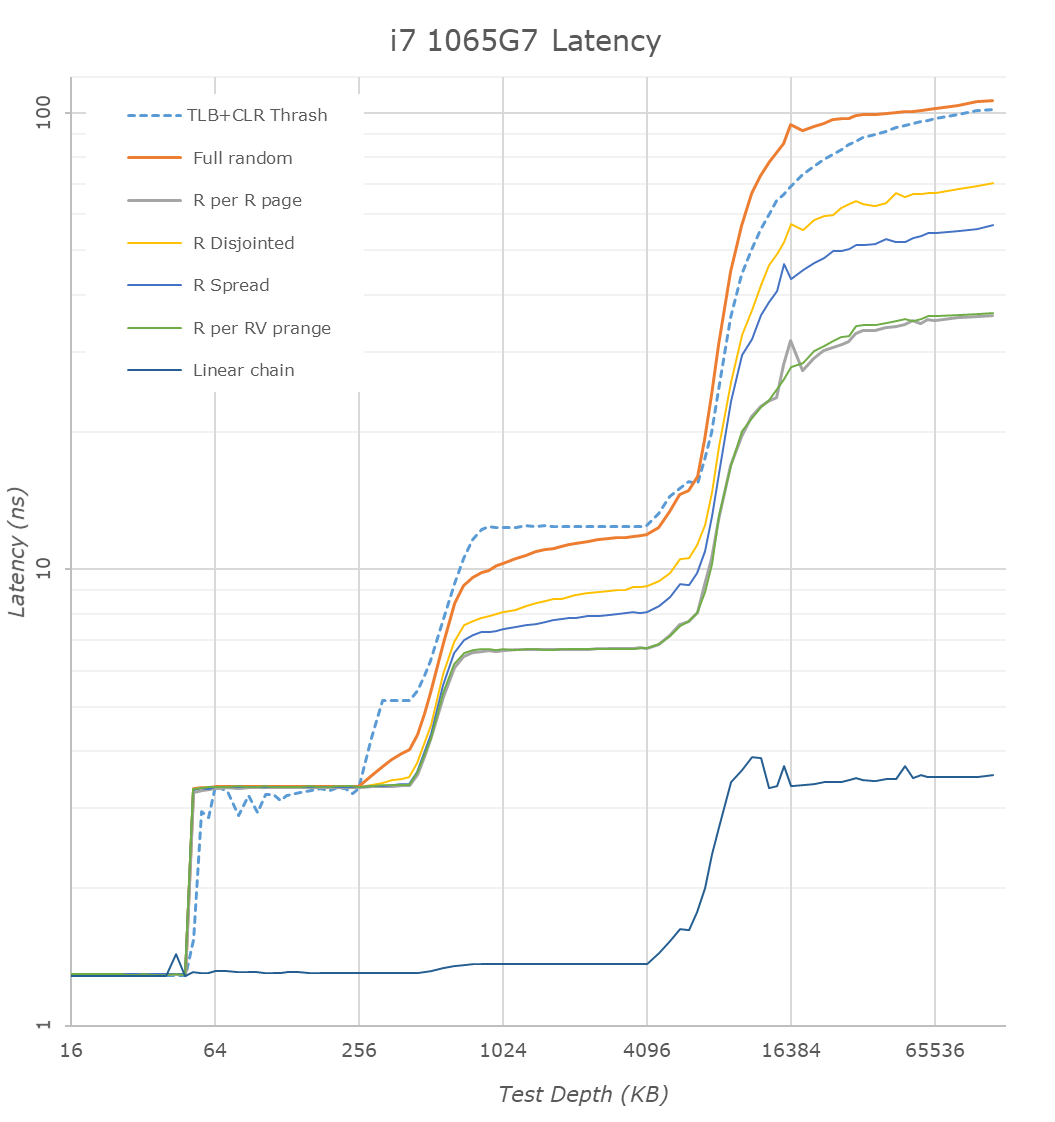
So it's not "traditional" L2 as you're familiar with it, it's more like an L2.5 or something. Although still accurately called L2 as it is the second level of cache, it's just that Apple went with a rather different cache hierarchy & latency structure than Intel did. But it's really not at all accurate to compare the 8MB of L2 on the A12Z to the 2MB of L2 on Ice Lake. Those are very different caches.