Live data from Hacker News

Mathematicians Measure Infinities, Find They’re Equal

quantamagazine.org

71–80 of 170 posts

Re: Mathematicians Measure Infinities, Find They’re Equal

#71
post #59

Earlier quoted context omitted.

Why do you think this is clickbait? The headline accurately describes the content of the article, which as far as I can tell accurately describes one result of this paper. Clickbait doesn't mean any interesting headline, it means a misleading and purely attention-grabbing headline.

It's like if someone proved P=NP and the magazine title was: "Mathematicians Measure Difficulty Levels, Find They're Equal."

Maybe I misread, but I feel like solving P=NP would be closer to solving the continuum hypothesis whereas the article describes solving a related problem which could have disproved the hypothesis should it have been found that the two sets were not equal.
Re: Mathematicians Measure Infinities, Find They’re Equal

#72

I did not know that this was an unsolved problem. It is quite paradoxical. You can map the subset of rational numbers in the range [0, 1) to the set of natural numbers, so there are an infinite number of disjoint subsets of the rational numbers that map to the natural numbers. Intuitively a 2nd dimension of infinity should be bigger, but the count of a set is defined to be one dimensional regardless of the dimensiona…

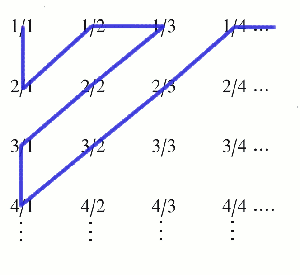
Another thing which has bothered me in the past was that a set of 2-tuple integers could be mapped by a set of 1-tuple integers, seemingly without any information loss.

This picture is for natural numbers but it shows you one way to do the mapping:

https://plus.maths.org/issue47/features/macgregor/diagram3.g...

Re: Mathematicians Measure Infinities, Find They’re Equal

#73
post #3

I find Cantor's diagonal argument unconvincing. The claim is that there are more real numbers in the range from zero to one than there are natural numbers. To see that this is false simply realize that you don't actually have to write a decimal point to specify the real numbers in this range. Without the decimal point these real numbers just become natural numbers. Can a rational person believe that there are infinit…

It's OK not to be convinced by an argument, even a mathematical proof, and especially an informal proof. But Cantor's argument is correct. If you don't find a mathematical proof convincing even though all the trained mathematicians seem to believe the proof is correct, here's my advice. You should FIRST convert the proof into a sequence of valid deductions in a fixed logic. (If you cannot do this, you don't understan…

> But "modeling non-terminating loops in a computer program" is NOT the motivation for real numbers

Indeed Turing himself proved that there are non-computable real numbers.

Re: Mathematicians Measure Infinities, Find They’re Equal

#74
post #59

Earlier quoted context omitted.

Why do you think this is clickbait? The headline accurately describes the content of the article, which as far as I can tell accurately describes one result of this paper. Clickbait doesn't mean any interesting headline, it means a misleading and purely attention-grabbing headline.

It's like if someone proved P=NP and the magazine title was: "Mathematicians Measure Difficulty Levels, Find They're Equal."

That's not a good headline, but it's not clickbait. If P vs. NP were a fairly obscure problem with little immediate impact outside of academia, that would be a fine layperson headline.

What would you have titled this Quanta article?

Re: Mathematicians Measure Infinities, Find They’re Equal

#75
post #46

I am having trouble grasping the result. As far as I understand it, any proof of any result has to be with respect to some axiom system. The continuum hypothesis result is that you cannot prove a infinity exists between the naturals and the real numbers under the usual axiom system A. How that was proved, I don't know, and I also don't know what axiom system was used in that proof. If the axiom system was also A, the…

Disclaimer: I have a math background, but this isn't my field.

The continuum hypothesis was proved to be independent of ZFC. From glancing at the first few paragraphs of the actual paper [2], it's been established for decades that the following inequality holds:

aleph_1 and that aleph_1 = p can be shown to imply aleph_1 = t. Note that the inequalities aren't strict inequalities, and this proof is essentially saying that they were equivalent all along.

[1] https://en.wikipedia.org/wiki/Zermelo%E2%80%93Fraenkel_set_t...

[2] https://arxiv.org/pdf/1208.5424.pdf

Re: Mathematicians Measure Infinities, Find They’re Equal

#76
post #65

Earlier quoted context omitted.

Start with zero. Add an infinitesimal epsilon an infinite number of times. Now go back to zero and subtract the same epsilon an infinite number of times. You have now traversed all the real numbers. The decimal representation of the epsilon has an infinite number of zeroes after the decimal point and before the last digit, which is '1'. So if you were to just chop off the leading zero and decimal point to make an equ…

> before the last digit, which is '1' No. There is no last digit. That's the whole point. If there were a last digit your argument would be correct, but there isn't, so it's not.

I don't see the problem with having a first digit and a last digit and an infinite number of digits in between.

Edit: Infinitesimal divided by two is infinitesimal, in the same way that infinity multiplied by two is infinity. So 0.000...0001 / 2 = 0.000...0001 . Infinitesimal multiplied by any finite number is infinitesimal. Infinitesimal multiplied by infinity is every number in the interval from infinitesimal to infinity. Or none of them. Or just one. Or all of them except one. Infinity just throws common sense out the window, then catches it as it tries to sneak back in through the chimney and sets it on fire. I'm not convinced that any sane person can adequately grasp the concept.

Don't confuse the limitations on mathematical notation with a limitation on imagination. 0.9 repeating is not exactly the same as the infinite sequence of ( 0.9 + 0.09 + 0.009 + ... ). The repeating notation indicates to use nine's complement for that portion of the fraction instead of ten's complement. 0.9 repeating is literally equal to one, by notation convention, but the infinite sequence of 9 digits is one minus infinitesimal, which is equal to one in every calculation that does not involve an infinity.

You have to have an infinite number of infinitesimals to make any number that isn't zero, but when you do that, you can get all of them.

Re: Mathematicians Measure Infinities, Find They’re Equal

#77

I did not know that this was an unsolved problem. It is quite paradoxical. You can map the subset of rational numbers in the range [0, 1) to the set of natural numbers, so there are an infinite number of disjoint subsets of the rational numbers that map to the natural numbers. Intuitively a 2nd dimension of infinity should be bigger, but the count of a set is defined to be one dimensional regardless of the dimensiona…

It also seems obvious to me.

There is no "infinity", there are just infinite loops, and they are all equivalent.

Re: Mathematicians Measure Infinities, Find They’re Equal

#78
post #63

Earlier quoted context omitted.

Start with zero. Add an infinitesimal epsilon an infinite number of times. Now go back to zero and subtract the same epsilon an infinite number of times. You have now traversed all the real numbers. The decimal representation of the epsilon has an infinite number of zeroes after the decimal point and before the last digit, which is '1'. So if you were to just chop off the leading zero and decimal point to make an equ…

That infinitesimal is not a real number. To simplify a little, a real number is something which is the limit of a sequence of rational numbers. Or, given an error bound 1/n, you can write down a rational number within 1/n of the real number. Two real numbers are the same if the difference between their approximations converges to 0 as n gets arbitrarily large. A number with infinitely many zeros after the decimal poi…

Fine, then. Just use the smallest positive nonzero real number, instead.

Edit: I really hope I'm not the only one laughing.

Re: Mathematicians Measure Infinities, Find They’re Equal

#79
> In a breakthrough that disproves decades of conventional wisdom, two mathematicians have shown that two different variants of infinity are actually the same size

I thought there are only two types of infinity and Cantor already proved that they are different.

* Uncountable infinity which is the cardinality of the set of real numbers

* Countable infinity which is the cardinality of the set of integers

Cantor has already proved that uncountable infinity is larger than countable infinity.

Is this article claiming that mathematicians have proved that these two infinities are equal now? Doesn't that contradict Cantor's proof? What's going on here? Is the Cantor's proof flawed or have we introduced a contradiction to mathematics?

Re: Mathematicians Measure Infinities, Find They’re Equal

#80

> In a breakthrough that disproves decades of conventional wisdom, two mathematicians have shown that two different variants of infinity are actually the same size I thought there are only two types of infinity and Cantor already proved that they are different. * Uncountable infinity which is the cardinality of the set of real numbers * Countable infinity which is the cardinality of the set of integers Cantor has alr…

Not all uncountable infinities are the same cardinality.
Post reply on HN