Live data from Hacker News

The quitting economy

aeon.co

71–80 of 196 posts

Re: The quitting economy

#71
post #20

Earlier quoted context omitted.

Perhaps we can move on from only caring about the stock price, if we stop providing bonuses/compensation to executives in stock, and also stop making the stock price a benchmark to getting many of those bonuses.

As an [outside] investor in the company, I'm more than happy to vote for compensation packages that are driven by stock price (management wins iff shareholders win). I'm unlikely to vote for a compensation system where management can win big without shareholders gaining. It's not accidental that the tie between share price and executive comp came into being.

> ...I'm more than happy to vote for compensation packages that are driven by stock price...

The challenge with this approach is share price is a highly lossy metric. By the time it all rolls up into the share price, you've lost a pile of other information. And a whole hell of a lot can hide under that lost information.

Example. IBM long ago sold off their PC hardware division and low-end servers. Those divisions' low profitability was dragging down the overall profitability metrics when the total numbers bubbled up the reporting. Selling off those assets gave a cash boost, and the shareholders were especially happy when the overall profitability numbers weren't getting held back by those laggard divisions. Big win!

Now for the rest of the story. This comes from what I saw at the ground level, from speaking with many IBM sales people at the time. After the sale, extremely good, higher-end sales reps saw the front-end of their pipelines collapse. By getting rid of those "low-value" divisions, many of these reps no longer had a built-in excuse to frequently see many different accounts.

Clients had no problem frequently seeing reps for these "low-value" products. The higher-end reps lots of times tagged along and found opportunities to help solve the client's pain points with higher-end solutions by simply being in the discussions, because these low-end products, in volume, interfaced with higher-end infrastructure all the time.

Without this channel of contacting clients, these higher-end reps were reduced to cold-calling and bringing in hordes of inside sales staff to bring the cold-calling volume up to the point where they could get back to their original sales volumes. The low-profit products were making IBM a profit, just not enough, but what the shareholders really should have seen was those products were a sales and marketing channel where the clients paid for the sales and marketing to reach them. Now IBM is spending cash it can't really afford on brute-forcing that channel, which clients hate.

I see this kind of "rest of the story" game played out in many different companies under many different guises, and the destruction of company value is pretty intense when it happens.
Re: The quitting economy

#72

Again, here's HN with a Silicon Valley bias. This is not an unavoidable trend and is not global. Japan's work market isn't exactly like this. Germany's Mittelstands are eating the world precisely by buckling this trend. Northern Italy (around Milan) has an artisan industry that thrives on skilled artisans working for small cottage industries, etc. If you want workers skilled in a very niche and crucial technology the…

>"Again, here's HN with a Silicon Valley bias"

Did you miss the opening sentence where the author states:

"In the early 1990s, career advice in the United States changed."

So yes the article is specifically talking about the US economy and not the global economy.

>"Germany's Mittelstands are eating the world precisely by buckling this trend."

The article is also referring specifically to publicly traded companies. I think that's pretty clear when the author states:

"In general, to keep stock prices high ..."

Germany's Mittelstands are largely family-owned companies, they are also not part of the US economy, ditto for some artisans in Northern Italy.

Re: The quitting economy

#73

"[...] thinking of themselves as the CEO of Me, Inc; and to survive in the neoliberal world of work, the CEO of Me, Inc must be a quitter." I fail to see how that's a bad thing. I've never quite understood this notion of tying your fate, your welfare and your livelihood to a single company. By not thinking of yourself as the CEO of Me Inc. you ultimately become a commodity for employers to do with as they please. At…

I fail to see how that's a bad thing. Quitting itself isn't bad, but shorter job tenures and reduced job security may have second-order effects. For example, economic downturns will cause faster rises in unemployment, leading to faster drops in consumer spending. And employers are going to see lower returns from investing in training - meaning colleges might need even more focus on applied skills. Hell, it might even…

> Hell, it might even limit the complexity of projects our society is capable of delivering - we might be less able to successfully deliver projects that take longer than a year or two.

I guess that's somewhat true. But I feel that for companies handling more complex topics (not just the new 'AI deep learning on big data with hadoop on rails in the cloud' startup), experts are hired with the understanding that both the work is interesting and it would be a long-term project with long-term benefits.

This is all, of course, without counting academia as possibly the ultimate example of long-term hiring with high-risk, high-reward returns.

Re: The quitting economy

#74

Firm hopping happens because hierarchy hopping within an organization get's obstructed. Sooner or later you can't get further up because someone has the position you want and you start looking for opportunities that allow you to move up.

That reminds me of frequent lane switching in traffic congestion. Unless the lane next to you is moving faster because of a fundamental reason (early stage unicorn), you'll get stuck again 100 feet down the road.

Re: The quitting economy

#75
post #19

I think it's important to note the negatives of the previous way of working. In the old days, pay was less (because the company was responsible for one's pension, and often for many benefits — e.g. corporate vacations were once a thing), and if the company did fail then one was left with nothing. Advancement could be very slow. One was working according to the whims of a slow-to-change set of central managers, who we…

> In the old days, pay was less

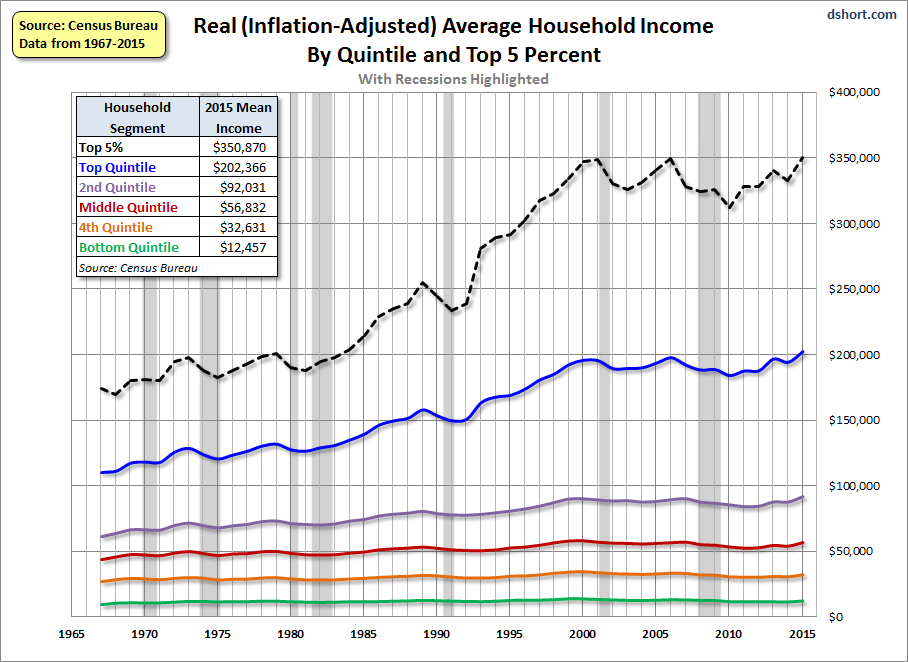
How can you suggest this? When adjusted for inflation, wages have remained constant or decreased in purchasing power, unless you happen to be in the top 5% of earners[0].

>Advancement could be very slow

As opposed to today's "non-existent"? The article we're discussing is all about how people hop jobs precisely because internal advancement is becoming a rare thing.

[0]:https://www.advisorperspectives.com/images/content_image/dat...

Re: The quitting economy

#76
post #9

Earlier quoted context omitted.

What do devs get paid in London on average? I always had the impression, perhaps wrong, that software engineers seem underpaid in England relative to the US, even accounting for currency and cost of living and such (which, probably London is as bad as SF on that front). (i've also gotten the impression that there's not the same level of cultural esteem for engineers and scientists and such in England, and that this m…

Contracting is reasonably good in London. You can easily get £5-600 a day if you're a (provably) senior Rails/Java/C++ and well above that with exotic financial or uberniche things. (Which is probably why more people are turning to contracting in London.)

Contracting in London seems to have morphed from "we want somebody for a short term project" to "for the level of experience/knowledge/skills we want this is literally the only way we can get it".

Re: The quitting economy

#77
post #70
post #61

Earlier quoted context omitted.

At this point in my career I've reached a salary plateau for the technical track. Short of landing a high-profile project at one of the major tech firms the ~6%-7% raises I've had the last couple of years are about the max of what I might expect from a "hop." Instead I'm looking to both exit this industry completely and, while I build the cushion necessary to do so, switch to management (which has ample support, curr…

! I've seen 6 to 7 percent about twice in my entire career. 3% is the usual max, and 1-2% more common.

But job hops are an easy 10-15%, hence the problem ;)

(Up to some limit obviously, as a guy with 16 years experience is unlikely to get a 10% premium over a guy with 15 years of experience)

Re: The quitting economy

#78

I really think trying to reason about labour markets using pure theory in a Hayek-Friedman-esque way is a dead end. It's the 2nd time in two days I made the recommendation, but throwing Ronald Coase into the Neoliberal canon would help a lot. He was a "chicago school" academic from the same intellectual family, so it shouldn't be too much of a culture shock. He wan't like "progressives" in the "evidence based" sense…

Transaction costs. Both the employee (search costs, hours in the day) and employer (job training, search costs, process knowledge) incur far greater transaction costs than you see in commodity markets. Business models that lower transaction costs (e.g. "gig economy" middlemen) tend to lead to the emergence of highly flexible labor markets. This currently only applies to jobs that don't require a high level of nontran…

There are labor market overhead costs that are often easily overlooked/under-appreciated too: tying one's health care, as one obvious example, to one's current employer necessarily undermines liquidity in the labor market.

But more importantly: the overall inability in current culture to have "not working" as a legitimate and survivable labor position (for the majority of the labor force, at least) also threatens the liquidity of the labor market. Employers may fire at will, certainly, but as a laborer you can much more rarely quit at will without threatening your establishment in the labor market (Americans often question holes in resumes and may see them as moral failings), and your possible (even short-term) survival (health care, shelter, food).

Re: The quitting economy

#79

It can be difficult to hire in this environment. I've had 3 employees quit less than 3 months into new full-time positions. My first inclination is to ask, "What are we doing wrong?" but the more I look around it seems like a common industry problem. Perhaps it's rational behavior - as the article highlights, companies now view people as disposable. There's loyalty to a manager, but not a company. (You always want a…

Maybe you're not paying enough?

Re: The quitting economy

#80
post #18

The most recent resource I've read on this was The Alliance by Reid Hoffman. In it, he postulates that both employees and employers are lying through their teeth: employers tell employees about the benefits, investment in its people, and family-feel. Employees say they want to be lifers. This never happens. Instead, 2 years is a pretty common stretch before turnover in white collar jobs, especially for younger folk.…

I think for this to work, we'd have to have some form of Universal Healthcare in place. Right now, if you don't have employer sponsored health insurance (and I doubt many employers would want to offer that to people who are simply doing a "tour of duty" [yeah, there should be a better name for that]), insurance isn't good. It became better with the ACA, but I don't know how hopeful I'd be that it sticks around.
Post reply on HN