Earlier quoted context omitted.
>All of these "projections" are generalizing from fictional evidence - to borrow a term that's popular in communities that push these ideas. This just isn't correct. Daniel and others on the team are experienced world class forecasters. Daniel wrote another version of this in 2021 predicting the AI world in 2026 and was astonishingly accurate. This deserves credence. https://www.lesswrong.com/posts/6Xgy6CAf2jqHhynHL/…
I respect the forecasting abilities of the people involved, but I have seen that report described as "astonishingly accurate" a few times and I'm not sure that's true. The narrative format lends itself somewhat to generous interpretation and it's directionally correct in a way that is reasonably impressive from 2021 (e.g. the diplomacy prediction, the prediction that compute costs could be dramatically reduced, some…
AI 2027
621–630 of 641 posts
Re: AI 2027
#622Earlier quoted context omitted.
How would you know what he believes? There's hype and there's people calling bullshit. If you work from the assumption that the hype people are genuine, but the people calling bullshit can't be for real, that's how you get a bubble.
Because they are not the same in any way. It’s not a bunch of junior academics, it’s literally including someone who worked at OpenAI
Sure, OpenAI put up with one of these safety larpers for a few years while it was part of their brand. Reasonable people can disagree on how much that counts for.
You're right it's not a bunch of junior academics. It's not even a bunch of junior academics. This stuff would never pass muster in a reputable academic peer-reviewed journal, so from an academic perspective, this is not even the JV stuff. That's why they have to found their own bizarro network of foundations and so on, to give the appearance of seriousness and legitimacy. This might fool people who aren't looking closely, but the trick does not work on real academics, nor does it work on the silent majority of those who are actually building the tech capabilities.
Re: AI 2027
#623Why is any of this seen as desirable? Assuming this is a true prediction it sounds AWFUL. The one thing humans have that makes us human is intelligence. If we turn over thinking to machines, what are we exactly. Are we supposed to just consume mindlessly without work to do?
By authors? They specifically state they don't like many decisions they describe
Re: AI 2027
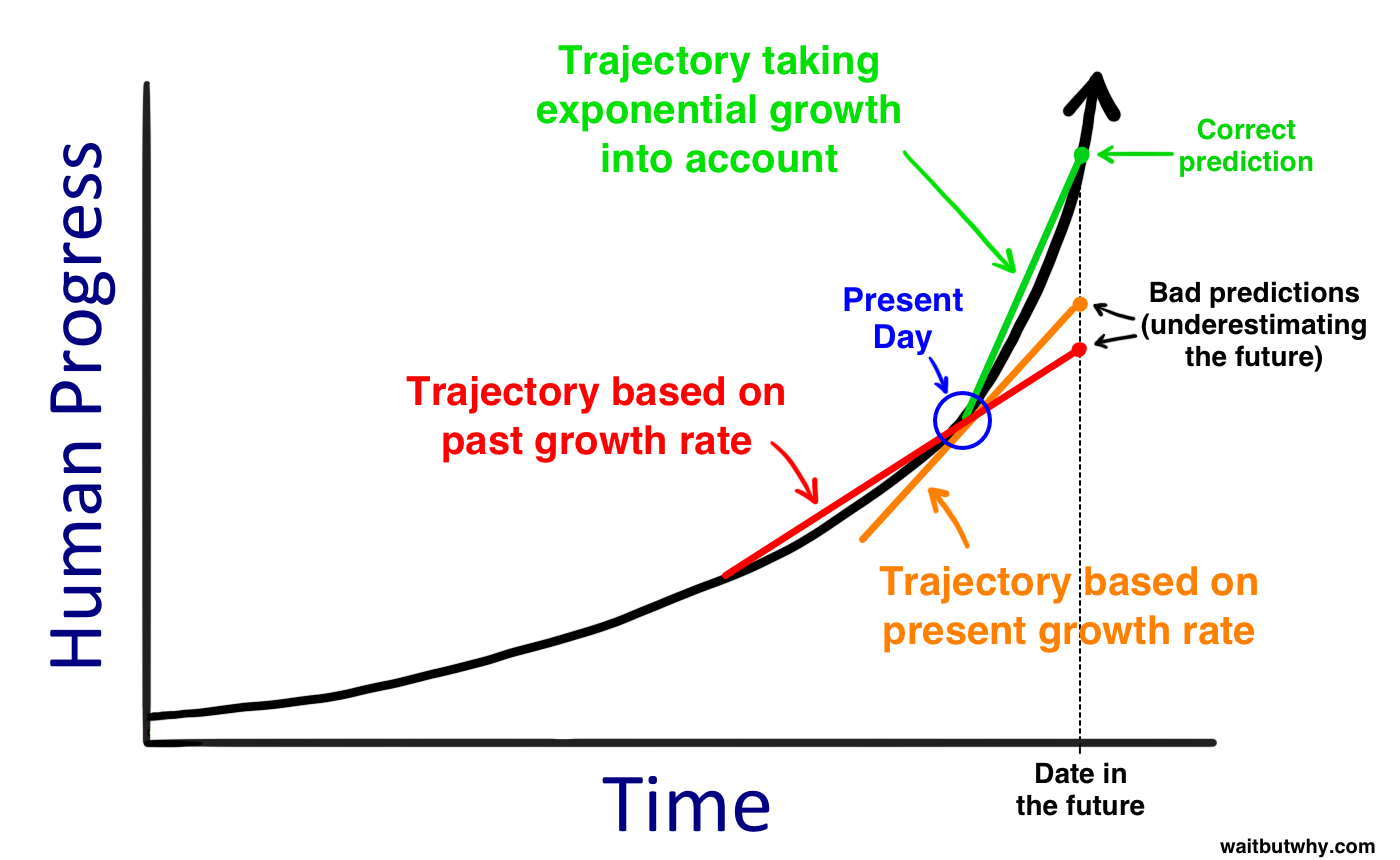
#624I think we've actually had capable AIs for long enough now to see that this kind of exponential advance to AGI in 2 years is extremely unlikely. The AI we have today isn't radically different from the AI we had in 2023. They are much better at the thing they are good at, and there are some new capabilities that are big, but they are still fundamentally next-token predictors. They still fail at larger scope longer ter…
Re: AI 2027
#625Earlier quoted context omitted.
> there are some new capabilities that are big, but they are still fundamentally next-token predictors Anthropic recently released research where they saw how when Claude attempted to compose poetry, it didn't simply predict token by token and "react" to when it thought it might need a rhyme and then looked at its context to think of something appropriate, but actually saw several tokens ahead and adjusted for where…
Isn't this just a form of next token prediction? i.e. you'll keep your options open for a potential rhyme if you select words that have many associated rhyming pairs, and you'll further keep your options open if you focus on broad topics over niche
But when we get a big aggregated of all of these little rules and quirks and improvements and subsystems for triggering different behaviours and processes - isn't that all humans are?
I don't think it'll happen for a long ass time, but I'm not one of those individuals who, for some reason, desperately want to believe that humans are special, that we're some magical thing that's unexplainable or can't be recreated.
Re: AI 2027
#626Earlier quoted context omitted.
Isn't this just a form of next token prediction? i.e. you'll keep your options open for a potential rhyme if you select words that have many associated rhyming pairs, and you'll further keep your options open if you focus on broad topics over niche
In the same way that human brains are just predicting the next muscle contraction.
I will feel and itch and subconsciously scratch it, especially if I'm concentrating on something. That's an subsystem independent of conscious thought.
I suppose it does make sense - that our early evolution consisted of a bunch of small, specific background processes that enables an individual's life to continue; a single celled organism doesn't have neurons but exactly these processes - chemical reactions that keep it "alive".
Then I imagine that some of these processes became complex enough that they needed to be represented by some form of logic, hence evolving neurons.
Subsequently, organisms comprised of many thousands or more of such neuronal subsystems developed higher order subsystems to be able to control/trigger those subsystems based on more advanced stimuli or combinations thereof.
And finally us. I imagine the next step, evolution found that consciousness/intelligence, an overall direction of the efforts of all of these subsystems (still not all consciously controlled) and therefore direction of an individual was much more effective; anticipation, planning and other behaviours of the highest order.
I wouldn't be surprised if, given enough time and the right conditions, that sustained evolution would result in any or most creatures on this planet evolving a conscious brain - I suppose we were just lucky.
Re: AI 2027
#627It’s good science fiction, I’ll give it that. I think getting lost in the weeds over technicalities ignores the crux of the narrative: even if this doesn’t lead to AGI, at the very least it’s likely the final “warning shot” we’ll get before it’s suddenly and irreversibly here. The problems it raises - alignment, geopolitics, lack of societal safeguards - are all real, and happening now (just replace “AGI” with “corpo…
You don’t just beat around the bush here. You actually beat the bush a few times. Large corporations, governments, institutionalized churches, political parties, and other “corporate” institutions are very much like a hypothetical AGI in many ways: they are immortal, sleepless, distributed, omnipresent, and possess beyond human levels of combined intelligence, wealth, and power. They are mechanical Turk AGIs more or…
For an AI controlled corporation, I don't know what it wants or what to expect. And if decision making happens at the speed of light, by the time we have any warning it may be too late to react. Usually with human concerns, we get lots of warnings but wait longer than we should to respond.
Re: AI 2027
#628Earlier quoted context omitted.
We are not overpopulated. I hate the type of people that hammer the idea that society needs to double or triple the birthrate (Elon Musk), but as it currently stands, countries like South Korea, Japan, USA, China, and Germany risk extinction or economic collapse in 4-5 generations if the birth rate doesn't rise or the way we guarantee welfare doesn't change.
We're not really overpopulated yet because the majority of humanity doesn't have two cents to rub against each other. They also want their cars, their houses, their netflix. This is what will really kill the planet.
Re: AI 2027
#629Earlier quoted context omitted.
What if people are manipulated by bot farms and think tanks and talking points supported by those corporations? I think this view of humans - that they look at all the available information and then make calm decisions in their own interests - is simply wrong. We are manipulated all the damn time. I struggle to go to the supermarket without buying excess sugar. The biggest corporations in the world grew fat off showi…
Corporations would prefer lower corporate tax. US corporate tax rates are actually every high. Partly due to the US having almost no consumption tax. EU members have VAT etc.
Re: AI 2027
#630Earlier quoted context omitted.
This is an interesting question, but it seems at least possible that as long as the fundamental operation is simply "generate tokens", that it can't go beyond being just a form of next-token prediction. I don't think people were thinking of human thought as a stream of tokens until LLMs came along. This isn't a very well-formed idea, but we may require an AI for which "generating tokens" is just one subsystem of a la…
But that means any AI that just talks to you can't be AI by definition. No matter how decisively the AI passes the Turing test, it doesn't matter. It could converse with the top expert in any field as an equal, solve any problem you ask it to solve in math or physics, write stunningly original philosophy papers, or gather evidence from a variety of sources, evaluate them, and reach defensible conclusions. It's all ju…
Let's say we have a humanoid robot standing in a room that has a window open, at what point would the AI powering the robot decide that it's time to close the window?
That's probably one of the reasons why, I don't really see LLMs as much more than just algorithms that give us different responses just because we keep changing the seed...