Live data from Hacker News

Mathematicians looking to make elections in the US more representative

nature.com

61–70 of 136 posts

Re: Mathematicians looking to make elections in the US more representative

#61
post #2

There are a ton of important issues, but, I believe that gerrymandering is a core issue in the United States because : Partisan gerrymandering allows for politicians to secure their seats - this leads to less voters being represented (allowing the politicians to become more polarized) e.g. when races are tight, politicians tend to move towards the center. [2] Partisan gerrymandering is strongly disliked by both parti…

Gerrymandering is self-limited. The party in power (in a State government) can either maximize the number of seats it has, or make seats safe. It cannot do both at once! Maximizing seats -> minimizing the margin of victory in each district -> increasing likelihood of losing its majority in a future election! Making seats safe -> maximizing margin of victory in each district and minimizing the number of seats by conce…

Saying gerrymandering is self-limiting because the party has to choose how to allocate its power is like saying sexual assault is self-limiting because the perpetrator can only use one orifice at a time.

Gerrymandering gives an absolute advantage. At the core of it, you are destroying part of the votes of your enemies, either by bundling them in one district, or completely destroying their power by cracking them.

Flawed argument, but good on you for noticing the tradeoff. Yes, there are two types of gerrymandering, with almost exactly opposite mechanics.

Unfortunately, the rest of your comment isn't even sophomoric...the US political structure is about sloppily conceived and aimless as your constant use of the phrase "X modulates Y".
Re: Mathematicians looking to make elections in the US more representative

#62
post #2

There are a ton of important issues, but, I believe that gerrymandering is a core issue in the United States because : Partisan gerrymandering allows for politicians to secure their seats - this leads to less voters being represented (allowing the politicians to become more polarized) e.g. when races are tight, politicians tend to move towards the center. [2] Partisan gerrymandering is strongly disliked by both parti…

One of my professors at UT Dallas has a book that argues that districts in fact should be partisan. It's been a few years but the logic is something like if you've got a 50-50 district, you're gonna end up with 50% of the people in the district unhappy. Where as if you intentionally designed districts to be like like 90-10 (or whatever possible), more people are happy. Not sure if I believe him, but it's interesting.…

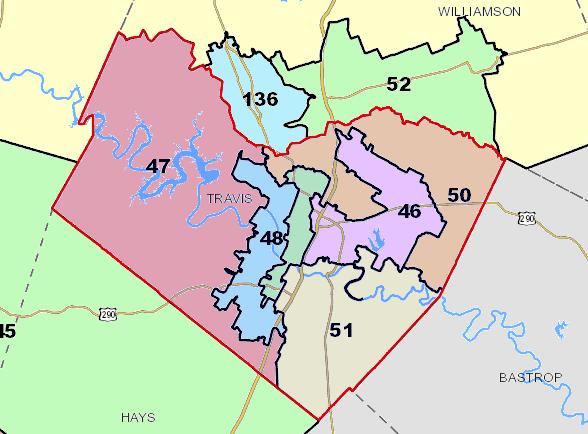
Part of gerrymandering is diffusing the vote of your opponent among "safe" districts. Look at Austin, Texas for example[1]. One would imagine the city would vote as a block.

I do concede that odd shaped districts can be more representative. I've been told the "famously gerrymandered" Earmuff district in Illinois[2] actually represents a single Latino community that was split.

[1] https://www.austinchronicle.com/binary/3468/h309.jpg [2] https://en.wikipedia.org/wiki/Illinois%27s_4th_congressional...

Re: Mathematicians looking to make elections in the US more representative

#63

Earlier quoted context omitted.

Gerrymandering is self-limited. The party in power (in a State government) can either maximize the number of seats it has, or make seats safe. It cannot do both at once! Maximizing seats -> minimizing the margin of victory in each district -> increasing likelihood of losing its majority in a future election! Making seats safe -> maximizing margin of victory in each district and minimizing the number of seats by conce…

I thought gerrymandering is the art of creatively drawing the lines such that all of the opposing constituents are squeezed into one or a few "throwaway districts", thus preserving comfortable majorities in the remaining districts. How is this self-limiting? Also, I don't quite see how it maps to the rather abstract phenomenon you are talking about? Edit -- wikipedia seems to match up with what I was remembering: htt…

Cryptonector's comment makes very little sense. It's an obvious advantage if you can move the boundaries between two seats in order to go from 80-20/50-50 to 75-25/55-45.

Re: Mathematicians looking to make elections in the US more representative

#64

Earlier quoted context omitted.

The problem is gerrymandering results in only one district that's 90-10 while 9 other districts are 55-45. Without gerrymandering, districts would have a normal distribution from 60-40 to 40-60.

It doesn't seem implausible that like-minded people would choose to live near each other.

Most people don't chose, they are just born in some place and stay nearby.

https://www.nytimes.com/interactive/2015/12/24/upshot/24up-f...

And even when choosing, they do it for job, etc reasons, not necessarily or primarily with political criteria.

Re: Mathematicians looking to make elections in the US more representative

#65

To me, the problem is winner-take-all districts to begin with. It all but ensures some constituents are going to be sorely disappointed. Why not consider something like multi-member districts? We could tune it even further by awarding variable voting power. Then the way the borders are drawn becomes far less relevant. I'm sure there are tradeoffs, but it would certainly be more representative.

Lets say that each state have 10 seats. Anyone can run for a seat in a state, but not in more than one state. Two or more people can form a party and have that party on the voting list with them personally on the ballot paper under that party name. (Some mechanism should prevent everyone and his mother to run for shit'n'giggles, e.g. a % of all voters signatures).

Distribute the seats based on largest quotient (details need not to be understood by lay man, but it is fairly simple), and there it is all states equally represented. If people are unsatisfied with current politician, they don't have to become part of the established system to enter.

Re: Mathematicians looking to make elections in the US more representative

#67
post #8

This article from 2013 puts it at D+7.1 overall for the House: http://www.motherjones.com/kevin-drum/2013/01/who-gerrymande... What surprises me, though, is how little attention is given to caucuses in the US presidential primaries. The turnout is very low and they're subject to strong arming and party insider corruption in both major parties.

Well speaking just for myself, I honestly would prefer an even more party insiders driven process for the primaries. Too much democracy seems to lead to insane levels of populism leading to characters like Trump. At any rate, US democracy guarantees one a vote in the general -- parties are private orgs and it's not "corrupt" or "wrong" for them to select candidates however they want.

> I honestly would prefer an even more party insiders driven process for the primaries. Too much democracy seems to lead to insane levels of populism leading to characters like Trump.

Non sequitur. The DNC's heavily party-insider-driven primary process gave us Clinton as Trump's opponent, rather than Sanders, a similarly populist (and popular!) candidate who most likely would have won.

Re: Mathematicians looking to make elections in the US more representative

#69

To me, the problem is winner-take-all districts to begin with. It all but ensures some constituents are going to be sorely disappointed. Why not consider something like multi-member districts? We could tune it even further by awarding variable voting power. Then the way the borders are drawn becomes far less relevant. I'm sure there are tradeoffs, but it would certainly be more representative.

Lets say that each state have 10 seats. Anyone can run for a seat in a state, but not in more than one state. Two or more people can form a party and have that party on the voting list with them personally on the ballot paper under that party name. (Some mechanism should prevent everyone and his mother to run for shit'n'giggles, e.g. a % of all voters signatures). Distribute the seats based on largest quotient (detai…

No need to invent anything new. Correct way to get proportional representation has been already figured out.

It's called d'Hondt method or Jefferson method. https://en.wikipedia.org/wiki/D%27Hondt_method

Thomas Jefferson introduced the method for proportional allocation of seats in the United States House of Representatives in 1791. Victor D'Hondt published it in 1882.

d'Hondt and Jefferson methods are equivalent. Only difference is the way result is calculated. d'Hondt method is used all over the world, but I Americans might feel more patriotic using Jefferson method.

Re: Mathematicians looking to make elections in the US more representative

#70

Earlier quoted context omitted.

The parent didn't mention ranked choice voting unless I read it wrong. I read them to argue in favor of multiple representatives per district. You can have that even with the current voting system. The top n candidates get the job with n > 1. There only difference is right now n = 1. That being said there is also the much simpler approval voting.

Yep, you read me correctly. Approval voting is great too, but I don't know that it addresses the issue of district boundaries on its own. And to address the question of complexity from the first person to reply to me, I don't think that's a realistic concern. Basically it would work like this: you vote normally (whether singe vote, approval, ranked, or whatever), then each party gets at most the number of winners pro…

[deleted]
Post reply on HN