Mathematicians looking to make elections in the US more representative
1–10 of 136 posts
Re: Mathematicians looking to make elections in the US more representative
#2There are a ton of important issues, but, I believe that gerrymandering is a core issue in the United States because :
Partisan gerrymandering allows for politicians to secure their seats - this leads to less voters being represented (allowing the politicians to become more polarized) e.g. when races are tight, politicians tend to move towards the center. [2]
Partisan gerrymandering is strongly disliked by both parties and across the political spectrum, the only people fighting for it are those currently in power (on both sides) [3]
Partisan gerrymandering disenfranchises a large portion of voters, whose votes end up “not counting” b/c of how district lines are drawn[4]
Because of this, I'm currently fundraising (from friends and family) for the legal team in the North Carolina case [1]. I've committed significant amount personally to the fundraise and can say that this is arguably one of the highest leverage ways to spent dollars that you can get to get America back on track as a representative democracy.
I've done a lot of research on this - if you want to help (with $$) or just want to learn more, feel free to reach out (valgui [at] gmail.com)
[1]http://www.campaignlegalcenter.org/sites/default/files/LWVNC... [2] http://www.nytimes.com/2012/10/21/us/politics/in-indiana-tig... [3]http://www.theharrispoll.com/politics/Americans_Across_Party... [4]http://www.latimes.com/opinion/op-ed/la-oe-wang-remlinger-ge...
Re: Mathematicians looking to make elections in the US more representative
#3The problem is with the idea of representative democracy at all. If the electorate is smart enough to figure out that Candidate A is _both_ correct on a range of policy matters _and_ of a trustworthy nature, then why are they not smart enough to decide directly on said policy matters?
Governments should be composed solely of civil servants drawn from academia and other fields in which they need to prove their knowledge and competence. Their job would be to advise on and implement the policy goals chosen by ballot measures.
Figuring out some way to allow direct ballot/referendum securely and efficiently would be more welcome than re-jigging the USA to bring it into line with one of the other countries that has an elite class shuffling between ruling in the interests of businesses and remunerating themselves as leaders of those businesses.
Re: Mathematicians looking to make elections in the US more representative
#4Sorry to nitpick, but the headline should be "The mathematicians who want to save the "American" democracy".
Re: Mathematicians looking to make elections in the US more representative
#5I think we need approval voting.
Re: Mathematicians looking to make elections in the US more representative
#6To me, the problem is winner-take-all districts to begin with. It all but ensures some constituents are going to be sorely disappointed. Why not consider something like multi-member districts? We could tune it even further by awarding variable voting power. Then the way the borders are drawn becomes far less relevant. I'm sure there are tradeoffs, but it would certainly be more representative.
Re: Mathematicians looking to make elections in the US more representative
#7The problem is with the idea of representative democracy at all. If the electorate is smart enough to figure out that Candidate A is _both_ correct on a range of policy matters _and_ of a trustworthy nature, then why are they not smart enough to decide directly on said policy matters? Governments should be composed solely of civil servants drawn from academia and other fields in which they need to prove their knowled…
Just like I hire a person to fix my car, or hire a person to fly the planes I sometimes travel on, we hire people to handle running the country for us. It's an abstraction of labor. I really don't want to be bothered with every little tiny decision about budget or foreign policy.
That said, people in the US are so busy that they don't have any time at all to even make informed decisions on who to elect to run the city/state/country for them. This is a problem...people need to work less, but good luck solving that one with a crippled economy and enormous wealth disparities.
In principle, I agree with you...we have the technology to allow referendum voting, and it would certainly make for a more representative government. However, I think time, understanding, and human nature are large barriers. Also, don't think that just because people can vote directly means they won't be easily swayed by ruling-class propaganda. A good example is when cities try to install their own fiber infrastructure and Comcast rolls in and convinces everyone it's somehow communism. That doesn't go away just because people have a more direct rule.
I think a representative republic still makes sense for our day and age. Gerrymandering is a huge issue and should be dealt with...along with lobbying and other forms of (very obvious) corporate intervention in our republic.
Re: Mathematicians looking to make elections in the US more representative
#8This article from 2013 puts it at D+7.1 overall for the House:
http://www.motherjones.com/kevin-drum/2013/01/who-gerrymande...
What surprises me, though, is how little attention is given to caucuses in the US presidential primaries. The turnout is very low and they're subject to strong arming and party insider corruption in both major parties.
Re: Mathematicians looking to make elections in the US more representative
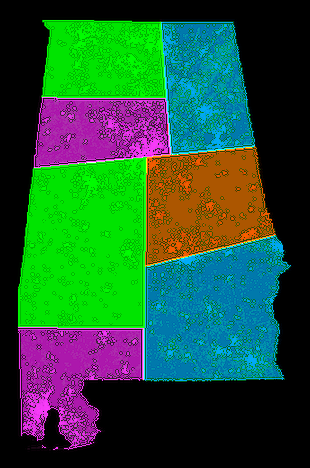
#9One of the most reasonable rules I've heard IMO for deterring voting districts:
> In each section (at first a state, etc), find a dividing line that splits the population in two.
This seems somewhat reasonable, and there's no way for humans to bias it.
Here's some pictures of what this looks like [1], and the write up of this idea [2]
Re: Mathematicians looking to make elections in the US more representative
#10This article from 2013 puts it at D+7.1 overall for the House: http://www.motherjones.com/kevin-drum/2013/01/who-gerrymande... What surprises me, though, is how little attention is given to caucuses in the US presidential primaries. The turnout is very low and they're subject to strong arming and party insider corruption in both major parties.
Well speaking just for myself, I honestly would prefer an even more party insiders driven process for the primaries. Too much democracy seems to lead to insane levels of populism leading to characters like Trump. At any rate, US democracy guarantees one a vote in the general -- parties are private orgs and it's not "corrupt" or "wrong" for them to select candidates however they want.