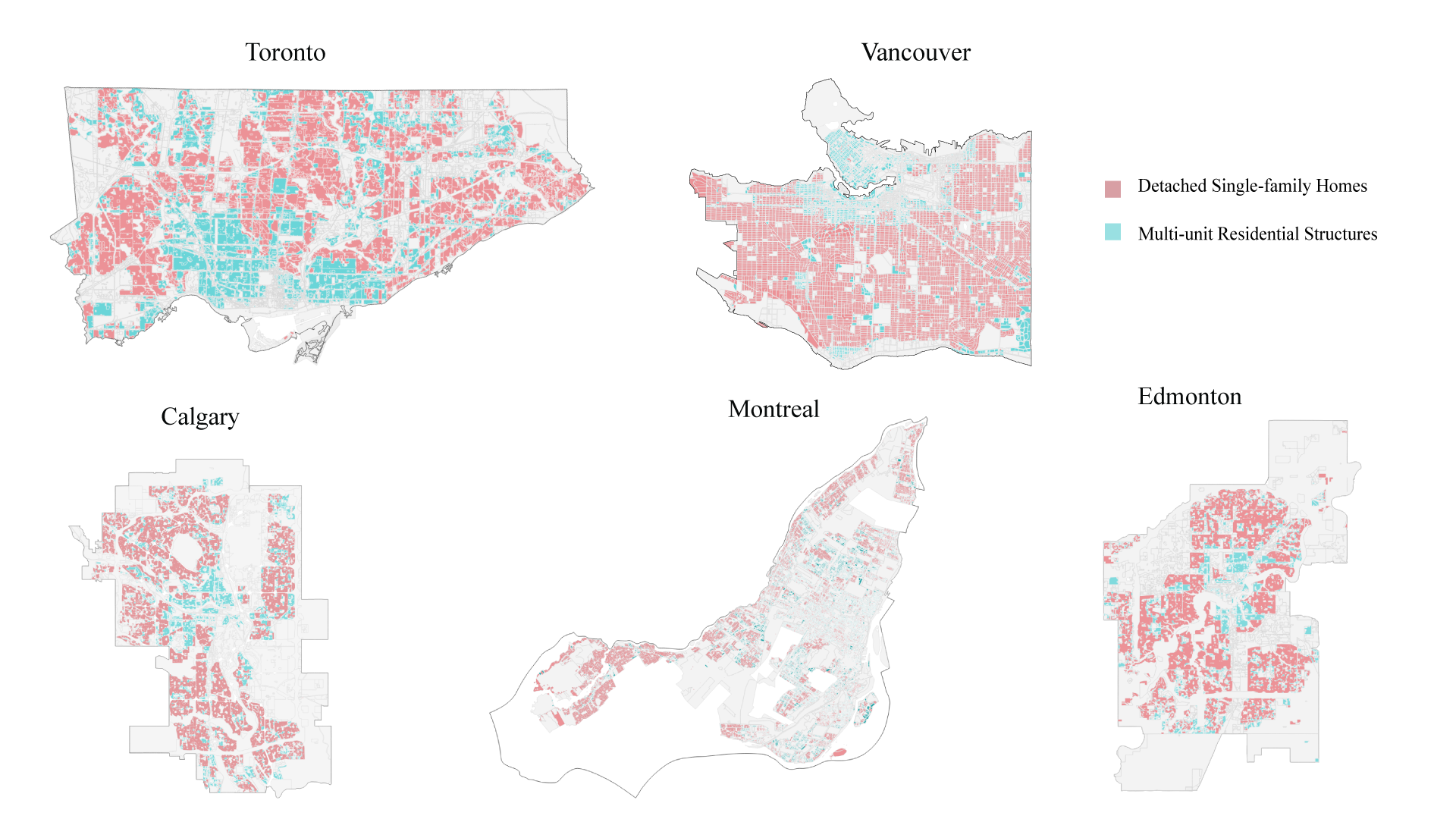
I don't accept the premise. Vancouver sure looks a lot different than it did 30 years ago, right? Well, certainly the peninsula/downtown does, but most of the city is still zoned for single-family housing:
http://www.datalabto.ca/wp-content/uploads/2019/07/thumb_nai...
Even Vancouver isn't building anywhere near what the demand would support. If people were allowed to build more housing in Vancouver, then they would. [0]
In general, people's intuition on this stuff isn't great, for a few different reasons:
1. Status quo bias. Any change tends to look like a lot of change. This is the, "I can see three cranes from where I'm standing, so we must be in a construction boom" fallacy.
2. Illusion that concentrated change indicates widespread change. People see a lot of development in one part of town and discount that such development is prohibited in 98% of the city. (This one definitely applies to Vancouver.)
3. Failure to account for proportionality. If somebody hears that a city added 5000 units, they'll probably think that's a lot. But is it? What if we're talking about a metro area with 10 million people? It's nothing. Big numbers can end up being small numbers when the scale is large enough.
3. Failure to account for growth in demand/population. We build fewer houses than we did 100 years ago, but we also have many times as many people! So even a static supply is bad, because you have to at least build enough to keep up with growth. And since some cities have seen a sustained surge in demand for the last 2 or 3 decades without enough construction, even seemingly large amounts of recent development might mean that you're still way behind.
[0] I'm aware that Vancouver has made some progress on this. I think they're going to start allowing more duplexes and more housing near SkyTrain stops. I don't follow Vancouver that closely, so I'll just note that I'm aware it's changing.