Earlier quoted context omitted.
> Intelligence, conscientiousness, affluence/social capital Agreed that these are important factors in success, but in practice they don't seem to be equivalent in importance. An unsuccessful person who lacks intelligence or conscientiousness but was born into affluence in the US is more likely to remain higher on the socioeconomic ladder than a successful person who has both intelligence and conscientiousness but wa…
> An unsuccessful person who lacks intelligence or conscientiousness but was born into affluence in the US is more likely to remain higher on the socioeconomic ladder than a successful person who has both intelligence and conscientiousness but was born poor. Are you using the same scales here? If the affluent person was 1% you should take a top 1% person in terms of intelligence or grit. If the affluent person was to…
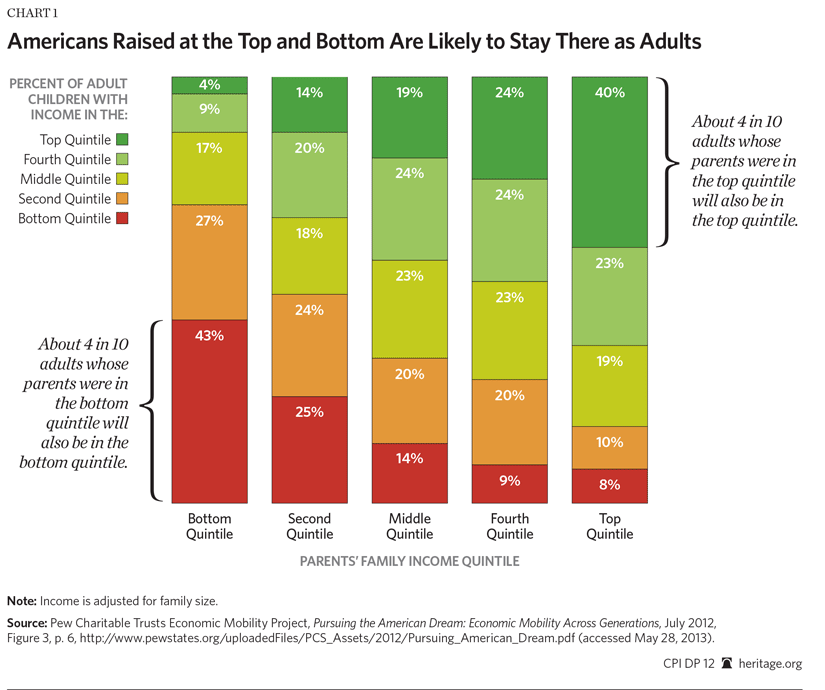
But another way of thinking about it is to look at the research on economic mobility. [1] For example, someone whose parents were in the top quintile is more likely to end up in the top quintile than anywhere else, followed by the next-highest quintile, etc and is much less likely to end up in the bottom quintile. Whereas someone born in the bottom quintile is more likely to remain in the bottom quintile, followed by the next-lowest, etc and is much less likely to end up in the top quintile.
One way to interpret that data is through the lens of the just-world hypothesis. This assumes that the United States is a meritocracy and that people will eventually end up at the correct quintile based on their personal effort and characteristics. And if there happens to be generational social stratification then it's probably due to intelligence and grit being hereditary.
Another way to interpret it is that the people with resources have instituted rules and systems that increase socioeconomic inertia so that they can pass as much of their status on to their children as they can while still allowing for enough mobility to prevent a revolution.
Having met, worked with, and taught people in the top and bottom quintiles, I do not find the first hypothesis compelling. That's not to say there is no movement, and those people I have met who have climbed the furthest are also some of the most intelligent, hard-working people I know. But telling them fairy-tales about meritocracies is not helpful -- they need to be prepared to fight long odds and work significantly harder to climb up than someone who is basically already there.
[1] https://www.heritage.org/sites/default/files/~/media/images/...