Earlier quoted context omitted.
What job were you doing at Tesla? Is there a particular reason you hate college so much? Purely curious
CapEx. I love working at Tesla. I was excited everyday to wake up and go work 12 hours a day. College, I couldn't focus. I'd had 6 years of supply chain experience before trying to get a degree in supply chain and if i'm being honest everything i was learning in school was completely pointless and would never be useful. I even have the GI bill so i was being paid to go to school and my soul still couldn't take it.
What I Worked On
401–410 of 421 posts
Re: What I Worked On
#402This comment really resonated with me, I found myself in this exact situation at 25, in a "very prestigious and selective place" for AI nonetheless. It took me a couple years to realize the smart people are just playing the game, the unsuspecting losers are "playing it straight" and getting endlessly frustrated. I found my balance by, frankly, taking advantage of a system that is FUBAR. Incidentally, I also took some…
Whether or not it's meaningful, solve some problems and enjoy it. Joy is not the same as meaning and it's less of a gamble to land on it
Re: What I Worked On
#403It’s nice to see even pg goes through phases of “I have no idea what to do next.” By the way, bel is underrated, and I say that not as a pg fan. The ideas in it are novel, because of its simplicity. The scheduler in particular is elegant. I suppose I should have taken some notes on what surprised me the most. But, basically, the idea of using a stack as the source of truth for all computation was both ... strange, an…
I had a look at the examples section on the bel post and read a few pages into the bel document, but all I saw is basically scheme with a slightly funky syntax and primitives (like where). So I guess pg must really be burying the lede (which, from what I gather from the above has at least partly to do with a elegant way to model concurrency, which ur-lisp lacked?).
Re: What I Worked On
#404Earlier quoted context omitted.
I think people have different definitions of "upper class". Maybe "Upper-middle class" would have been a better term, since pretty much everyone in the U.S. calls themselves some flavor of middle class. But my point is is that most people are not doing nearly as well financially as a mathematician/manager working at Westinghouse modeling nuclear reactors[1][2]. For example, 70% of americans have less than $1,000 of s…
That third link points to a survey by a bank that had 69% of respondents saying they had less than $1000 "in a savings account" in 2019. That's not the same thing as "in savings". "In savings" would include things like bonds, CDs, high-yield checking accounts, 401(k)s, IRAS, etc, etc, etc. Even if we exclude random equities in a brokerage account. The proliferation of high-yield checking accounts in particular has si…
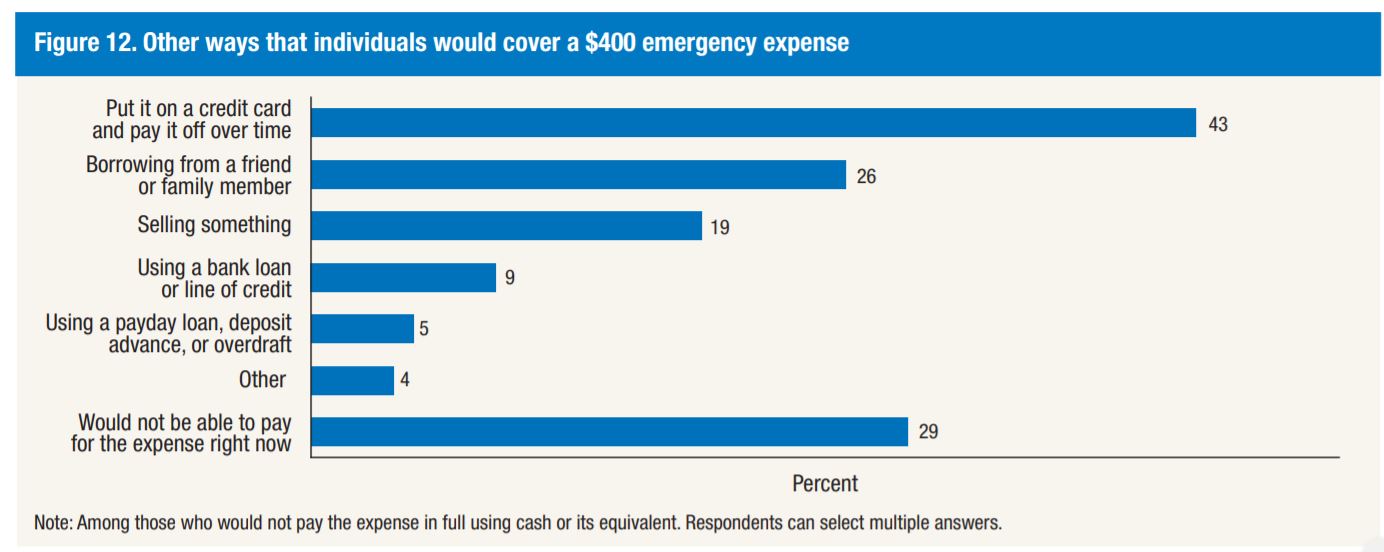
I really don't see how the article you linked disagrees with this basic conclusion. See the graph: https://static.politifact.com/politifact/photos/Kamala_scree...
People would need to go into debt in order to pay it (only 19% said they could pay for it by "selling something", which might be selling equities, but probably includes pawning personal possessions). IRAs or 401ks are not liquid. And neither is home equity, for that matter. So I would say that half of Americans not having the savings to pay a $500 expense is accurate, even though calling it a "complete upheaval" was not.
Even if you include non-liquid assets, the average person isn't doing so great. For example age 35-44, median net worth is $91,300, and the bottom quintile is net worth negative. I think it's easy to imagine how someone growing up in such a household would have a different experience than someone in the top quintile, who will have a net worth of >$300,000.
Re: What I Worked On
#405Earlier quoted context omitted.
Funny because I do have the same feeling these days: that ML is a hoax. Even funnier: I do have a master's degree in ML.
Someone else on HN used the phrase "cognitive automation". I like this as a descriptive phrase. ML won't be "intelligence" per se, but it can do repetitive tasks that otherwise required thought.
With emerging digital tools at the time which made it possible to store & retrieve datasets that I was already interpreting in detail anyway.
Since it was programmable too, ended up using the memory to store the key points from many permutations of well-characterized raw training data, then running that against new datasets to give me advice on how to save time on the greatly reduced manual work remaining.
Re: What I Worked On
#406> "How should I choose what to do? Well, how had I chosen what to work on in the past? I wrote an essay for myself to answer that question, and I was surprised how long and messy the answer turned out to be. If this surprised me, who'd lived it, then I thought perhaps it would be interesting to other people, and encouraging to those with similarly messy lives. So I wrote a more detailed version for others to read, an…
The end was a very golden braided beginning.
But more options are open than ever before, and his life's work continues . . .
Re: What I Worked On
#407I’ve enjoyed many of pg’s essays, but this is my favourite of all time. I often feel burned out and uninspired these days, even after past successes. It’s wonderful to take a look back at a time when overly ambitious ideas would be naively pursued, unrelated hobbies would prove fruitful in unexpected ways, and to remember that inspiration can be found again many times through the course of life. Thank you pg.
same. thanks pg
It's a good feeling that after "retirement" this all still lies ahead of you if you still want it.
Re: What I Worked On
#408This was a good read. I wish I could understand the mindset of people who can live spontaneously like this. I always plan so far in the future because I feel like it’s way too easy to ruin my life financially. Is this a generational thing? A class difference?
I think class does have a lot to do with it. It's not (just) the obvious reasons, like having access resources to start new ventures or having a backstop in case things don't pan out. For some there is a feeling of responsibility for your family, from the very beginning, that informs every choice you make. If it were just me, I know I can live cheaply and get by if I have to, and therefore could afford to take on hig…
Me too, and I could see there was no other possible way to save my parent's house than to start my company.
Re: What I Worked On
#409I don’t have much to add to this discussion except to note that PG has impeccable punctuation but doesn’t capitalise the days of the week. Odd.
As an aside, I always think his icon on the web browser looks a bit like the Texas flag.
Re: What I Worked On
#410Earlier quoted context omitted.
I fear I'm one of these unsuspecting losers...except I guess that comment makes me suspecting. IDK, I don't want to play the game but it only gets worse in the corporate world. I wish there was a good solution, where someone could play it straight and get rewarded justly. Your art work is beautiful by the way.
Since we're commenting on a pg essay, IIRC startups are said to be the place where you CAN play it straight and get rewarded justly. The core idea being you can't fake or politic your way into making something users want. I wish I could find the link to the essay that directly states this but I'm having trouble finding it now (and my Google-fu doesn't seem to be strong enough to locate it).
My anecdote: I worked at a startup for 4 months and I was basically playing it straight, ie, a loser. My CEO constantly kept pushing the idea of releasing a shitty product which just barely worked. His justification was that there were giant foreign competitors that raised millions of $ with admittedly very shitty products. Like I'm talking about forms that barely worked in their shitty React Native mobile apps. Anyway, our product was shitty and our users did not use the damn thing (poor retention). However, there was an easy/cheap way to grow quite quickly due to the nature of the service. It was all too much for me and I quit.
Anyway, it really dawned on me during the last few months that my boss didn't actually care about the product - he was playing the game of growing at all costs, put the nice numbers on a chart, and raise the next round of funds from VCs (a lot of them showed interest from the outside). And to be really frank, if he was honest with me that this was the actual game, that he wanted to get acquired or do an IPO purely based on growth metrics, it would be easier for me to understand. Instead, he kept talking about revolutionizing education with technology and that left a lot of us absolutely baffled.