Live data from Hacker News

Why I don't believe in Uber's Success

blog.benjamin-encz.de

401–410 of 413 posts

Re: Why I don't believe in Uber's Success

#401

Earlier quoted context omitted.

> As far as war chest goes, Uber basically has no competition. Google has more money coming in half year than Uber has ever raised, and it's from profits . The major car companies also have billions of dollars of revenue and collectively they hold hundreds of billions, possibly trillions, of dollars of fully depreciated assets.

You're right about the cash available, but how much is Google (and its investors) willing to lose to compete with Uber? Are Google's investors willing to put up with another [vastly more expensive] Google Plus? Because when I say war chest, I mean Uber is willing to lose it all. Rides are Uber's only revenue source, whereas Google has never made a cent in that industry.

Google's investors don't have a choice. Brin and Page have voting control.

In any case, it's hypothetical. Uber's unit economics are made of losses and there is no structural moat around their business. They'll run out of money and that will be that.

Re: Why I don't believe in Uber's Success

#402
The claim that taxi supply is sufficient in most cities to compete with Uber aside from on price is clearly not based on much experience with taxis in the US.

I grew up in Australia where every city is served by a small number of taxi companies and central dispatch works great. In every US city I've lived or visited (except NYC) the fragmentation of taxi companies and driver behavior -- most DC cab drivers would refuse to accept credit cards even after it became illegal not to ("my machine she is broken") -- makes taxis worse in every dimension than Uber, and frequently too unreliable to use for things like trips to airports. (In Sydney, I would take a taxi to the airport, in any US city you'd book a van.)

It's not just price -- fragmentation makes dispatch hopeless because the individual companies have too few taxis in their pool and don't hand off bookings to each other efficiently, and local regulations are a nightmare, e.g. in the Washington DC metro area it's painful to get taxis from Arlington (VA) to downtown (DC) and vice versa (Arlington is literally only not downtown DC because Virginia asked for its corner of DC back, we're talking 2 mile rides), and you need to guess which taxi company to use because dispatch is also fragmented and broken. When Uber and Lyft appeared we simply stopped using taxis cold. (Our favorite DC Uber driver was a limo driver who simply used Uber to make money in down-time, and he was clearly not confused about tax and costs.)

I think the idea that privately owned self-driving cars will compete with Uber is wrongheaded but doesn't damage the argument. Any dispatch service that achieves critical mass -- public or private -- can leverage self-driving cars to compete with Uber. I think self-driving cars will vastly reduce car ownership, and pools of automatic taxis will replace them, reduce congestion, and allow lots of car-dedicated space in cities to be reclaimed. I'd argue this threatens Uber's ride-sharing business as much as anything else.

I agree that Uber is almost a victim of its valuation -- it could be incredibly valuable as a virtual integrated vehicle dispatch -- tracking driver and customer quality, vehicle location and capability, and matching vehicles to needs and collecting fares, but by trying to own everything and be valued accordingly it may risk implosion when it fails to deliver.
Re: Why I don't believe in Uber's Success

#403

Earlier quoted context omitted.

If you look into the indicators that fall into the Retail and Services sales category, there are extremely big ticket items and high-volume items that aren't sold in high volume or at all due to regulation. All auto sales, gas purchases, alcohol & tobacco, heavy industrial equipment (commercial farm equipment, etc) are included in that category. Online sales only being 10% of that still probably looks massively outsi…

Your spending habits may not be representative of the greater population.

And that last statement about my spending habits is tangential to everything I said previous to it.

Re: Why I don't believe in Uber's Success

#404
post #396

Earlier quoted context omitted.

Iranian hostage crisis comes to mind.

Really? I was alive at the time and the hostage crisis remains indelibly linked to Carter in my mind (aside from the belief of many on the left that Reagan cut some kind of deal with Iran to hold the hostages until after he won). Do younger people recall it differently?

Well, there's a conservative effort to re-write that history:

http://www.politifact.com/truth-o-meter/statements/2016/jan/...

Re: Why I don't believe in Uber's Success

#405

Earlier quoted context omitted.

Your spending habits may not be representative of the greater population.

And that last statement about my spending habits is tangential to everything I said previous to it.

> I haven't made a B&M retail purchase any more times than I can count on one hand since 2004

Re: Why I don't believe in Uber's Success

#406
Their algorithms increase the usage of each car, reducing the cost per passenger mile. So Uber can cheaper than normal taxis.

My own self driving car is unlikely to be cheaper to buy than my manually driven car. But the self driving Uber will be significantly cheaper to run than one with a driver.

I can't wait til I no longer need my own car. Uber, and competitors, are the future.

Re: Why I don't believe in Uber's Success

#407
post #295
post #237

Earlier quoted context omitted.

In a self driving world, peak traffic will be served by buses. (Or subways in cities that can handle it) Like everything - high bandwidth vehicles will do the bulk of the work, and seamlessly trade off to "last mile" self driving small vehicles.

I'd think self driving cars would kill busses. I'd much rather nap / work / watch TV / do hobbies in my car (where I'd keep stuff for doing all that), then in a bus. If the car is electric, it isn't so bad on the environment, and it can park itself in a no humans allowed garage (so little chance for breakins). As for rush hour, I'd hope swarm scheduling lowers congestion substantially (though this and making longer c…

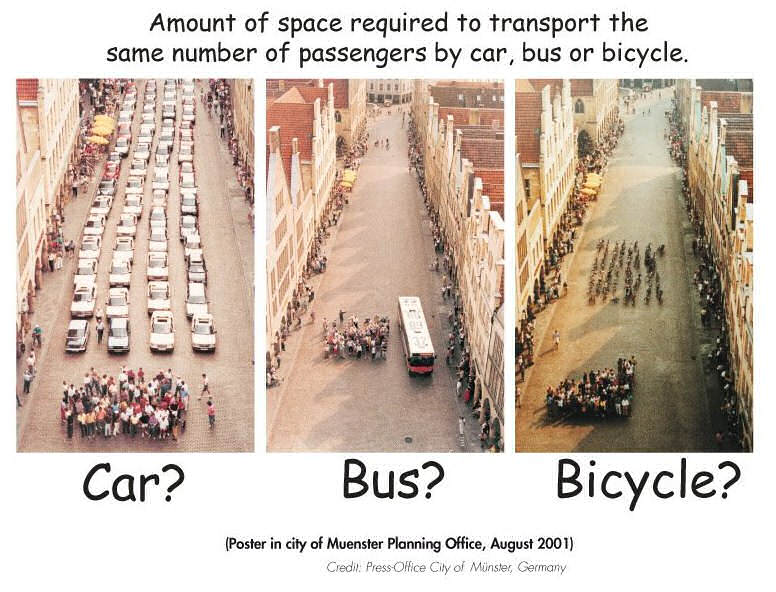
Self-driving cars will replace buses? And who, pray tell, will pay for expanding our roadways?

http://john-s-allen.com/blog/wp-content/uploads/2010/03/muen...

Re: Why I don't believe in Uber's Success

#410
post #357
post #339

Earlier quoted context omitted.

I just signed up for the 4 weeks of flat rate uber pool in NY. $89 and you can use Uber Pool as much as you want for free between 6am and 8pm inside Manhattan. Previously I would spend $117 in a monthly metrocard.

As the article explains, that $89 is heavily subsidized. If you had to pay $200 for that same monthly pass you would probably reconsider.

Isn't the subway subsidized as well?
Post reply on HN