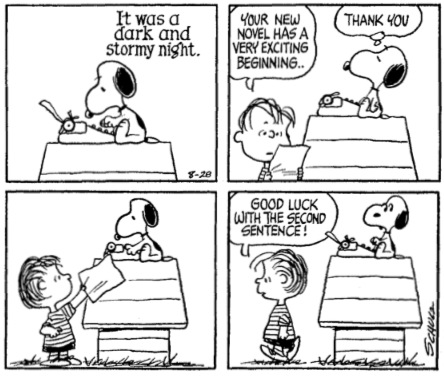
Most people stop reading something after the first few sentences. In that crucial 10 to 15 seconds, a book (or essay, or article, or blog post) has to make, and win, a subconscious appeal to your attention. Your reader's attention span is like a snotty doorman at a hot club. Your opening sentence needs to grab his interest and sneak the rest of the piece into the door. Consider the following examples from fiction: "I…
To my knowledge I don't know anyone who picks up novels, reads the first few sentences, then throws them away. Maybe people do this in airport bookstores, but I don't think Orwell, Ray Bradbury, or Kafka wrote with the ADHD audience in mind. On the other hand I know that many readers hate to put a book down without giving it a fair shot. The "catchy opening" design pattern is present in a lot of art where the audienc…
Browsing is (was?) incredibly common in the bookstore era, and will become even more so in the modern era and beyond. Especially as digital sampling becomes more prevalent, and as the barrier to entry (price) comes down significantly. If anything, we'll see even more buy-and-then-browse behavior. And for what it's worth, book returns were prevalent in the heyday of the B&M bookstore, and they're a significant factor in Amazon's business to this day. (In fact, I'm willing to wager that quite a few people, even the highly literate ones, haven't read the majority of the books sitting on their shelves.)
Regardless, I'm not talking about the opening line as a sales proposition. I'm talking about the opening line as a gambit to get someone to keep reading when they first pick up the piece. How many times have you bought a book, or picked up a magazine, or clicked open a blog post, and simply lost interest after the opening paragraph? I'm not saying you immediately regret picking it up, but rather, that you think to yourself "Meh, I'll skip this one and read something else. Maybe I'll come back to it later." This behavior is pretty common, and by nature, the human attention span in limited. In no way am I talking about the "ADHD audience" here. I'm talking about basic human wiring.
As for Kafka, Orwell, et al., bear in mind that their initial audience was a reader at a publishing house, journal, or newspaper. Oftentimes, your first target reader is the one who decides whether or not to publish you in the first place. This person reads thousands of pieces a week, and getting his or her attention has been a crucial task since the invention of the printing press.