Live data from Hacker News

How to Write an Opening Sentence

asserttrue.blogspot.com

41–50 of 83 posts

Re: How to Write an Opening Sentence

#41

Most people stop reading something after the first few sentences. In that crucial 10 to 15 seconds, a book (or essay, or article, or blog post) has to make, and win, a subconscious appeal to your attention. Your reader's attention span is like a snotty doorman at a hot club. Your opening sentence needs to grab his interest and sneak the rest of the piece into the door. Consider the following examples from fiction: "I…

To my knowledge I don't know anyone who picks up novels, reads the first few sentences, then throws them away. Maybe people do this in airport bookstores, but I don't think Orwell, Ray Bradbury, or Kafka wrote with the ADHD audience in mind. On the other hand I know that many readers hate to put a book down without giving it a fair shot. The "catchy opening" design pattern is present in a lot of art where the audienc…

"To my knowledge I don't know anyone who picks up novels, reads the first few sentences, then throws them away. Maybe people do this in airport bookstores, but I don't think Orwell, Ray Bradbury, or Kafka wrote with the ADHD audience in mind."

Browsing is (was?) incredibly common in the bookstore era, and will become even more so in the modern era and beyond. Especially as digital sampling becomes more prevalent, and as the barrier to entry (price) comes down significantly. If anything, we'll see even more buy-and-then-browse behavior. And for what it's worth, book returns were prevalent in the heyday of the B&M bookstore, and they're a significant factor in Amazon's business to this day. (In fact, I'm willing to wager that quite a few people, even the highly literate ones, haven't read the majority of the books sitting on their shelves.)

Regardless, I'm not talking about the opening line as a sales proposition. I'm talking about the opening line as a gambit to get someone to keep reading when they first pick up the piece. How many times have you bought a book, or picked up a magazine, or clicked open a blog post, and simply lost interest after the opening paragraph? I'm not saying you immediately regret picking it up, but rather, that you think to yourself "Meh, I'll skip this one and read something else. Maybe I'll come back to it later." This behavior is pretty common, and by nature, the human attention span in limited. In no way am I talking about the "ADHD audience" here. I'm talking about basic human wiring.

As for Kafka, Orwell, et al., bear in mind that their initial audience was a reader at a publishing house, journal, or newspaper. Oftentimes, your first target reader is the one who decides whether or not to publish you in the first place. This person reads thousands of pieces a week, and getting his or her attention has been a crucial task since the invention of the printing press.
Re: How to Write an Opening Sentence

#42

Most people stop reading something after the first few sentences. In that crucial 10 to 15 seconds, a book (or essay, or article, or blog post) has to make, and win, a subconscious appeal to your attention. Your reader's attention span is like a snotty doorman at a hot club. Your opening sentence needs to grab his interest and sneak the rest of the piece into the door. Consider the following examples from fiction: "I…

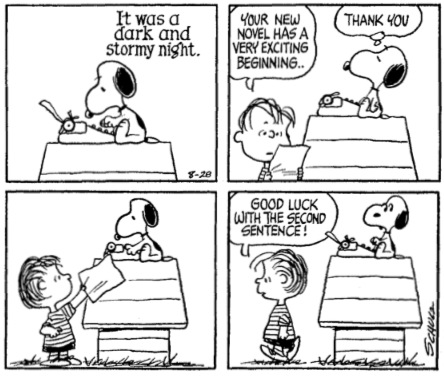
Also consider:

"It was a dark and stormy night" [1]

[1] http://en.wikipedia.org/wiki/It_was_a_dark_and_stormy_night [1] http://1.bp.blogspot.com/-C9p9mw62qB8/TsWPk2-GMcI/AAAAAAAACF...

Re: How to Write an Opening Sentence

#43

Earlier quoted context omitted.

To my knowledge I don't know anyone who picks up novels, reads the first few sentences, then throws them away. Maybe people do this in airport bookstores, but I don't think Orwell, Ray Bradbury, or Kafka wrote with the ADHD audience in mind. On the other hand I know that many readers hate to put a book down without giving it a fair shot. The "catchy opening" design pattern is present in a lot of art where the audienc…

"To my knowledge I don't know anyone who picks up novels, reads the first few sentences, then throws them away. Maybe people do this in airport bookstores, but I don't think Orwell, Ray Bradbury, or Kafka wrote with the ADHD audience in mind." Browsing is (was?) incredibly common in the bookstore era, and will become even more so in the modern era and beyond. Especially as digital sampling becomes more prevalent, and…

I think most novelists write with the intent to be read after they have some years of experience. It's the next, natural step. Whether that reader is at a publishing house or not is a little hard to know, especially in Kafka's case.

From what I've read and studied at university, Kafka wrote for his friends a lot. He shared his writings with them and they had a laugh. His pieces were known (by his friends) as dark comedies. Whereas in Western Europe and North America, they are read as existential pieces.

Kafka doubted many times that his novels and stories would ever be published because of their 'immoral' content. So, I'm interested in any further info you have that might suggest otherwise.

Re: How to Write an Opening Sentence

#44

Like that time someone told us how to design a well-designed site in 30 minutes, I decided whilst clicking through "How to Write an Opening Sentence" that I would read the first sentence and then decide whether I should listen to the guy on "how to write an opening sentence". It read: >"When I was a 25-year-old Senior Editor of The Mother Earth News, I did a lot of rewrite editing. " I decided against it, so I didn't…

> spent three weeks Unnecessary detail. > how to get my articles to stay at a low reading angle I don't know what this even means. What's a "low reading angle"? > instead of getting flung back in my face by an impatient editor This is factually incorrect. The author was the editor, and the person doing the flinging was the founder. > the experience was invaluable I'm not a fan of just blunting telling the reader "you…

you don't even understand what I wrote. Try opening an issue of the new yorker or something. you can't understand a single opening paragraph - so the problem's with them, right? right?

Re: How to Write an Opening Sentence

#45
post #2

Iain Banks manages to provide both one of the most memorable opening sentences: "It was the day my grandmother exploded." and my favourite opening paragraph (or two): "Two days ago I decided to kill myself. I would walk and hitch and sail away from this dark city to the bright spaces of the wet west coast, and there throw myself into the tall, glittering seas beyond Iona (with its cargo of mouldering kings) to let th…

Since we're doing great opening lines I'm going to throw two odd ones into the mix (which are still great!):

"In the beginning, the universe was created. This has made a lot of people very angry and been widely regarded as a bad move." - Douglas Adams 'The Restaurant at the End of the Universe'

and...

"Mr. and Mrs. Dursley of number four Privet Drive were proud to say they were perfectly normal, thank you very much." - Harry Potter (right below the opening chapter name called "The Boy Who Lived")

So humble and small compared to the journey you're about to go on.

Re: How to Write an Opening Sentence

#46
post #17

Just wanted to add that this advice will necessarily change with the times. Something sounds trite and cliche if you've heard it (or something like it) too much. Most of the things that sound trite and cliche now sounded great the first time you heard them. That's how they got repeated enough to become trite and cliche in the first place. If everyone followed the advice in this article, the advice would be terrible.…

A coworker of mine (25ish) had seen a lot of movies, but not Casablanca. So I loaned it to him. He said "my first reaction was 'this is so cliched' and then I realized that it rather was where many cliches came from"

Umberto Eco: http://www.themodernword.com/eco/eco_casablanca.html

Re: How to Write an Opening Sentence

#47
post #17

Just wanted to add that this advice will necessarily change with the times. Something sounds trite and cliche if you've heard it (or something like it) too much. Most of the things that sound trite and cliche now sounded great the first time you heard them. That's how they got repeated enough to become trite and cliche in the first place. If everyone followed the advice in this article, the advice would be terrible.…

A coworker of mine (25ish) had seen a lot of movies, but not Casablanca. So I loaned it to him. He said "my first reaction was 'this is so cliched' and then I realized that it rather was where many cliches came from"

For the same reason, it's impossible to listen to the music of Debussy and Delius in the same way it was heard when it was new. Then, the parallel chords of stacked thirds, modal harmonies, and blurred harmonic rhythm were new and exciting, but now, they've been done so much that it's in every movie's scene in the mist, and every other feminine hygiene product ad.

Re: How to Write an Opening Sentence

#48

Most people stop reading something after the first few sentences. In that crucial 10 to 15 seconds, a book (or essay, or article, or blog post) has to make, and win, a subconscious appeal to your attention. Your reader's attention span is like a snotty doorman at a hot club. Your opening sentence needs to grab his interest and sneak the rest of the piece into the door. Consider the following examples from fiction: "I…

> "It was a bright cold day in April, and the clocks were striking thirteen." --George Orwell, 1984

I think I've frequently heard this called a great opening line, and I've never worked out why. It doesn't tell me anything that I care about, it doesn't seem especially clever, and I don't notice myself having any other discernible emotional reaction to it.

Can someone explain?

Re: How to Write an Opening Sentence

#50
post #2

Iain Banks manages to provide both one of the most memorable opening sentences: "It was the day my grandmother exploded." and my favourite opening paragraph (or two): "Two days ago I decided to kill myself. I would walk and hitch and sail away from this dark city to the bright spaces of the wet west coast, and there throw myself into the tall, glittering seas beyond Iona (with its cargo of mouldering kings) to let th…

Even though I'm not a great fan of his work, Banks did write one of the most memorable opening lines ever in The Crow Road . Two other great examples: William Gibson's Neuromancer : "The sky above the port was the color of television, tuned to a dead channel." Herman Melville's Moby Dick : "Call me Ishmael." Neither strictly tells the reader what the books are about, but they're great hooks.

For sheer flippancy, it's hard to beat

Kurt Vonnegut Slaughterhouse Five "All of this happened, more or less."

[edit: originally I put Catch-22, which the user below correctly points out was not Vonnegut and had a different opening line]

Post reply on HN