Live data from Hacker News

Barely Half of 30-Year-Olds in the U.S. Earn More Than Their Parents Did at 30

wsj.com

361–370 of 394 posts

Re: Barely Half of 30-Year-Olds in the U.S. Earn More Than Their Parents Did at 30

#361

Earlier quoted context omitted.

Gold standard has nothing to do with it. What money is, at a fundamental level, is a promise you can later redeem for real goods and services. Why there's so much mortgage and student loan debt follows directly from the demographic changes - the retiring generation needs promises to provide real goods and services (both directly through saving, and indirectly through pensions and the like), so capital markets seek ou…

No, banks are creating credit. https://bankunderground.co.uk/2015/06/30/banks-are-not-inter... By creating credit faster than the underlying wealth creation of an economy banks are appropriating real goods and services and the wealth generation later (or rather now as they lent for decades like this) and they walk off with the goods whilst we all drown in asset inflation. I would agree that demographics played a big…

I think you are talking about fractional-reserve banking, which has been around for hundreds of years. This can exist with or without a gold standard.

Re: Barely Half of 30-Year-Olds in the U.S. Earn More Than Their Parents Did at 30

#362

Earlier quoted context omitted.

I think it's great when there's perspectives from the non-typical-HN reader, it's easy to forget how exceptional most people's lives are here. So, with that upbringing, how did you end up doing machining and precision manufacturing? And how'd you wind up on Hacker News? What brand of CNC machines do you work with?

Thank you for the encouraging words. I try and check HN every day before my shift but I usually never have time to comment until much later, at which point there isn't much activity in the threads, so I sometimes wonder whether or not my posts add any value or if I'm just writing for myself. With regards to how I ended up in my current job I'll do my best to offer a succinct timeline. My prior work experience consist…

Inconel please continue to comment whenever you think you have something to contribute to the conversation. I also appreciated hearing your perspective. Your writing is fine! No need to feel self conscious.

Re: Barely Half of 30-Year-Olds in the U.S. Earn More Than Their Parents Did at 30

#363
post #90
post #46

Earlier quoted context omitted.

Up until we finally get our collective heads out of our asses and implement something like Basic Income.

That isn't going to happen easily. My experience: I've talked about this to many people (highly educated, smart people) - most of them are adamant on the idea that human beings absolutely have to work to deserve anything, even food and water. This might very well be anecdotal, but very few people get ideas like Basic Income intuitively. It would likely take tremendous amount to first make people understand, then acce…

That's why I think basic income supporters should also be advocating for a land value tax to fund the basic income, which should really be rebranded as a "citizen's dividend". This shifts the source of funding from coming off "the backs of hard workers", to compensation for allowing others the privilege of denying you monopoly ownership over our collective land and natural resources. Rather than an "us vs. them" mentality, we're all collective shareholders of our land, and basic income then become's the dividend.

Regarding "hard work", we need to start seeing work as a means to an end rather than an end in itself. We need to focus more on what it is that's actually being accomplished rather than whether or not somebody's working hard. If society can operate without you needing to work hard, then hard work should be a choice.

Re: Barely Half of 30-Year-Olds in the U.S. Earn More Than Their Parents Did at 30

#364
post #90

Earlier quoted context omitted.

That isn't going to happen easily. My experience: I've talked about this to many people (highly educated, smart people) - most of them are adamant on the idea that human beings absolutely have to work to deserve anything, even food and water. This might very well be anecdotal, but very few people get ideas like Basic Income intuitively. It would likely take tremendous amount to first make people understand, then acce…

I honestly feel basic income is a MUST have. I so much believe in it that I WANT the automation to come, I want to see the jobs disappear, I live for the day when robots do all the physical work and a job is optional--and we can pick and choose what we work on because having a roof over our head and food on the table, and healthcare is just a given. We can be entrepreneurs, etc.. I have a ton of app ideas, but I work…

The average adult hunter-gatherer only worked about 22 hours [1]

We've advanced so much technologically, yet we're working more than hunter-gatherers were hundreds of thousands of years ago.

What are we working towards again?

[1] https://www.psychologytoday.com/blog/freedom-learn/201611/in...

Re: Barely Half of 30-Year-Olds in the U.S. Earn More Than Their Parents Did at 30

#365
post #90

Earlier quoted context omitted.

That isn't going to happen easily. My experience: I've talked about this to many people (highly educated, smart people) - most of them are adamant on the idea that human beings absolutely have to work to deserve anything, even food and water. This might very well be anecdotal, but very few people get ideas like Basic Income intuitively. It would likely take tremendous amount to first make people understand, then acce…

All humans have a psychological need to be needed. The current way to best feel this is to provide income for yourself and your family through work, and provide a service for your employer. This is extremely satisfying for a majority of people. Take away work and these two things collapse. To get UBI to work, we need a new way for people to feel needed.

One can choose to work on whatever they want, however they want. Believe it or not, most people have an innate desire to want to contribute to society and/or improve/create things. Basic income is not communism, you'll still get compensated for doing paid work. As long as that incentive to make money is there, there will always be people working.

Re: Barely Half of 30-Year-Olds in the U.S. Earn More Than Their Parents Did at 30

#366

Earlier quoted context omitted.

No, banks are creating credit. https://bankunderground.co.uk/2015/06/30/banks-are-not-inter... By creating credit faster than the underlying wealth creation of an economy banks are appropriating real goods and services and the wealth generation later (or rather now as they lent for decades like this) and they walk off with the goods whilst we all drown in asset inflation. I would agree that demographics played a big…

I think you are talking about fractional-reserve banking, which has been around for hundreds of years. This can exist with or without a gold standard.

Nope, read the bank of england blog above.

> While money is essential to facilitating purchases and sales of real resources outside the banking system, it is not itself a physical resource, and can be created at near zero cost.

> The fact that banks technically face no limits to instantaneously increasing the stocks of loans and deposits does not, of course, mean that they do not face other limits to doing so. But the most important limit, especially during the boom periods of financial cycles when all banks simultaneously decide to lend more, is their own assessment of the implications of new lending for their profitability and solvency. By contrast, and contrary to the deposit multiplier view of banking, the availability of central bank reserves does not constitute a limit to lending and deposit creation. This, again, has been repeatedly stated in publications of the world’s leading central banks.

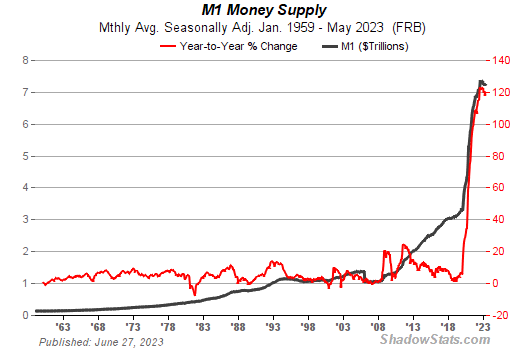
The current model of understanding is broken. To issue money nothing has to be created, therefore if one issues money whilst wealth creation stands still one appropriates some of the total wealth through inflation.

Before if you wanted more money you had to have more gold reserves, or the govt/central bank had to lower the exchange rate.

> http://www.econlib.org/library/Enc/GoldStandard.html

Because new production of gold would add only a small fraction to the accumulated stock, and because the authorities guaranteed free convertibility of gold into nongold money, the gold standard ensured that the money supply, and hence the price level, would not vary much.

http://www.shadowstats.com/imgs/charts/m1.gif

Again the boe blog from above:

> the availability of central bank reserves does not constitute a limit to lending and deposit creation

Private banks decide how much land costs. And they always lend as much as they can, so land will always be as much as people can possibly pay. This means that no amount of efficiency gains will ever improve life. All you will see is inflation and people who bought just before the jump have a gain, but again the next batch are pushed into servitude. Because we haven't had a big step-change in efficiency for a couple of decades (and in part because it's not passed on due to globalisation / migration) it's misery all round, unless you are a usurer.
Re: Barely Half of 30-Year-Olds in the U.S. Earn More Than Their Parents Did at 30

#367

Compound that with the percentage of income 30 year olds spend on housing, education, health care and child care compared to their parents and we have a recipe for disaster.

The sense of entitlement is a lot higher these days. I grew up in a 900 sqft house with 1 bathroom. Yet all my peers (myself included) seek out homes 2x, 3x or bigger. Same with cars.... my parents bought used, reliable cars. Today we want fancy things. Growing up we had cable tv and a phone line. Probably spent $50/month total. The family cellphone bill, home broadband, various tv services easily top out over $300/m…

This logic is flawed in the sense of completely misunderstanding of "progress".

Sure, the 900sqft home argument might be somewhat valid. But in the majority of the situations I've seen, it's the opposite happening. So I'd challenge this one for sure.

As for the cable TV and phone line... Yea. There is something called technological progress. We have more services today because that's the world we live in, a connected world, where work and personal lives merge and access to the internet is paramount.

Your parents bought used reliable cars, great, people still do. But cars are relatively cheaper/easier to produce as well. Are you going to say the same thing when the next generation "rents" car rides as their monthly expense?

Eating out... yep. People eat out more. It's more efficient and frankly cheaper in some scenarios. That's not always the case, but often is. And in larger cities where kitchens are absolutely tiny, cooking is not only inefficient, but sometimes not even possible. So, I'd challenge this as a misunderstanding of the times - again.

Where money is spent vs how it's earned and the cost of living play into all of this. And just because the allocations aren't the same, the idea that it should be attributed to "entitlement" simply puts you on the "out of touch" spectrum.

Good day.

Re: Barely Half of 30-Year-Olds in the U.S. Earn More Than Their Parents Did at 30

#368

Earlier quoted context omitted.

I may be reading too much into what you are getting at with your second question, but: What does it even mean to draw that distinction in this context? Our current state is already a forceful one (as would be any other distribution of claims with any real power of enforcement). Wealth, like anything else, is ultimately enforced by, er, force. (E.g.: What is it for you to own land? It's the ability to have me forceful…

The people having their money removed from them may have a word or two to say about the plan.

Everyone may have a word or two to say about every aspect of how society is run; such is democratic politics. But you speak as though the amount of money someone is construed as having is a physical quality intrinsic to them, instead of a social relation we agree to. The idea that taxation is a taking imposed after the fact on an otherwise natural distribution is muddled; it's all just numbers in ledgers, the tokens of a game whose rules are chosen by society in the first place.

Re: Barely Half of 30-Year-Olds in the U.S. Earn More Than Their Parents Did at 30

#369

Earlier quoted context omitted.

I think you are talking about fractional-reserve banking, which has been around for hundreds of years. This can exist with or without a gold standard.

Nope, read the bank of england blog above. > While money is essential to facilitating purchases and sales of real resources outside the banking system, it is not itself a physical resource, and can be created at near zero cost. > The fact that banks technically face no limits to instantaneously increasing the stocks of loans and deposits does not, of course, mean that they do not face other limits to doing so. But th…

Of course a gold standard would limit the creation of money, but the ability of banks to increase the money supply would still exist under fractional-reserve banking.

https://en.wikipedia.org/wiki/Fractional-reserve_banking

Re: Barely Half of 30-Year-Olds in the U.S. Earn More Than Their Parents Did at 30

#370

Earlier quoted context omitted.

I may be reading too much into what you are getting at with your second question, but: What does it even mean to draw that distinction in this context? Our current state is already a forceful one (as would be any other distribution of claims with any real power of enforcement). Wealth, like anything else, is ultimately enforced by, er, force. (E.g.: What is it for you to own land? It's the ability to have me forceful…

The people having their money removed from them may have a word or two to say about the plan.

The people barely scraping by with no rest to look forward to may have a word or two to say about the status quo.
Post reply on HN