Live data from Hacker News

OpenAstroTracker: A cheap 3D-printed tracking mount for DSLR astrophotography

github.com

31–37 of 37 posts

Re: OpenAstroTracker: A cheap 3D-printed tracking mount for DSLR astrophotography

#31

Earlier quoted context omitted.

Surely in camera, it is just a matter of taking a shot, wait an interval, take another shot, then shift/rotate the two images until X number of bright spots line up and then form a new composite, rinse and repeat. If you have a motor in the camera for stabilising you can use that shift/rotate parameter to move the sensor for the next shot.

Modern cameras can physically move the sensor inside the camera. It is called IBIS or In Body Image Stabilization. Taking one long exposure I imagine would better pick up on faint sources of light compared to multiple short exposures.

> Taking one long exposure I imagine would better pick up on faint sources of light compared to multiple short exposures.

You definitely need an exposure long enough for the light sources to actually show up on the image. But beyond that point, sometimes you can do better by taking lots of separate exposures: https://en.wikipedia.org/wiki/Lucky_imaging Really depends on what the limiting factor is in your imaging system. For cheap consumer cameras, sensor sensitivity is more of an issue than atmospheric fluctuations, so longer exposures are usually better.
Re: OpenAstroTracker: A cheap 3D-printed tracking mount for DSLR astrophotography

#33
post #32
post #22

Tried to find some mechanical data on this and couldn't :( . What's the size of it, what's the working speed of motors?..

literally everything is on the website.

If that information is there, it's definitely not easy to find. Can you share a link?

Re: OpenAstroTracker: A cheap 3D-printed tracking mount for DSLR astrophotography

#34
post #33
post #32

Earlier quoted context omitted.

literally everything is on the website.

If that information is there, it's definitely not easy to find. Can you share a link?

Your questions are: how big is it and what are the working speeds of the motors.

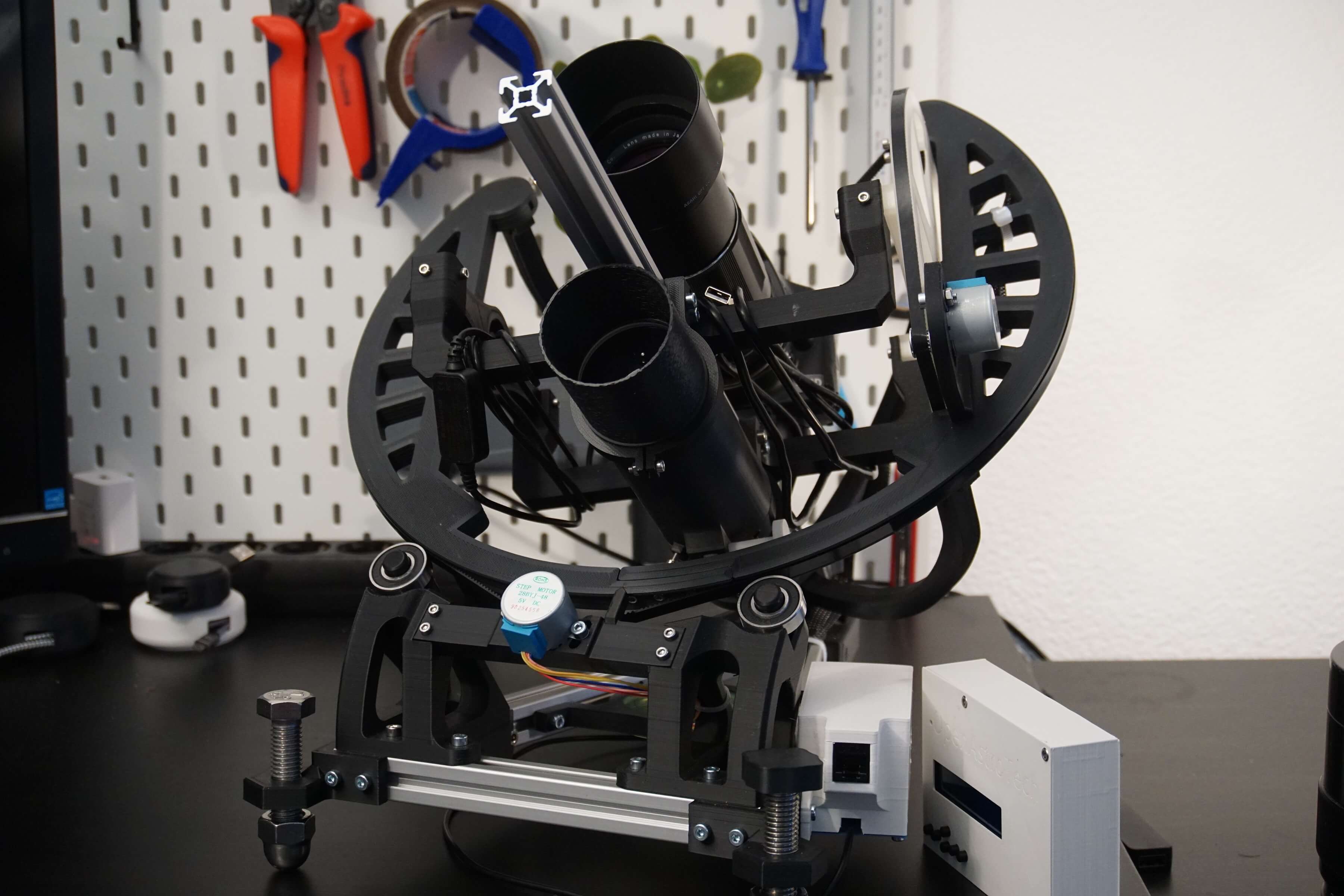
It is this big: https://wiki.openastrotech.com/alu-oat.jpg but if you need more accurate dimensions: https://wiki.openastrotech.com/en/OpenAstroTracker/Printing (select the appropriate parts aand look at their dimensions in a 3D STL viewer. Those are in millimeters) and then look at the youtube video where you can see it in context.

The motors: the working speed of the motor is identical to the speeds required to keep the scope aligned. For one of the axes, that means it causes the system to do a full 360 rotatation every 24h. Steppers (both the small kind and the big kind) can work at 1500RPM but this is irrelevant- we care much more about precise small movements.

Re: OpenAstroTracker: A cheap 3D-printed tracking mount for DSLR astrophotography

#36
post #34
post #33

Earlier quoted context omitted.

If that information is there, it's definitely not easy to find. Can you share a link?

Your questions are: how big is it and what are the working speeds of the motors. It is this big: https://wiki.openastrotech.com/alu-oat.jpg but if you need more accurate dimensions: https://wiki.openastrotech.com/en/OpenAstroTracker/Printing (select the appropriate parts aand look at their dimensions in a 3D STL viewer. Those are in millimeters) and then look at the youtube video where you can see it in context. The…

Thank you very much; I was hoping for some more direct answers, e.g. diameter of the ring is 400 mm and speed of rotation is up to 15 RPM. I'd like to do something significantly different with this design (outside of astro-photography, so different properties and ranges are relevant) and was interested in existing capabilities.

I saw the video and knew approximate values, I just wanted to see explicit specs - like blueprints for parts with sizes, or capabilities of motor-belt-ring coupling.

Re: OpenAstroTracker: A cheap 3D-printed tracking mount for DSLR astrophotography

#37
post #36
post #34

Earlier quoted context omitted.

Your questions are: how big is it and what are the working speeds of the motors. It is this big: https://wiki.openastrotech.com/alu-oat.jpg but if you need more accurate dimensions: https://wiki.openastrotech.com/en/OpenAstroTracker/Printing (select the appropriate parts aand look at their dimensions in a 3D STL viewer. Those are in millimeters) and then look at the youtube video where you can see it in context. The…

Thank you very much; I was hoping for some more direct answers, e.g. diameter of the ring is 400 mm and speed of rotation is up to 15 RPM. I'd like to do something significantly different with this design (outside of astro-photography, so different properties and ranges are relevant) and was interested in existing capabilities. I saw the video and knew approximate values, I just wanted to see explicit specs - like bl…

you don't want this design for non-astrophotography. Much of the design is centered around rotating the imaging device in sync with the rotation of the earth so you can take exdtremely long exposures.

Instead, you probably want something like this: https://www.bhphotovideo.com/c/product/689699-REG/Giga_Pan_E...

There aren't "blueprints" but the STL files for the printed parts and the assembly provide the same information.

Motor belt couplings like this are pretty well understood, mainly within the context of moving XY stages for 3D printers, but also in the larger context of industrial movement. Unfortunately, I don't think all of that is really documented in a way that is useful for people who aren't willing to invest significant effort into learning how to work with 3D printers, etc (or get a degree in mechanical engineering).

Post reply on HN