Earlier quoted context omitted.
> Because a mirror doesn't reverse anything. Well, a mirror gives you a different picture than a webcam and a computer screen (unless the webcam software flips the picture along the x axis). Now why is that, that the software needs to flip along the x axis? It is actually because a mirror mirrors around the the z axis, so it switches front and back.
It's the webcam that is flipped.
The case for, and against, the still-unseen Planet 9
31–40 of 40 posts
Re: The case for, and against, the still-unseen Planet 9
#32Earlier quoted context omitted.
Why does a mirror reverse left and right, but not up and down? and does it have something to do with us having two eyes?
Physics girl explains it well: https://m.youtube.com/watch?v=vBpxhfBlVLU
Re: The case for, and against, the still-unseen Planet 9
#33I love that this is still a topic-- along with 'is glass a fluid', this is one of the few questions I recall from childhood that turns out to still be relevant serious physics. (Re 'is glass a fluid', my condensed matter professor said something like 'if it is, it flows too slowly to observe significant movement in the lifetime of the universe'.)
Why does a mirror reverse left and right, but not up and down? and does it have something to do with us having two eyes?
Re: The case for, and against, the still-unseen Planet 9
#34Earlier quoted context omitted.
Physics girl explains it well: https://m.youtube.com/watch?v=vBpxhfBlVLU
This explanation makes sense to me until (as seppel mentioned below) I think of a webcam. A webcam (minus any software) isn’t flipped at all—but looks like a mirror if you flip it along the x axis, as many programs do by default.
How did you turn the camera?
You could have turned it towards you by turning it bottom over top and then you would have to vertically flip the image, but you probably would have never even thought to do it.
So instead you chose to turn it left to right so to get a mirror image you have to flip the pixels left to right.
You’re human so flipping a camera upside down seems quite silly but that’s just an artifact of your environment.
Re: The case for, and against, the still-unseen Planet 9
#35Re: The case for, and against, the still-unseen Planet 9
#36Earlier quoted context omitted.
I think your counting's off: if you want to count dwarfs then Ceres would be "Planet 5", in which case "Planet 9" would be Neptune most of the time, since only a small part of Pluto's orbit crosses inside Neptune's. Pluto's number would also depend on the current location of at least Quaoar, Haumea and Makemake, since I know their orbits cross inside Pluto's. Pluto may also swap numbers over time with others, like Se…
Pluto is an order of magnitude larger than Ceres, so its perfectly possible to define planet in such a way that pluto is a planet and ceres is not.
Re: The case for, and against, the still-unseen Planet 9
#37Earlier quoted context omitted.
The software of the webcam usually flips the video, so that it looks like a mirror to you.
That's not true, that would mean that webcam video by default would flip any writing and make it unreadable.
That is exactly what happens if I open Facetime on my Mac and hold something in the camera.
To be a bit more precise: There are two streams generated. One is shown to yourself, and this one works like a mirror. The other one is shown to remote participants and this one is not flipped.
Re: The case for, and against, the still-unseen Planet 9
#38Earlier quoted context omitted.
The software of the webcam usually flips the video, so that it looks like a mirror to you.
That's not true, that would mean that webcam video by default would flip any writing and make it unreadable.
Re: The case for, and against, the still-unseen Planet 9
#39Earlier quoted context omitted.
Pluto is an order of magnitude larger than Ceres, so its perfectly possible to define planet in such a way that pluto is a planet and ceres is not.
This is what I was thinking. Setting the minimum size to 2000Km diameter, and excluding satellites/mooons, we'd just have had to add one planet, if my reading is correct.
- Eris is more massive than Pluto (1.6e22kg versus Pluto's 1.3e22kg)
- Eris is only slightly smaller than Pluto, at 2326km diameter (more than your arbitrary 2000km cutoff)
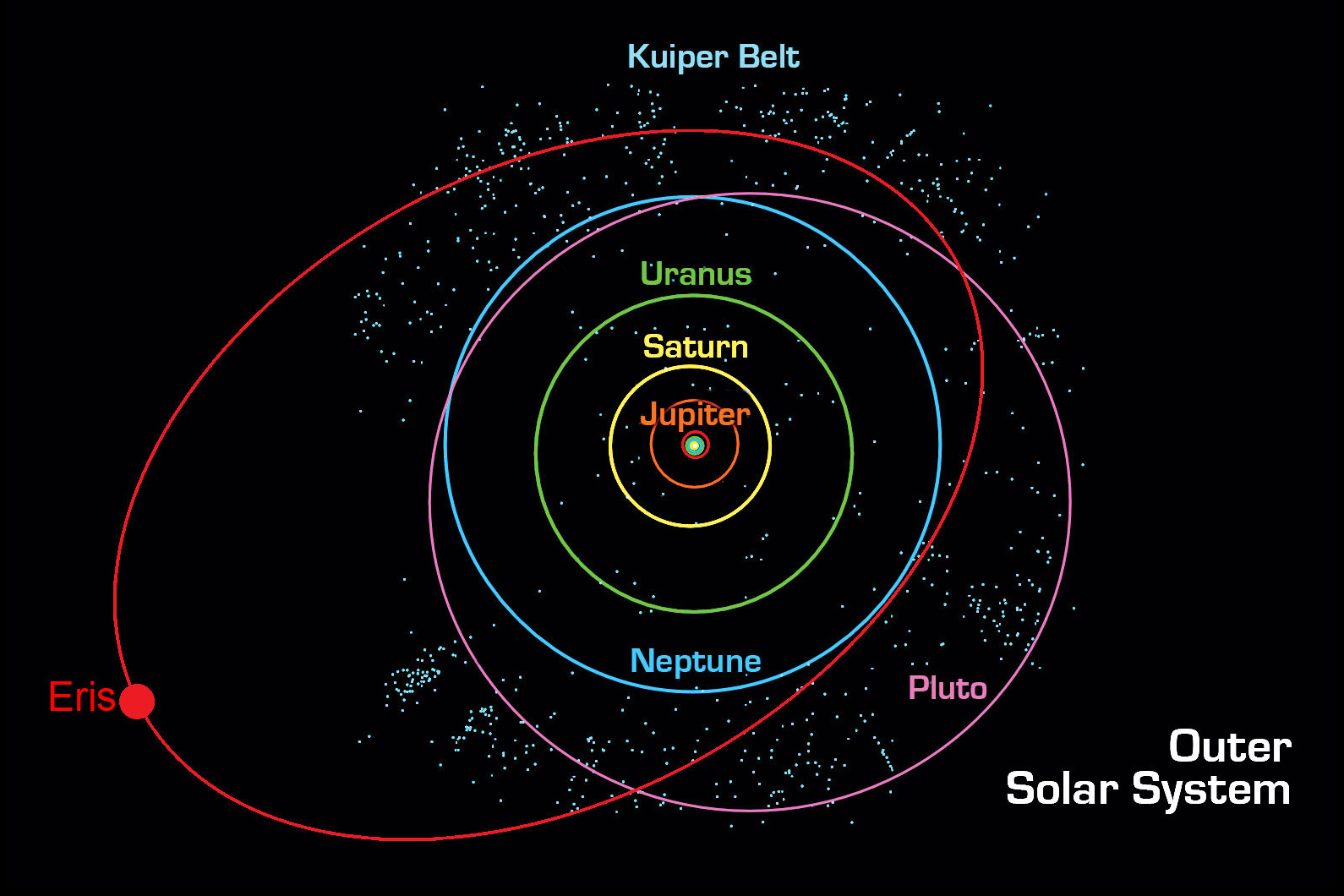
- The orbit of Eris crosses Pluto's, so it may be closer to the Sun part of the time https://solarstory.net/img/articles/big/orbit-of-eris.jpg
Re: The case for, and against, the still-unseen Planet 9
#40Earlier quoted context omitted.
This is what I was thinking. Setting the minimum size to 2000Km diameter, and excluding satellites/mooons, we'd just have had to add one planet, if my reading is correct.
It's hard to justify counting Pluto without counting Eris: - Eris is more massive than Pluto (1.6e22kg versus Pluto's 1.3e22kg) - Eris is only slightly smaller than Pluto, at 2326km diameter (more than your arbitrary 2000km cutoff) - The orbit of Eris crosses Pluto's, so it may be closer to the Sun part of the time https://solarstory.net/img/articles/big/orbit-of-eris.jpg
On reread that probably wasn't clear, since I still think of Pluto as a planet.