Live data from Hacker News

Tesla battery researcher unveils new cell that could last 1M miles

electrek.co

31–40 of 78 posts

Re: Tesla battery researcher unveils new cell that could last 1M miles

#31
post #30
post #27

Can anyone tell whether this is a solid state electrolyte? I’m still hooked on what I saw in that Netflix documentary where the guy was able to cut and puncture the battery without combustion. Also seemed capable of being much more dense.

It is not. This is a fairly conventional cell, with a different crystal structure for one of the ingredients, and a tweaked mix of liquid electrolytes. The most important part of this paper is that they actually prove that optimizing for cycle and calendar life can have such incredible effects.

Will we end up with seasonal battery's? Many already accustomed to switching tiers in winter. Whilst temperature management of batteries would cover many aspects, some locations a better tuned battery would make it more efficient overall perhaps.

EDIT [s/riers/tires/;sleep]
Re: Tesla battery researcher unveils new cell that could last 1M miles

#32
post #24

This is very exciting. BEVs that were made before 2016 (I think that was when the last breakthrough trickled down to BEVs in the market) typically had a battery lifetime of about 70k miles or maybe a bit more before reaching 70% capacity. Fast-charging regularly might reduce capacity by several percent points within a few hot summer months. Basically, you bought a car for €30k and it might become useless 5-7 years la…

I think that was mainly due to early EVs having low battery capacities in general (because batteries cost a lot more then) so daily commuting would cycle them much more deeply than current high-capacity models. This 2017 article[1] shows battery life data for hundreds of Tesla Model S's (which have always come with large-capacity batteries). One of the highest-mileage cars in their data pool had just over 220k km (137k mi) on its battery with 90% of the original capacity remaining. There are also a few outliers with under 100k km that are below 90% capacity, I suspect those are cars that have been subject to a lot of long drives and supercharging.

[1] https://www.greencarreports.com/news/1110149_tesla-model-s-b...

Re: Tesla battery researcher unveils new cell that could last 1M miles

#33
post #5

Earlier quoted context omitted.

The GP is correct and not just being pedantic. This is just click bait. A battery (life)range is degraded (mostly) by (dis)charging speed, average discharge level and ambient heat. The bigger the battery, the less strain on each cell, and hence longer life time. I hope tesla is improving its battery, but this title is really bad.

This just needs some context to make sense, and when you add in the "in robot taxis" that is on the original article, that makes a very sensical context: a vehicle that can carry people. All language requires these sorts of assumptions; its implicit in pretty much every sentence. For most people, they will understand what is meant very quickly. Could it be better? Sure. But the question is better for whom, and with w…

>All language requires these sorts of assumptions; its implicit in pretty much every sentence. For most people, they will understand what is meant very quickly.

I have a snarky saying that no matter how clear you make yourself, someone can always misunderstand you if they really want to.

Re: Tesla battery researcher unveils new cell that could last 1M miles

#34

Earlier quoted context omitted.

Nothing here indicates a discharge rate. I'm having trouble finding the actual wattage produced by these cells over the 6 hour discharge time. Also, 6 hours is a longer than the current Tesla will run full charge at highway speeds (350 mile range, 75 mph ~= 4.5 hours). Plus, the current tesla can be re-charged and continue to operate, conditions I don't see mentioned. If it is similar to existing batteries though...…

"Nothing here indicates a discharge rate." In battery terminology, and this paper, charge/discharge rate is referred to as "C". Charging or discharging at 1C means a battery would be fully charged/discharged in 1 hour. A 100 Wh cell discharging at 1C would produce 100 W. Likewise, at 3C it would take 20 minutes and produce 300 W. At C/3, it would take 3 hours.

Are charge and discharge rate usually equal?

Re: Tesla battery researcher unveils new cell that could last 1M miles

#36
post #9

Earlier quoted context omitted.

Okay there you're becoming too Aspergers and literal about language.

> becoming too Aspergers Why did you think it necessary to gauge GP's comment on a scale measuring how likely it could have come from someone with what is considered a mental disorder? You could have easily omitted that phrase and the post would have conveyed the same meaning. Here, you’ve either a) derided the non-malicious, involuntary behavior of a group of people, or b) tactlessly called out GP for being a member…

"Don't feed egregious comments by replying; flag them instead."

https://news.ycombinator.com/newsguidelines.html

Re: Tesla battery researcher unveils new cell that could last 1M miles

#38
post #5

Earlier quoted context omitted.

Okay there you're becoming too Aspergers and literal about language.

The GP is correct and not just being pedantic. This is just click bait. A battery (life)range is degraded (mostly) by (dis)charging speed, average discharge level and ambient heat. The bigger the battery, the less strain on each cell, and hence longer life time. I hope tesla is improving its battery, but this title is really bad.

> The GP is correct and not just being pedantic.

>> Any battery can last one million miles if it's just sitting on a seat in a vehicle.

Snark or pedantry? I say both.

Re: Tesla battery researcher unveils new cell that could last 1M miles

#39
post #12

Earlier quoted context omitted.

> Um, that is cheating. Running any battery at less than capacity will extend its life. You could put two batteries in the car, run them at 50% or alternate between them, and get double the life. No prizes for that. Don't phones already do this? (IE: 100% is not really 100%, 0% is not really 0%.) I don't see it as cheating, it's akin to the practical limit vs. the actual limit

Many laptops do it too. Lenovo even markets it as a visible (and annoying) power management feature. Most however simply handle the charge cycles behind the scenes, and adjust their definition of "100%" over time, so the user can remain blissfully unaware (and less likely to change the setting). I don't mind this really. Batteries degrade over time; that's kinda just how they work, and I'd much rather have 100% mean…

> Lenovo even markets it as a visible (and annoying) power management feature.

I wish macOS/Windows allowed this natively. I'm travelling this week with my Macbook, but it's been docked for the past couple months at 100% charge. Would be better for the battery if I could keep it at 60% charge until I plan on travelling.

Re: Tesla battery researcher unveils new cell that could last 1M miles

#40
post #26

Earlier quoted context omitted.

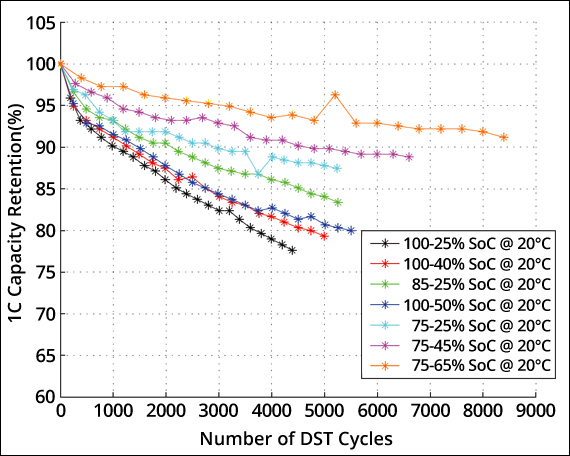
Would this be a correct summary of the paper? 1) eliminates Cobalt 2) improves energy density (more range) 3) faster charge rate 4) less SOC (state of charge) swing, meaning less cost & weight 4) 5x longer lifespan

what is 'state of charge swing'?

I think it is referring to the fact that it is ubiquitous to leave some amount of reserve so that the battery is never fully charged (100% SoC) or discharged (0% SoC). This formulation is capable of going the full 0-100%, while most formulations will last significantly longer if they don't do that.[1] In that graph, charging to 75% and discharging to 25% gives you about 3x more life than from 25%-100%.

NB that most li-ion cells are rated for 300-1000 cycles at 100% Depth of Discharge. Reducing the DoD to 90% or 80% will get you thousands or tens of thousands of cycles, although it is abnormal to actually measure that long. A charge-discharge cycle at .1 C (the former standard) takes 20 hours.

[1]: https://batteryuniversity.com/_img/content/DST-cycles-web2.j...

Post reply on HN