Live data from Hacker News

Tesla battery researcher unveils new cell that could last 1M miles

electrek.co

11–20 of 78 posts

Re: Tesla battery researcher unveils new cell that could last 1M miles

#11

>> The new battery tested is a Li-Ion battery cell with a next-generation “single crystal” NMC cathode and a new advanced electrolyte. If this is anything like growing single-crystal parts for aircraft, it won't be cheap. The real question should be whether these new battery modules will last twice as long while remaining less than twice as expensive. >> Controlling the charge to less than 100% state-of-charge also h…

They tested it to 100% DOD (Depth of Discharge) over 5000 cycles;

https://electrek.co/wp-content/uploads/sites/3/2019/09/Scree...
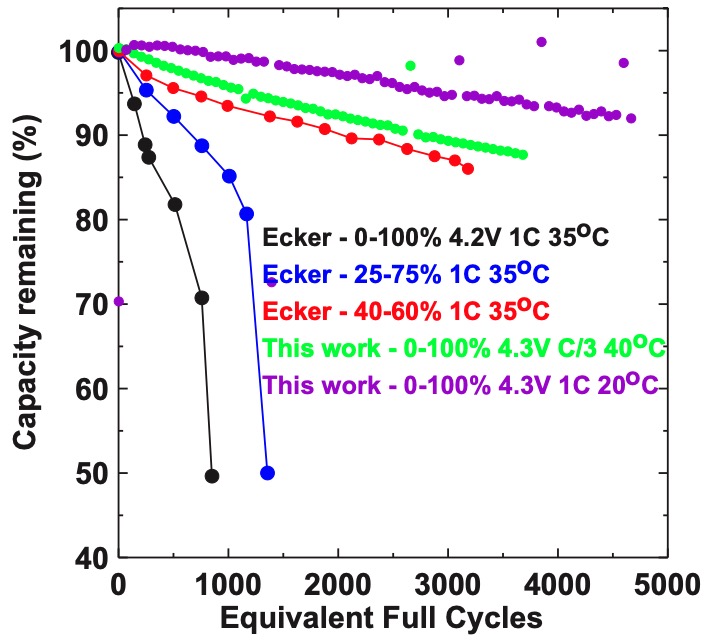
Re: Tesla battery researcher unveils new cell that could last 1M miles

#12

>> The new battery tested is a Li-Ion battery cell with a next-generation “single crystal” NMC cathode and a new advanced electrolyte. If this is anything like growing single-crystal parts for aircraft, it won't be cheap. The real question should be whether these new battery modules will last twice as long while remaining less than twice as expensive. >> Controlling the charge to less than 100% state-of-charge also h…

> Um, that is cheating. Running any battery at less than capacity will extend its life. You could put two batteries in the car, run them at 50% or alternate between them, and get double the life. No prizes for that.

Don't phones already do this? (IE: 100% is not really 100%, 0% is not really 0%.)

I don't see it as cheating, it's akin to the practical limit vs. the actual limit

Re: Tesla battery researcher unveils new cell that could last 1M miles

#13

>> The new battery tested is a Li-Ion battery cell with a next-generation “single crystal” NMC cathode and a new advanced electrolyte. If this is anything like growing single-crystal parts for aircraft, it won't be cheap. The real question should be whether these new battery modules will last twice as long while remaining less than twice as expensive. >> Controlling the charge to less than 100% state-of-charge also h…

> >> Controlling the charge to less than 100% state-of-charge also helps push the longevity.

> Um, that is cheating. Running any battery at less than capacity will extend its life. You could put two batteries in the car, run them at 50% or alternate between them, and get double the life. No prizes for that.

I imagine the idea is that by going to X% instead of 100% fill, you extend by more than 1/X. So at 95%, perhaps we gain 20% life instead of the expected, 1/.95 ~= 1.05 -> extra 5% life.

Re: Tesla battery researcher unveils new cell that could last 1M miles

#14
post #12

>> The new battery tested is a Li-Ion battery cell with a next-generation “single crystal” NMC cathode and a new advanced electrolyte. If this is anything like growing single-crystal parts for aircraft, it won't be cheap. The real question should be whether these new battery modules will last twice as long while remaining less than twice as expensive. >> Controlling the charge to less than 100% state-of-charge also h…

> Um, that is cheating. Running any battery at less than capacity will extend its life. You could put two batteries in the car, run them at 50% or alternate between them, and get double the life. No prizes for that. Don't phones already do this? (IE: 100% is not really 100%, 0% is not really 0%.) I don't see it as cheating, it's akin to the practical limit vs. the actual limit

They do, but they don't claim this as any sort of advancement of battery technology. It's batteries 101.

Re: Tesla battery researcher unveils new cell that could last 1M miles

#15
post #5

Earlier quoted context omitted.

The GP is correct and not just being pedantic. This is just click bait. A battery (life)range is degraded (mostly) by (dis)charging speed, average discharge level and ambient heat. The bigger the battery, the less strain on each cell, and hence longer life time. I hope tesla is improving its battery, but this title is really bad.

This just needs some context to make sense, and when you add in the "in robot taxis" that is on the original article, that makes a very sensical context: a vehicle that can carry people. All language requires these sorts of assumptions; its implicit in pretty much every sentence. For most people, they will understand what is meant very quickly. Could it be better? Sure. But the question is better for whom, and with w…

The robo-taxi connotation is even worse.

Any robo-taxi can be programmed to drive like a grand-ma to improve battery life. The cost of a x2 battery size is easier to amortize. Its life time can be managed and optimized with ML.

And yes - it can get the greatest and latest battery chemistry.

At this stage - we just dont need a "battery miracle" or a Musk-moonshot (trade-mark?) for passenger EVs.

Re: Tesla battery researcher unveils new cell that could last 1M miles

#16

"Miles per battery" is possibly the stupidest metric to use to describe a battery capacity. Any battery can last one million miles if it's just sitting on a seat in a vehicle.

I think it's the best metrics I've seen in a while.

"For usage where our previous battery gets 300,000 - 500,000 miles, this gets a million miles". It's a real world number.

Re: Tesla battery researcher unveils new cell that could last 1M miles

#17

>> The new battery tested is a Li-Ion battery cell with a next-generation “single crystal” NMC cathode and a new advanced electrolyte. If this is anything like growing single-crystal parts for aircraft, it won't be cheap. The real question should be whether these new battery modules will last twice as long while remaining less than twice as expensive. >> Controlling the charge to less than 100% state-of-charge also h…

Who would have thought that microchips would become so cheap? And they are built on silicon crystals. The economies of scale for batteries for cars, phones, computers, will kick in in a way that they don’t for aerospace. Car or phone battery tech will end up in airplanes!

Re: Tesla battery researcher unveils new cell that could last 1M miles

#18
post #12

>> The new battery tested is a Li-Ion battery cell with a next-generation “single crystal” NMC cathode and a new advanced electrolyte. If this is anything like growing single-crystal parts for aircraft, it won't be cheap. The real question should be whether these new battery modules will last twice as long while remaining less than twice as expensive. >> Controlling the charge to less than 100% state-of-charge also h…

> Um, that is cheating. Running any battery at less than capacity will extend its life. You could put two batteries in the car, run them at 50% or alternate between them, and get double the life. No prizes for that. Don't phones already do this? (IE: 100% is not really 100%, 0% is not really 0%.) I don't see it as cheating, it's akin to the practical limit vs. the actual limit

Many laptops do it too. Lenovo even markets it as a visible (and annoying) power management feature. Most however simply handle the charge cycles behind the scenes, and adjust their definition of "100%" over time, so the user can remain blissfully unaware (and less likely to change the setting).

I don't mind this really. Batteries degrade over time; that's kinda just how they work, and I'd much rather have 100% mean "my device is done charging" and 0% mean "my device can no longer run." The specifics of what voltage or charge level or whatever actually translates to those numbers is not important, and honestly the battery / laptop manufacturer probably knows the right settings for those better than I ever will, so it's fine.

Re: Tesla battery researcher unveils new cell that could last 1M miles

#19
post #15

Earlier quoted context omitted.

This just needs some context to make sense, and when you add in the "in robot taxis" that is on the original article, that makes a very sensical context: a vehicle that can carry people. All language requires these sorts of assumptions; its implicit in pretty much every sentence. For most people, they will understand what is meant very quickly. Could it be better? Sure. But the question is better for whom, and with w…

The robo-taxi connotation is even worse. Any robo-taxi can be programmed to drive like a grand-ma to improve battery life. The cost of a x2 battery size is easier to amortize. Its life time can be managed and optimized with ML. And yes - it can get the greatest and latest battery chemistry. At this stage - we just dont need a "battery miracle" or a Musk-moonshot (trade-mark?) for passenger EVs.

The point of the Robotaxi use case is it presents a very high duty cycle (multiple full charges per day) but with lower maximum range constraints.

So it’s particularly well suited for a chemistry which provides slightly lower density trade-off for double the total lifetime cycles. Similarly for EV buses and trucks.

Better chemistry at lower cost benefits passenger cars but also public transit and grid storage. It’s a multi-hundred-billion if not trillion dollar market overall.

It has nothing particularly to do with “Musk-moonshot” other than Tesla hyping and accelerating the pace of EV mass adoption, which drives a virtuous cycle for battery chemistry investment.

Re: Tesla battery researcher unveils new cell that could last 1M miles

#20
post #10

Post of the actual paper; https://news.ycombinator.com/item?id=20908726 For those commenting that the discharge rate is too slow in the test, or the depth of discharge was fudged... the tests were run with a high discharge rate combined with 100% charge at storage. > Figure 23 shows the projected fractional capacity of these NMC532/graphite cells as a function of time in years in a scenario where the cells are cycled…

Nothing here indicates a discharge rate. I'm having trouble finding the actual wattage produced by these cells over the 6 hour discharge time. Also, 6 hours is a longer than the current Tesla will run full charge at highway speeds (350 mile range, 75 mph ~= 4.5 hours). Plus, the current tesla can be re-charged and continue to operate, conditions I don't see mentioned.

If it is similar to existing batteries though... great!

Post reply on HN