Live data from Hacker News

Nissan Motor Company has announced a new type of gasoline engine

reuters.com

31–40 of 152 posts

Re: Nissan Motor Company has announced a new type of gasoline engine

#31
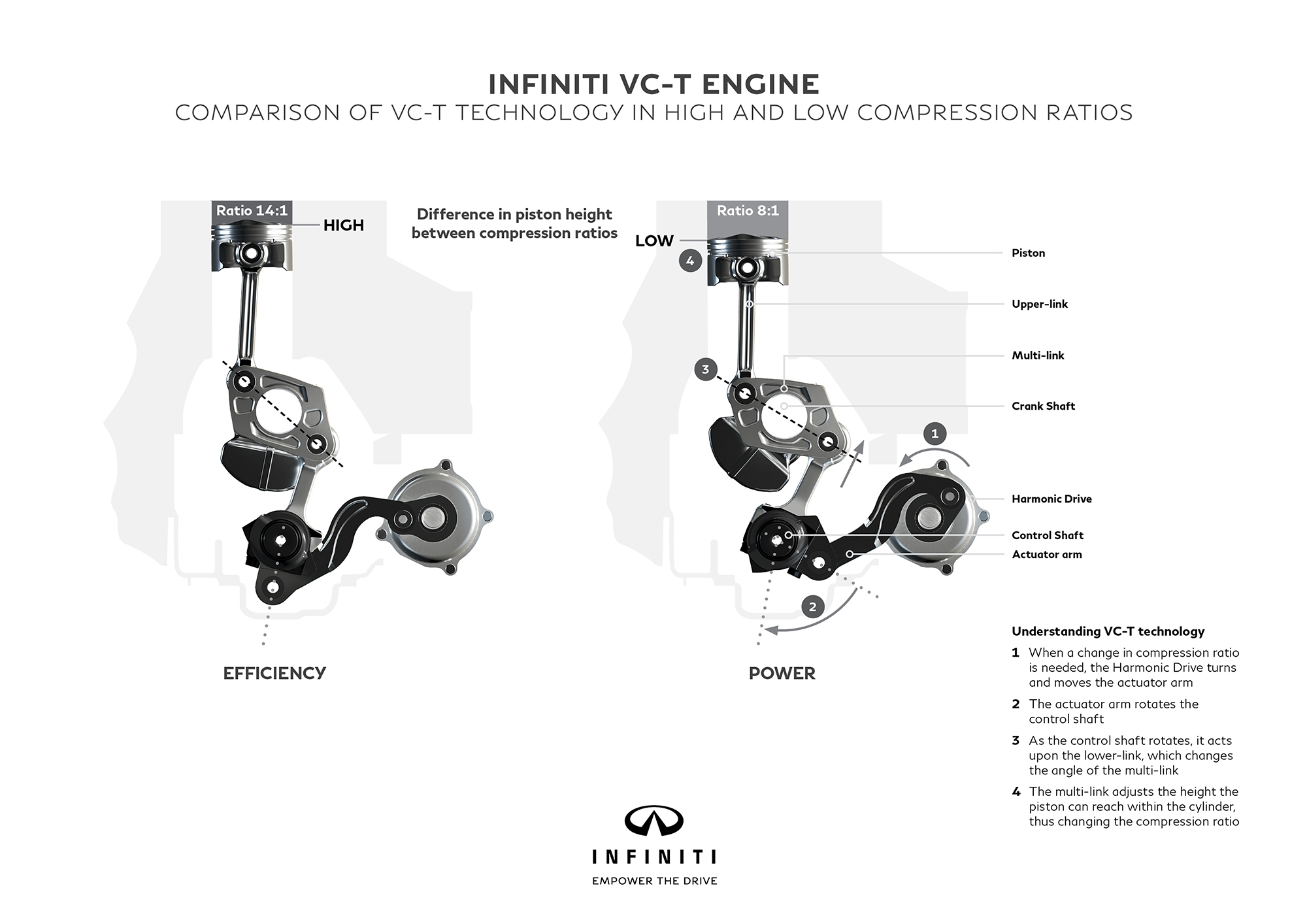
Here is a simple explanation gathered from this image http://o.aolcdn.com/hss/storage/midas/de3e84cf46030cd7b3ea39... :

The difference from a conventional engine is that the engine stroke is increased or decreased automatically. The stroke is the distance the piston travels up and down in order to turn the crankshaft. A shorter distance that is closer to the combustion chamber increases the compression ratio because there is less space for the fuel/air mixture. When the system is operating in low compression mode the piston travels more and does not reach as high. The combustion chamber then ends up being farther away and a lower compression ratio is achieved.

What is novel about this approach is how the combustion chamber was left in the same place. Past efforts by SAAB had the engine head moving the combustion chamber away from the pistons. This drastically changes the characteristics of the combustion process. Something that makes emissions control challenging. Any power loss due to a dynamic combustion chamber is removed by pressurising it with a turbocharger, just like Nissan did.

Possible issues with this design could be:

- Uneven wear of the cylinder bore due to the piston travel being dynamic.

- An overboost condition during a high compression cycle could damage the mechanism and even crack the engine block.

- Increased NHV due to regular wear and tear making its way into the valvetrain and transmission input shaft.

This is a good effort and I hope Nissan is able to pull it off. Make sure to wait two years before you buy a vehicle with this technology. Dont be the guinea pig. :)

Re: Nissan Motor Company has announced a new type of gasoline engine

#32

Earlier quoted context omitted.

The drawback is that higher compression ratios require higher octane fuels. Nissan claims to have solved this by some kind of intelligent feedback system that allows them to control compression ratios on the fly. Presumably the compromise there is that it will require more moving parts, be expensive, and may come with issues of its own. Variability in something like a combustion chamber is a cool idea, so is variabil…

That used to be true, but with modern engine design technique you can get higher than ever compression ratios on standard gas...

There are presumably still limits that this addresses, right? Please correct me if I'm wrong, I'd like to learn.

Re: Nissan Motor Company has announced a new type of gasoline engine

#33
I'm curious as to what, if anything, would preclude variable displacement from being used in diesels as well as petrol engines. Diesels also have performance/economy tradeoffs like this gasoline engines, so it stands to reason that tweaking compression should give similar benefit. I've got a feeling that rumors of diesel's impending demise are greatly exaggerated.

Re: Nissan Motor Company has announced a new type of gasoline engine

#34
Despite claiming they could replace diesels, I don't see any real numbers other than comparisons with their own gasoline engines. For internal combustion engines, the most efficent are still two-stroke diesels, which can have thermal efficiencies of over 50%:

https://en.wikipedia.org/wiki/Brake_specific_fuel_consumptio...

Seeing as this design includes several more moving parts than conventional ones, it's an open question how much reliability and longevity are affected; I remember reading in a book that over the years many have tried to make more efficient engines and succeeded in achieving that goal, only to be let down because of real-world reliability issues.

Re: Nissan Motor Company has announced a new type of gasoline engine

#35

Earlier quoted context omitted.

That used to be true, but with modern engine design technique you can get higher than ever compression ratios on standard gas...

There are presumably still limits that this addresses, right? Please correct me if I'm wrong, I'd like to learn.

I suspect it does two things-

1) lets the engine have high compression AND a turbo. Typically a turbo is run with lower compression, because even today nobody can make an engine run 14:1 with a turbo. Speculating, when you floor it the compression might drop to 8:1 and the turbo kicks in; then when you highway cruise, it runs 14:1 for efficiency.

2) lets the little engine still hit big torque numbers at low speeds. This is most likely if the engine is variable stroke, as longer strokes improve low speed torque.

Re: Nissan Motor Company has announced a new type of gasoline engine

#37

I'm curious as to what, if anything, would preclude variable displacement from being used in diesels as well as petrol engines. Diesels also have performance/economy tradeoffs like this gasoline engines, so it stands to reason that tweaking compression should give similar benefit. I've got a feeling that rumors of diesel's impending demise are greatly exaggerated.

Diesel's fatal flaw is particulate emissions.

Attempts to mitigate those, without cheating (e.g., VW), have proven difficult.

Re: Nissan Motor Company has announced a new type of gasoline engine

#39
post #9

Earlier quoted context omitted.

Variable compression? So logical next step is variable octane, right? One tank of 87 and one tank of 93, dynamically mixed in response to changing compression ratio. :)

not sure if joking or not, but the injection map on your ecu does that.

I think you are incorrect. Most production cars (all that I know) have only a single fuel tank, thus nothing to mix.

Re: Nissan Motor Company has announced a new type of gasoline engine

#40
post #9

Earlier quoted context omitted.

Variable compression? So logical next step is variable octane, right? One tank of 87 and one tank of 93, dynamically mixed in response to changing compression ratio. :)

not sure if joking or not, but the injection map on your ecu does that.

[deleted]
Post reply on HN