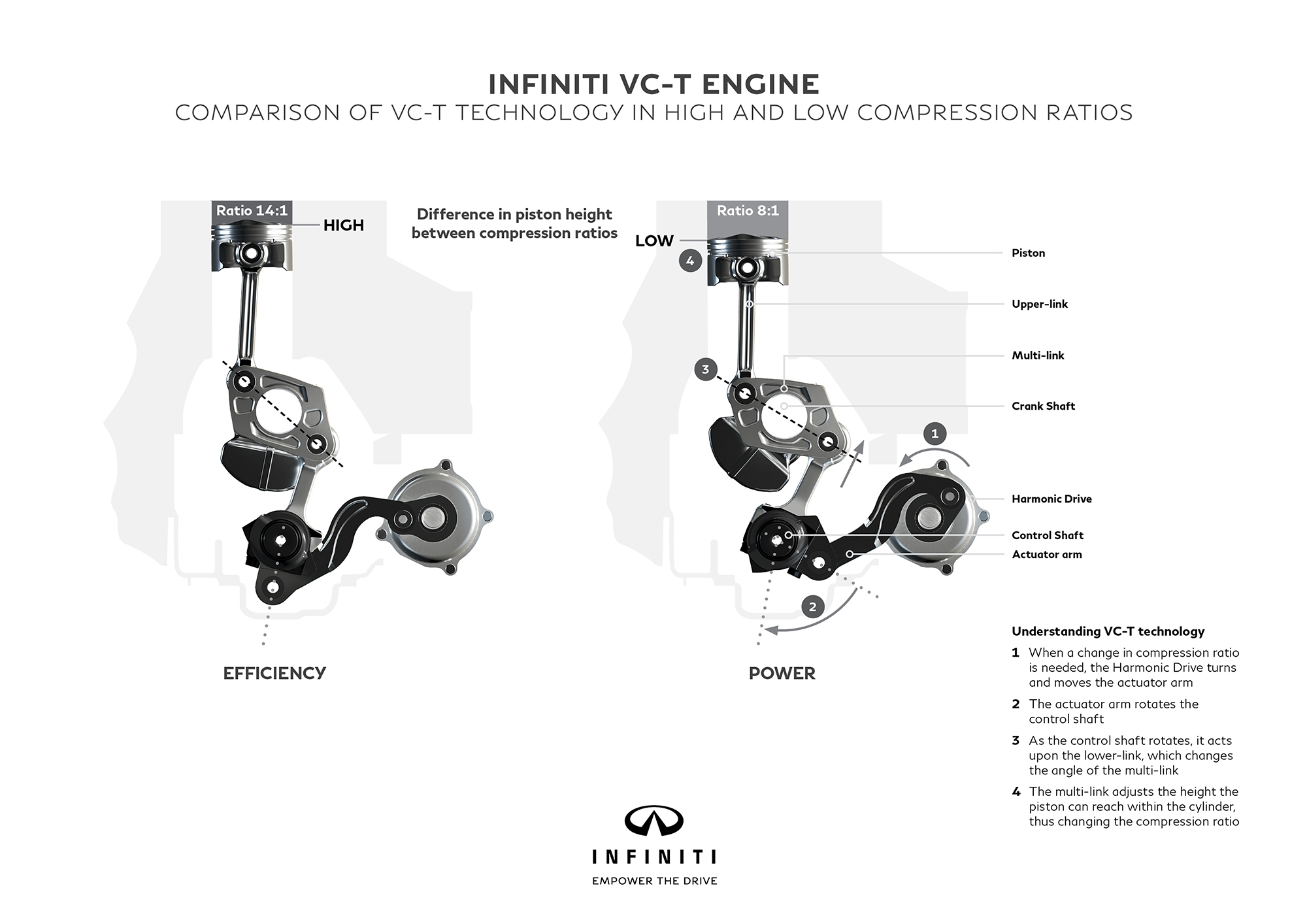
The difference from a conventional engine is that the engine stroke is increased or decreased automatically. The stroke is the distance the piston travels up and down in order to turn the crankshaft. A shorter distance that is closer to the combustion chamber increases the compression ratio because there is less space for the fuel/air mixture. When the system is operating in low compression mode the piston travels more and does not reach as high. The combustion chamber then ends up being farther away and a lower compression ratio is achieved.
What is novel about this approach is how the combustion chamber was left in the same place. Past efforts by SAAB had the engine head moving the combustion chamber away from the pistons. This drastically changes the characteristics of the combustion process. Something that makes emissions control challenging. Any power loss due to a dynamic combustion chamber is removed by pressurising it with a turbocharger, just like Nissan did.
Possible issues with this design could be:
- Uneven wear of the cylinder bore due to the piston travel being dynamic.
- An overboost condition during a high compression cycle could damage the mechanism and even crack the engine block.
- Increased NHV due to regular wear and tear making its way into the valvetrain and transmission input shaft.
This is a good effort and I hope Nissan is able to pull it off. Make sure to wait two years before you buy a vehicle with this technology. Dont be the guinea pig. :)