Live data from Hacker News

Bus stop balancing is fast, cheap, and effective

worksinprogress.co

291–300 of 656 posts

Re: Bus stop balancing is fast, cheap, and effective

#291

How is this not a solved problem already? I'd assume people managing routes do this sort of analysis already. If they don't then sure give this a go in a few places and measure the results. Sounds like its worth a short if we're so off from EU.

We're talking about the US here; they're very good at ignoring solutions to solved problems. See city planning, traffic design, healthcare, zoning, etc. If it's not invented in the US, it can't possibly work there, they claim.

Re: Bus stop balancing is fast, cheap, and effective

#292

Earlier quoted context omitted.

Removing unnecessary bus stops is a prerequisite to making busses fast. You can't run a fast bus service if the bus is stopping every single block.

That optimizes speed, not latency. I don't care how long it takes to get off the bus nearly as much as I care how long it takes to get on .

For a fixed number of busses, the faster the busses are traveling the less time there is between busses.

Re: Bus stop balancing is fast, cheap, and effective

#293
post #230

I'm for all for less bus stops, but how do you make it equitable for people who can't walk longer distances if they are disabled or have an underlying health condition? Run a separate paratransit line?

In European cities this is mitigated by having low-floor buses and stops with level boarding to support mobility scooters and wheelchairs. There are also dedicated taxis available for people with disabilities (possibly subsidised). Over a long term this is also a self-regulating problem. Elderly people and services/businesses for them take into account availability of public transit when choosing properties. Buses ar…

"If you have a congested city"

I would agree with and extend your remarks that we also have problems where traffic patterns and geography don't match political boundaries and transit is traditionally locally run and locally budgeted.

So in the USA you end in scenarios where it takes 20 minutes to drive 20 miles but a bus would take four legs with three transfers across three separate city bus companies, figure at least three hours each way. And again, as per your "mass transit" you can't expect taxpayers in my city to provide a special bus run into my neighboring adjacent city much less the city next to that one.

This results in people being very happy indeed to pay the financial and environmental costs of car ownership to avoid sitting in a bus for six hours of daily commute.

There are also interesting social issues; if you're late its a personal failing, even if you take mass transit. I recall a friend at work getting fired because the bus was late too many times. Oh well, should have bought a car. The feeling of not being in control is further worse due to crime rates. No one will sneak up on my wife and stab her in the neck in her car, but it certainly happens on buses and no one cares if it happens depending on local race relations. None of the other passengers on the bus even cared, for racial reasons. Its pretty messed up here.

Its easy for the public in general to advise others to do inconvenient or career ending or life threatening activities, to "save the planet" or whatever, but I wouldn't do it, and I'd certainly never let my wife or kids do it, so we own cars and avoid public transit at all costs. Not taking that advice as been pretty nice so far.
Re: Bus stop balancing is fast, cheap, and effective

#294

Earlier quoted context omitted.

Maybe it goes without saying, but the reason you don’t mind the bus in Europe is not because you are European but because the European buses are nicer. The things you say about noise and pollution are also true in the US, and American drivers are acutely aware of them. But the alternative is not a European bus, so people drive.

>> Maybe it goes without saying, but the reason you don’t mind the bus in Europe is not because you are European but because the European buses are nicer. Actually I think it is both. Car culture in Europe is nowhere as dominant as it is in the US. Many Europeans grow up with public transportation as the default mode of getting around. So they are more likely to be accustomed to things that become grievances for Amer…

There's an intimidation factor that a lot of Americans won't quickly admit to when it comes to taking the bus. They don't know if they can tap with their phone to pay, if they need cash, if they can use change, if they need exact cash/change, if they need a specific transit card etc. They don't know the etiquette for asking to get off the bus and sometimes it varies by bus design. They don't know the routes or the time schedules and find it confusing and overwhelming and often have a low tolerance for the embarrassment that can come with publicly learning something.

Re: Bus stop balancing is fast, cheap, and effective

#295
post #256
post #205

Earlier quoted context omitted.

> I'm personally able to walk a block or two further “A block or 2” each way at the start and destination is a significant difference (4-8 blocks) for most elderly people. Busses fill two different roles, as primary means of transportation and arguably more importantly as a backup means of transportation. They can serve a vital role for cities without the kind of investment it would take to make most typical HN reade…

> as primary means of transportation and arguably more importantly as a backup means of transportation One bus route can't wear two hats. Faster, sparser routes are typically complemented by slow, meandering collector routes which provide the kind of backstop you describe. Moreover, elderly and disabled people can use paratransit [1], which exists precisely to serve people with mobility issues too severe for regular…

Around 1/5 of the US population is elderly ~1/4 by 2050, add in moderately disabled people and this isn’t a small population we are talking about.

Paratransit is for a far smaller percentage of the population due to the significant expense.

Re: Bus stop balancing is fast, cheap, and effective

#296

I believe the central thesis of this article is unsupported, and other assertions are false. One, the article asserts that too many stops is the main cause of low ridership in the US. I didn’t even see a correlation (which would still not prove one causes the other) between number of stops and ridership. This is the central thesis of the article. Two, removing stops will likely not make the remaining stops nicer. Cit…

At risk of sounding like a mindless futurist, I will say that the Transit App has considerably improved my experience of public transit in the US, because it doesn't tell me when the next scheduled ride is, but instead when the next actual bus is, based on realtime data provided by other Transit users onboard the vehicle. The only time in recent memory that this screwed me was in SF trying to get a Muni that I though…

Another failure mode I've seen is a tourist with their phone set to their home timezone having their Google Maps mentioning bus lines I wasn't familiar with (which were the late night service that wouldn't go by any time soon). This seems like a weird failure mode for the app to have, as it clearly had network connectivity and should have noticed the discrepancy (or at least provide a notice).

Re: Bus stop balancing is fast, cheap, and effective

#297

One big dream I have is to have some kind of free of cost at the point of service micro transit -- my dream is basically uber pool without the uber. Vans about the size of a Ford Transit or even a fuller size bus up to 40 passengers that picks up and drops passengers where they are or where they want to go to all with the push of a button on their smart phone and lots of patience. The idea is to have a huge number of…

Much of the world has a primitive version of this but unionized bus drivers prevent this from being economical in the west. It’s absolute comedy that NYC has a full fleet of 40 foot buses operating on its narrow streets, obstructing traffic, and forcing drivers to reverse to make turns. I hope they go the way of the buggy whip maker when autonomy is good enough for NYC, they’ve been holding us back from having so many nice things including smaller and more frequent buses.

Re: Bus stop balancing is fast, cheap, and effective

#298

YES! I moved to SF from Paris (where I spent my whole life before that) a year ago. I exclusively use lime instead of public transit because of how slow it is! Going from Folsom&8th to Mason&Girard takes 50 minutes! And you spend most of the time stopped! With a lime I can usually get there in 20 to 25 minutes. I would use my own bike that I use to commute to work if you could lock a bike without getting it stolen al…

Folding bikes are the answer there IMO. You can just bring it into the office. You can get pretty good electric ones too now (probably a requirement for SF).

I can already bring my regular bike in the office. The problem is when you're meeting with friends, going to a restaurant, well anything that's not commuting to work...

Re: Bus stop balancing is fast, cheap, and effective

#300

Earlier quoted context omitted.

This is highly location dependent with how unequal the US transit infrastructure is. It'd help to add your city for anecdotes to mean much.

I lived in Columbus Ohio as an exchange student and I really disliked the car-centric nature of...everything. I wish it had better public transport in general but I honestly wish that about pretty much any place.

Typing this from a suburb of Columbus now.

COTA provides decent service to get around in the downtown and directly adjacent neighborhoods, but it drops off sharply as soon as you get outside of that area.

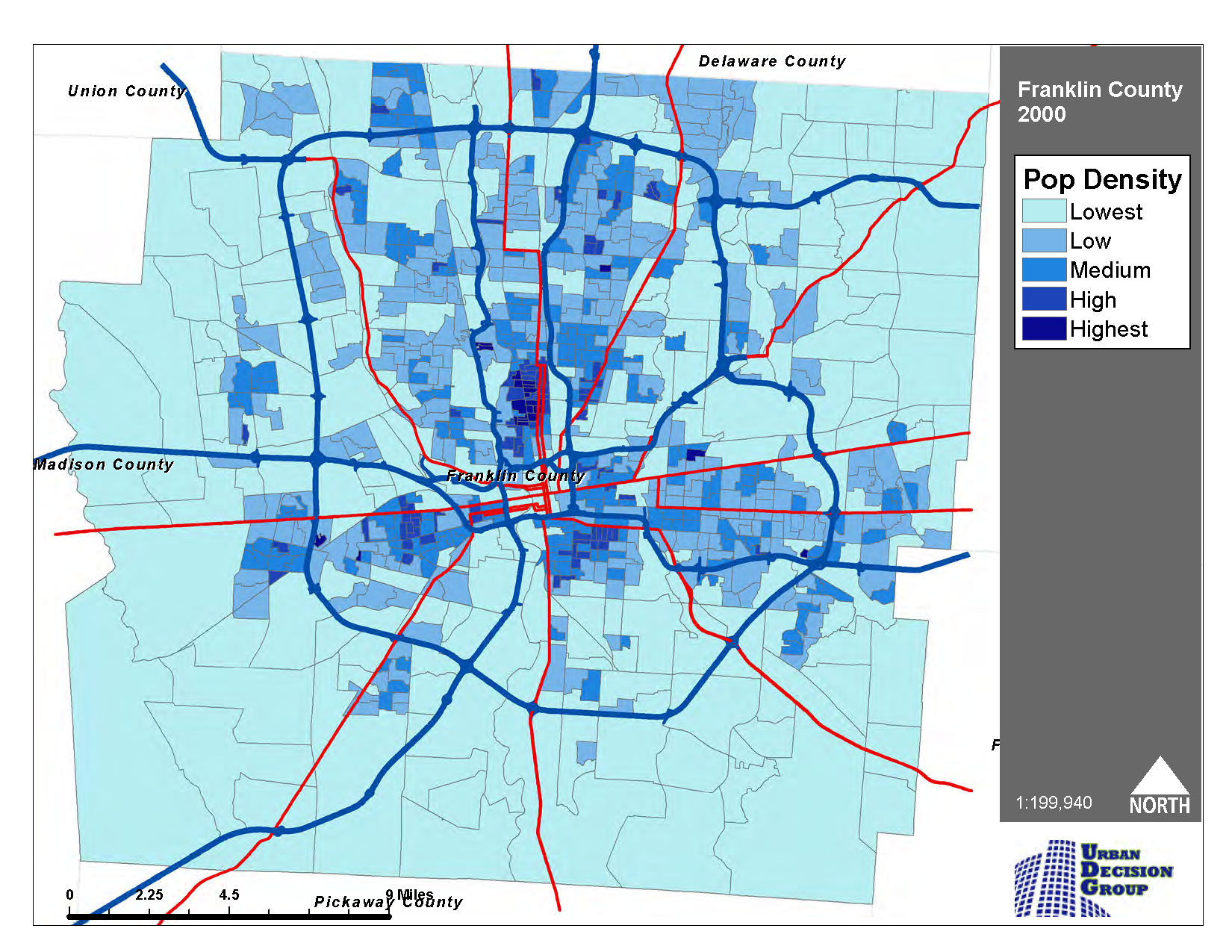
Part of the problem is the typical US sprawl of the place. The area inside the beltway is ~200 square miles - https://urbandecisiongroup.com/wp-content/uploads/2013/04/fc...

I live just outside the beltway. Driving to the OSU stadium just north of downtown would take me about 25 minutes. According to Google maps, the nearest COTA stop is a 20 minute walk away, then it's an hour and ten minutes to get to the stadium.

Agreed it would be lovely to be able to hop on a bus or train and get somewhere within a reasonable amount of time.

Post reply on HN