Live data from Hacker News

AI Recognises Race in Medical Images

explainthispaper.com

271–280 of 357 posts

Re: AI Recognises Race in Medical Images

#271
post #246

Earlier quoted context omitted.

You can't say anything about someone's bone density by deciding that they are black. Averaging the bone density of everyone that you've defined as black might be predictive of distributions of the bone densities of large numbers of people you've defined as black. But it's just because of the metrics you've chosen. If you started defining race by bone density, and ignored ahistorical half-biblical half-mystical 19th-c…

The following is a response to only your first paragraph: Huh? If the distributions of bone densities among “people you would visually identify as ‘race X’ ” and “people you would visually identify as ‘race Y’ ” differ, then knowing that an individual would be someone you would visually identify as ‘race X’, gives you some amount of statistical information about their bone density. I guess you just mean that you can’…

> If the distributions of bone densities among “people you would visually identify as ‘race X’ ” and “people you would visually identify as ‘race Y’ ” differ, then knowing that an individual would be someone you would visually identify as ‘race X’, gives you some amount of statistical information about their bone density.

Only if they differ substantially. If they look like https://evergreenleadership.com/wp-content/uploads/2014/01/B..., you can't conclude much from an individual's bone density measurement, even if "people of race X have 3% more bone density than people of race Y".
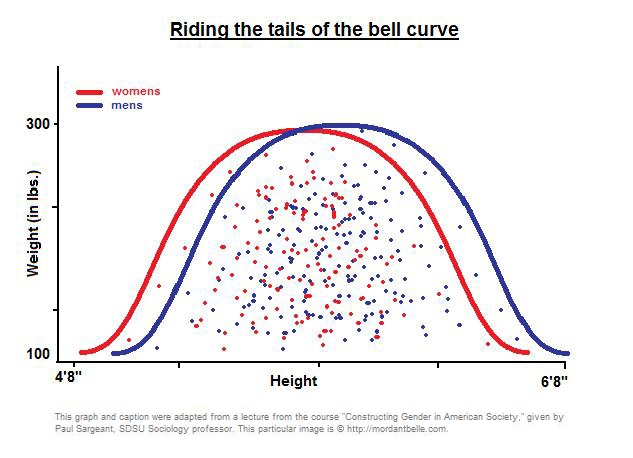
Re: AI Recognises Race in Medical Images

#272

Earlier quoted context omitted.

From what I understand, the definition of a social construct is a bit nuanced, and it's possible to both believe race is a social construct and that it correlates with things. As a metaphor, let's say we create two categories in the world for all people - tallers (people above six feet in height) and shorters (people below six feet in height). Human height objectively exists, but these categories are social construct…

But with the taller/shorter, you would commonly have two tallers producing a shorter, or two shorters producing a taller. If we were talking about husbandry, we would say that tallers and shorters don't "breed true". But with race, you never have two white people produce a black person, or vice versa (and no, a black person with albinism is not a white person).

Even disregarding albinism, it's possible for people of northern european descent with fair skin to have darker skinned children. For example, in a case where the parents have germ line mutations that they pass on to their child, there could be (improbably) a collection of mutations that greatly increased the quantity of melanin. However, skin color is a complex trait with many small differences coming from a large number of different genes, so large changes in skin color are very unlikely. Nothing of what I am describing is albinism, and would have been part of the process of natural selection for fair-skinned people in northern climates with less solar exposure.

Re: AI Recognises Race in Medical Images

#273

Earlier quoted context omitted.

Race in the context of physical differences does not map to the social concepts of race. For example, US documents usually include Latino as a possible race, even though Latin Americans are white, black, indigenous Americans, or a mix - and Spaniards are what usually would be classified as white. If you check older forms you'd see Italians and Irish people categorized as a different (non white) category, etc.

Do US documents do that? In my recollection, you're usually asked to specify a race, and then "Latino" is included in a separate ethnicity question.

You're correct. US documents generally have race and ethnicity separate, with Hispanic/Latino origin being an ethnicity.

Re: AI Recognises Race in Medical Images

#274

Earlier quoted context omitted.

"never" is too strong here. Two black people occasionally produce a white baby without albinism. There's a lot of genes that code skin color and you can have a bunch of recessive "white skin" genes and still be very black-skinned yourself. Then sometimes your child gets all the recessive white-skin genes from both parents. I had a personal friend who was white with two black parents, not albino, and genetic tests pro…

Well, if they are black people with white ancestors(or white people with black ancestors), then they aren't the people I was thinking about. Almost certainly, the only reason your black friends produced a white baby, is because they had white ancestors at some point. If two doberman pinschers had a puppy that looked like an English bulldog, it would be strange and newsworthy. But, if the two doberman's actually had g…

> Well, if they are black people with white ancestors(or white people with black ancestors), then they aren't the people I was thinking about.

Africa is very, very, very genetically diverse compared to the rest of the world. I don't think there exists a population which doesn't contain genes for lighter skin.

I think race labels make some sense in a social/cultural context: In America we can call someone "black" when they are 75+% white, because for their entire childhood/life, socially, society at large treated them similarly as they treat people who are "100% black".

But race doesn't make sense in a genetic context. It's probably far more absurd than defining the difference between an accent vs dialect vs language. Even though there are clear differences between individuals/families, the boundaries are absolutely arbitrary.

Re: AI Recognises Race in Medical Images

#275
post #240
post #217

Earlier quoted context omitted.

I would like to agree with that, since I would like to believe race is a construct that we can dispense with at some point. That said, assuming the paper is just wrong is simply bias. If there is an identity associated with race, there is no reason to think it doesn’t impact biology. There is no reason to assume it’s genetic.

Well if race has biological basis and also if race is inherited, there is no way around a genetic basis. Also there is a more than hundred year history of scientific research and no genetic (or other) grounding for race has been found. So yes, that is the source of my bias.

> Well if race has biological basis and also if race is inherited, there is no way around a genetic basis.

False. Diet and behavior affect biology amongst other things.

> Also there is a more than hundred year history of scientific research and no genetic (or other) grounding for race has been found.

We didn’t have machine learning or big data 100 years ago.

Re: AI Recognises Race in Medical Images

#276

Earlier quoted context omitted.

The point is showing that the heritability of skin tone and height are about the same is meaningless when talking about skin tone differences among races. Literally, news articles are written and go viral about "black couple has white baby", whereas there has never been an article "Two 6'3" people have an adult child who is only 5'5"" If you had a series of 100,000 parents+genetic children paraded in front of you, do…

I admit that my previous comment was tongue-in-cheek; I found it interesting that the two numbers were so close. To make up for it, I'll try a more serious response. I suspect you are making a category error comparing "two parents who are both rather taller or both rather shorter than their child" and "two parents who are appear to be of one race, but their child appears to be of a different race". To put the two int…

> And no, I wouldn't be crazy surprised in either case,

With all due respect, I don't believe you're being honest here. And that goes to my point about people wanting race to not be a social construct. I believe you're lying to yourself(or just lying to me) that you wouldn't be crazy surprised in either case.

> But the real, underlying question that is the base for "many people really, really don't want race to be real" is, "So what?"

Exactly. You don't want race to be real, you think it might be misused if it was real, and so you argue that it isn't real. That is not a compelling basis for an argument. A good argument for the earth being round is not that you're scared of people punching you in the nose if you say it is flat.

> Now, neither you nor I particularly care whether homosexuality is genetic or a choice, but I hope you can see how someone who has to respond to "So just don't be gay!" might prefer one over the other.

Yes, I can see how they would prefer that. But it has no bearing on the reality of whether being gay is genetic, or a choice, or possibly both, and really has no place in scientific analysis of sexuality.

Re: AI Recognises Race in Medical Images

#277
post #242

This is probably a great time to remind everyone that the reason the blood types are A, B, AB, and O (as opposed to, say, A, B, C, D or another nomenclature) is that when the first blood type experiments were run, only people with A and B protein configurations were available for testing in the lab where the tests were executed. I'd be very cautious drawing sweeping conclusions from research like this. The researcher…

I thought this was some expert-level trolling at first, but your post history suggests you’re acting in good faith, so: Blood types are categorized as A/B/AB/O because of the presence (or for O, absence) of protein markers on the surface of blood cells. A/B/C/D would be a much less descriptive system.

This is what I get for trying to tell that story from memory. What I intended to say was that the original blood groups were A, B, and C, and only with later research into the antibodies and surface proteins was it discovered that 'C' was really an 'AB' group. 'O' wasn't in the original set because none of the original donors had type-O blood, nor was Rh-factor discovered for the same reason. The original clotting discoveries weren't wrong, but they were dangerously not-right, as in "Your blood turns to jelly in your veins" not-right.

The relevant point is that early research (especially when there isn't a well-understood causality story, as is the case here) is more likely to be off due to small sample size than representative of the reality for the global population. I would treat a claim as broad as "AI Recognises Race in Medical Images" as the kind of thing that will end up with giant qualifiers on it as follow-up work is done.

Re: AI Recognises Race in Medical Images

#278

Never mind the images; who was deciding what 'race' the training data matched against? In this modern age of globalism, they must have searched hard to find anyone with any kind of historically-categorized dna. I'm guessing, they just used folks' self-identification for race on some form. Which is largely a social construct.

From the preprint ( https://arxiv.org/ftp/arxiv/papers/2107/2107.10356.pdf ) : " In this work, we define racial identity as a social, political, and legal construct that relates to the interaction between external perceptions (i.e. “how do others see me?”) and self-identification, and specifically make use of the self-reported race of patients in all of our experiments. "

Thank you. Exactly as I feared. Its a social definition, and makes it even more weird that an AI could predict from physical attributes i.e. an x-ray.

Re: AI Recognises Race in Medical Images

#279
post #87

Earlier quoted context omitted.

I am dismayed by your example that runs counter to the modern science. While "faster than light neutrino" was highly unexpected and rather suspect from the start, the "bone geometry differs slightly between ethnic groups" is well established among the anthropologists of humans. There are also parallels in wider biology of animals - mentioning that to underscore it's as scientifically expected, and not merely construe…

I agree that an AI model might be able to glean race on a probabilistic basis from x-rays. This specific model's ability to do it from a 64 pixel version of said x-ray makes me skeptical it's doing so successfully.

That's 1/4 the size of the texture of a Minecraft block. An AI could easily be trained to identify the block type of a Minecraft block based on an 8x8 subsample of one of its textures, and there's no reason something similar couldn't happen with biological race. Unless you a priori assume all racial differences are socially constructed and/or only skin deep.

Re: AI Recognises Race in Medical Images

#280

Earlier quoted context omitted.

From the preprint ( https://arxiv.org/ftp/arxiv/papers/2107/2107.10356.pdf ) : " In this work, we define racial identity as a social, political, and legal construct that relates to the interaction between external perceptions (i.e. “how do others see me?”) and self-identification, and specifically make use of the self-reported race of patients in all of our experiments. "

Thank you. Exactly as I feared. Its a social definition, and makes it even more weird that an AI could predict from physical attributes i.e. an x-ray.

What percentage of dark skinned people of African descent do you think wouldn't self-identity as black? Same for percentage of light skinned European descent, Asian descent, Central/South American descent, etc.? I'm sure there are some out there who would identify as a different race, and there are people of mixed heritage that throw a wrench in the works too, but the vast majority of humans will self-identity as a race that matches with their skin color and heritage.
Post reply on HN