[dead]
James Webb Space Telescope reveals that most galaxies rotate clockwise
251–260 of 318 posts
Re: James Webb Space Telescope reveals that most galaxies rotate clockwise
#252Earlier quoted context omitted.
It just occured to me that "rotation direction" is a pretty coarse measurement. Actually, you could look at the angle of a galaxy relative to ours, where (let's say) 0° is viewed exactly from "above" (rotating clockwise), 180° is viewed exactly from "below" (rotating counterclockwise), 90°/270° is viewed side-on etc. How about some stats based on this parameter?
What does "above" or "below" even mean in the context of something without a top or bottom? Or are you defining "above" to mean "the vantage point from which the galaxy appears to be rotating in the direction of earth clocks" for the purpose of this question?
Not to disagree with your justified Socratic questioning, but this sparked my interest and I figured I'd share my (novice!) TIL: it appears the IAU uses a coordinate system based on our solar system on January 1st 2000, 00:00 AM, or "J2000.0". Thus (0, 0, 0) is at the ~center of Sol and the x and y are within Earth's orbital plane, which means the z axis is orthogonal to that. In other words, it seems like "above"/"up" in a astronomical sense denotes the same approximate direction as "Northward"/"North", which is pretty fascinating!
Of course as an arrogant computer scientist I think they're downright kooky for not basing it on the galaxy, but ce la vie. Presumably there's one of those too, and this just wins for boring social inertia reasons as much as for any technical ones.
image: https://geoscienceaustralia.github.io/ginan/images/ICRF-75pc...
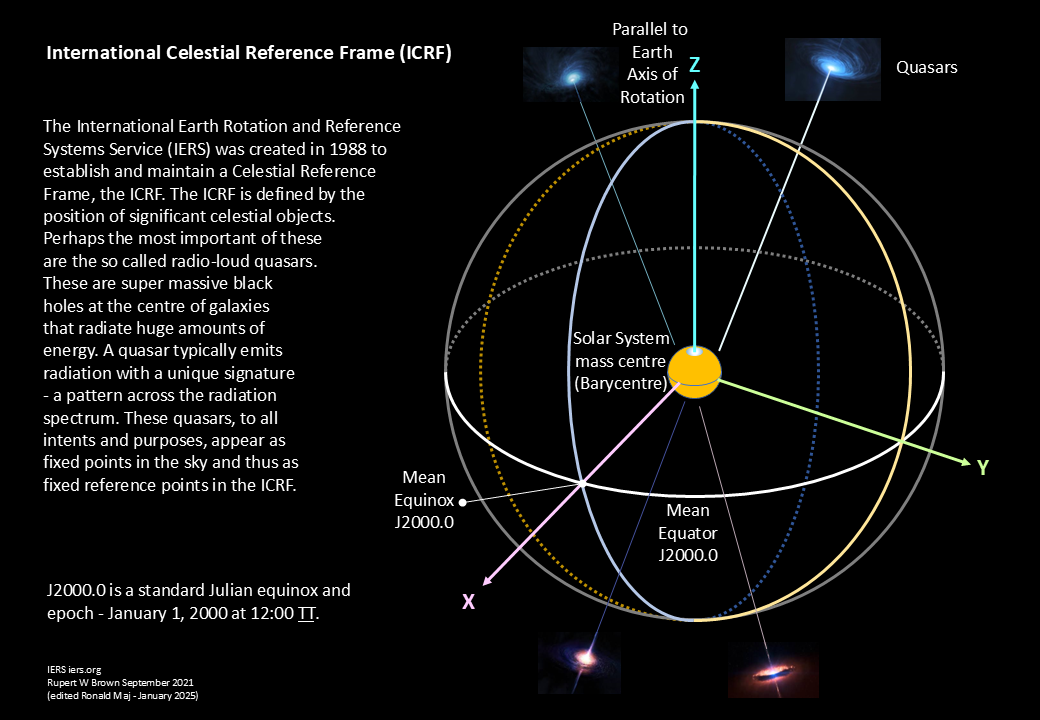
wiki: https://en.wikipedia.org/wiki/International_Celestial_Refere...
Of course this doesn't really matter for the above musing since top/bottom would purely be conventional based on our viewpoint, but otherwise illuminating on the issue of understanding rotation directions across the universe.
Re: James Webb Space Telescope reveals that most galaxies rotate clockwise
#253> The same solo author (a computer scientist) has made many similar claims based on a variety of datasets. Often coming to completely contradictory conclusions. Some of these claims have been followed up by astronomers, who found errors in his analysis and poor statistical tests. His claims have been discussed in this sub before. Independent studied have found no significant evidence of anisotropy. https://academic.o…
Thank you. That's a shame, it was a cool-sounding story, just unlikely enough to sound plausible.
Clockwise? To which observer?
Re: James Webb Space Telescope reveals that most galaxies rotate clockwise
#254Earlier quoted context omitted.
Thank you. That's a shame, it was a cool-sounding story, just unlikely enough to sound plausible.
Clockwise? To which observer?
It's arbitrary, but that's fine. The important part would be any asymmetry. The Big Bang implies that there shouldn't be one.
Re: James Webb Space Telescope reveals that most galaxies rotate clockwise
#255Earlier quoted context omitted.
If I was an editor at the Smithsonian, I'd be worried about peddling bogus theories for clicks at a time my employer is under scrutiny from the government. Apparently, they are not worried though, which astonishes me, hence my comment.
Out of all of the things, this government is scrutinizing, factual, accuracy, and quality of reasoning don’t seem to be of particular importance.
No, but having people call you out would make you feel even more vulnerable than you already are.
Re: James Webb Space Telescope reveals that most galaxies rotate clockwise
#256Earlier quoted context omitted.
Dumber question: would a galaxy that appears to spin clockwise appear to spin counter-clockwise when viewed from the other side? Does this imply that the real question is why galaxies' relative orientations seem to favor more spinning in one direction than the other?
Yes, that's it exactly. There's a net asymmetry in the distribution of galaxy axes. "Clockwise" by itself is a relative term. This seems to be the paper in question: https://academic.oup.com/mnras/article/538/1/76/8019798 That said: I'd wait a bit here. This is a single-author paper by a non-astronomer (he's a CS professor). The sample size seems small (N=263), and the measurement coarse (he's just bucketing galaxies…
Wouldn't it be biased towards nearby galaxies? A net rotation of the local cluster would be reasonable. But it would be very wrong to extrapolate that to the whole universe.
Re: James Webb Space Telescope reveals that most galaxies rotate clockwise
#257Earlier quoted context omitted.
Answering to your and original question above: there are no poles (or axes of rotation) in the Universe. On large scales (think distances to include thousands and millions of galaxies each with billions of stars with even more planets) the Universe is uniform - isotropic and homogeneous [1]. It is expanding with acceleration in all direction in each and every point of its space, so there is no preferred direction thu…
So it makes about as much sense to ask why 2/3rds of the galaxies are "upside-down" from our vantage point, because there's no clear reason it should be something other than 50% in a sample size this large?
Correct. On the largest scales it should be 50-50.
If it's not that would add a significant term to the Big Bang that nobody had previously expected. It would be a rather big deal... if it holds up.
Re: James Webb Space Telescope reveals that most galaxies rotate clockwise
#258Earlier quoted context omitted.
This is exactly the dumb question I came here to ask. So now I wait with you for a less dumb person to reply. My clock certainly seems to tick in the opposite direction when I look at it from behind.
Answering to your and original question above: there are no poles (or axes of rotation) in the Universe. On large scales (think distances to include thousands and millions of galaxies each with billions of stars with even more planets) the Universe is uniform - isotropic and homogeneous [1]. It is expanding with acceleration in all direction in each and every point of its space, so there is no preferred direction thu…
Hemispherical Power Asymmetry (HPA) observed in the Cosmic Microwave Background (CMB) temperature fluctuations [1]
"We conclude that the hemispherical power asymmetry still remains as a challenge to the standard model." [1]
Re: James Webb Space Telescope reveals that most galaxies rotate clockwise
#259Earlier quoted context omitted.
The inner black hole did not come from the outside, it formed inside and if i had to guess, it is stuck in the inside together with all the other matter, unable to interact with the outside of the outer black hole.
Just thinking about this infinite recursion gives me the mental equivalent of a stack overflow.
The trick is that bigger black holes are less dense. Supermassive black holes can have the density of water. If the universe is gravitationally closed, it would have the density of... well, just look up at night. (Actually much less than that; you see more stars because you're inside a galaxy.)
The density makes the scale recursion less mysterious.