Live data from Hacker News

The Ute Tribe will construct one of the largest solar farms in the US

ksut.org

231–240 of 302 posts

Re: The Ute Tribe will construct one of the largest solar farms in the US

#231

Earlier quoted context omitted.

I'm ignorant of how this works, but aren't tribal nations exempt from at least state and local regs?

Sovereign (as not all are considered such) tribal lands are dictated solely by the Bureau of Indian Affairs (and Congress, obviously, as the institution granting that authority). In practice, unless something goes heavily against Federal interests (illicit drug production/trade, for instance), it is regulated by the nation ("tribe") alone.

so there are reservations that don't have tribal sovereignty? or did you mean off-rez holdings, or federally unrecognized tribes?
Re: The Ute Tribe will construct one of the largest solar farms in the US

#232

Earlier quoted context omitted.

What's the GDP of the Ute nation? It's probably quite a significant investment for them as well.

2.96bln USD So 35% of the Ute Nation's GDP vs 1.3% of the Phillipines. OP is clearly either uninformed or biased. Or just doesn't understand Tribal Sovereignty status in the US.

Worth noting GDP is per year. Where the project cost is over the 30 year life[1] of the project. Through the magic of finance 35% becomes 1.17%.

[1] One feels that 30 life for something where components can be constantly replaced as they wear out is a misnomer.

Re: The Ute Tribe will construct one of the largest solar farms in the US

#233

Earlier quoted context omitted.

Panels are a commodity at this point. I hate to say it but mineral extraction, processing and panel manufacturing will be way more expensive than importing from China. Prerequisites for manufacturing panels here at an even remotely competitive price includes reducing labor costs and extracting/refining minerals at scale. I absolutely agree we should onshore solar production but simply onshoring manufacturing isnt the…

most of the onshoring is not dictated by cost but the realization that something that looks like COVID lockdowns of Chinese factories and ports makes just-in-time untenable. Most likely, you will see a lot of made in Mexico/Caribbean/Canada

Aka “friend-shoring”. Honestly I struggle to see why we can’t start bootstrapping some tech build here in the US.

Re: The Ute Tribe will construct one of the largest solar farms in the US

#234

Earlier quoted context omitted.

The LCOE cost advantage of alternative energy vs ... everything ... at this point is well known and calculated in Lazard's yearly LCOE study. Nuke advocates do themselves no favors playing shell games and weasel words with the economics. Nuclear is expensive. The nuclear industry needs to figure out how to make it a lot cheaper. And no, it's not just the NIMBY regulation. The legacy nuke industry has a ton of deeply…

Solar is cheaper when you have a flexible and well interconnected grid capable of smoothing out, say, a cloud passing over Ute nation land and abruptly pulling 1GW out of the grid. That kind of grid costs money and we have no idea how much and how achievable it is. The alternative, grid scale storage for the full rated power, is still insanely expensive and makes renewables completely uncompetitive. Yes, nuclear is g…

Australian research on this suggests renewables will still be cheapest as the grid moves to fully carbon free, includin the cost to integrate with the grid:

https://www.csiro.au/en/news/all/articles/2023/october/genco...

> Even with this extra VRE cost in 2030, the answer to whether renewables are the cheapest form of energy is still yes. And it remains so when VRE is at 90 percent of the energy system

Re: The Ute Tribe will construct one of the largest solar farms in the US

#235

I wonder if the tribes have enough autonomy to build transmission lines quickly. Just the Navajo Nation can build enough solar/wind and transmission lines within their reservation and probably connect to the grids in Colorado, New Mexico, Utah and Arizona. US is incredibly slow in building transmission lines, takes decades. And, if they have enough autonomy to import Chinese panels (50% cheaper), a network of these n…

Transmission lines are already there because of the nearby decommissioned coal plant: https://en.wikipedia.org/wiki/San_Juan_Generating_Station

Re: The Ute Tribe will construct one of the largest solar farms in the US

#236
post #48

Earlier quoted context omitted.

> who...will they sell the juice to? Utah is already a power exporter. Utah generates about one-fifth more electricity than it consumes, and the state is a net supplier of power to other states.[1] [1] https://www.eia.gov/state/analysis.php?sid=UT

This tribe is in Colorado, not Utah, despite the name. Transmission is expensive; you'd rather sell locally. Before you finance a $1B project it would be good to have a sense of how you expect to sell the outputs!

Transmission lines are already there because of the nearby decommissioned coal plant: https://en.wikipedia.org/wiki/San_Juan_Generating_Station

Re: The Ute Tribe will construct one of the largest solar farms in the US

#237

> But also, it makes sense not to transmit power too far from where you are yep, they’ll waste the energy trying to transmit it sounds like they’re going to be attracting bitcoin miners. they’re the only use case that’s able to be in the middle of nowhere without needing other infrastructure, like robust internet. any other use cases you all know of?

Transmission lines are already there because of the nearby decommissioned coal plant: https://en.wikipedia.org/wiki/San_Juan_Generating_Station

Re: The Ute Tribe will construct one of the largest solar farms in the US

#238

Earlier quoted context omitted.

Sovereign (as not all are considered such) tribal lands are dictated solely by the Bureau of Indian Affairs (and Congress, obviously, as the institution granting that authority). In practice, unless something goes heavily against Federal interests (illicit drug production/trade, for instance), it is regulated by the nation ("tribe") alone.

so there are reservations that don't have tribal sovereignty? or did you mean off-rez holdings, or federally unrecognized tribes?

There are recognized tribes without recognized lands. There are federally unrecognized tribes. And there are properties of tribal institutions that do not fall on sovereign land.

So the easiest answer is: "yes"/"all of the above"

Re: The Ute Tribe will construct one of the largest solar farms in the US

#239

Earlier quoted context omitted.

Panels are a commodity at this point. I hate to say it but mineral extraction, processing and panel manufacturing will be way more expensive than importing from China. Prerequisites for manufacturing panels here at an even remotely competitive price includes reducing labor costs and extracting/refining minerals at scale. I absolutely agree we should onshore solar production but simply onshoring manufacturing isnt the…

> Will probably always have to utilize low foreign wages This mindset lies at the center of neoliberalism and should be examined with nuance and perspective, since the quality of each individual's experience can vary wildly in a market which accepts such inequalities as necessary for the health of the overall system.

I think you’re missing the price competitive constraint. I said it would need low foreign wages to be price competitive with China. Under what non-neoliberal mindset is this false? I can only think of one and I dont think its what you have in mind: reduce labor rights and eliminate the minimum wage.

Re: The Ute Tribe will construct one of the largest solar farms in the US

#240
post #172

Earlier quoted context omitted.

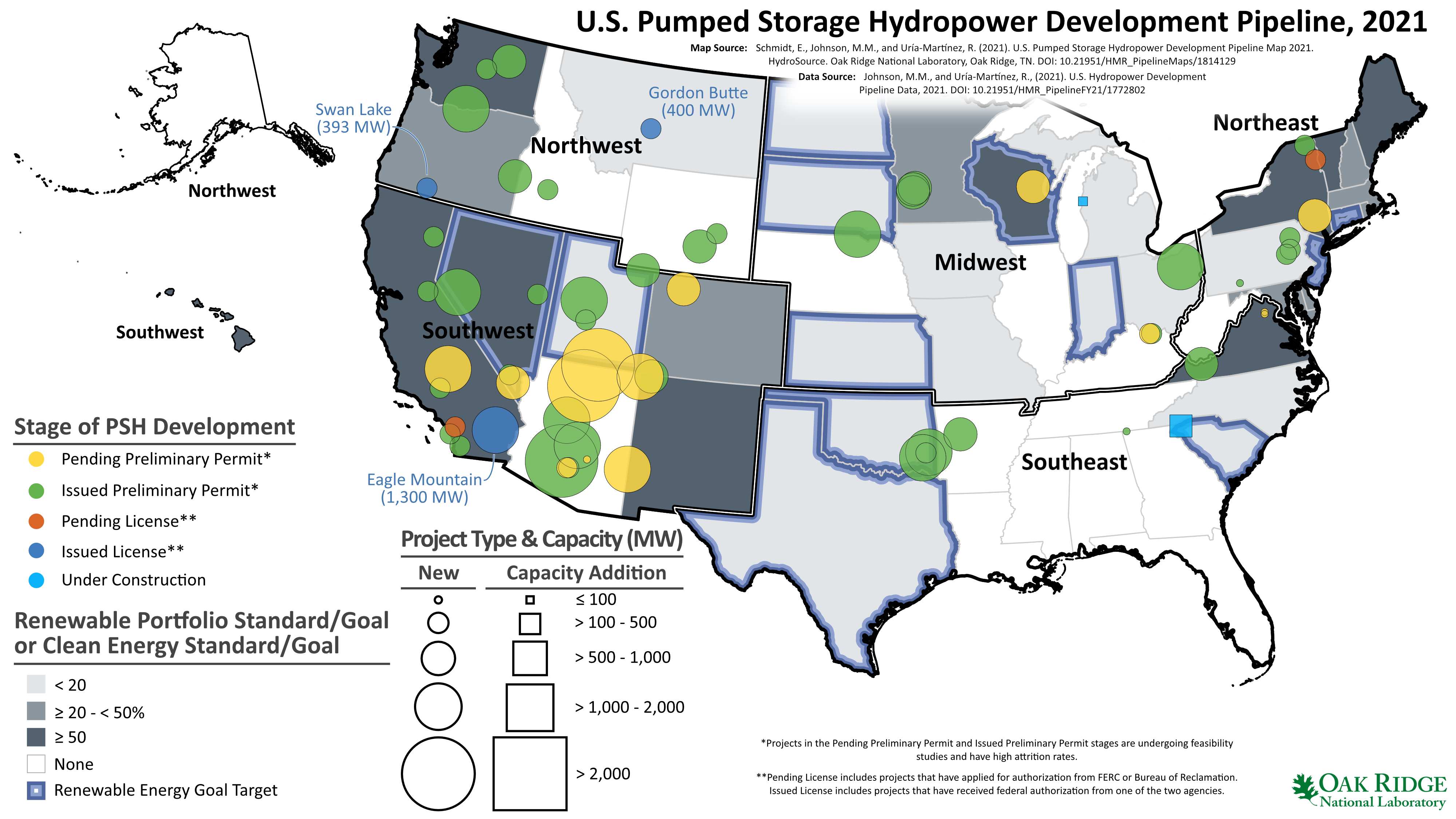
Pumped hydro is very dependent on geography. Good luck doing pumped hydro in Kansas.

Sure. No solution is one size fits all. This particular solar installation happens to be in Colorado, very close to a lot of area where pumped hydro would be extremely cost effective. Somewhere like Kansas, wind power and battery based storage may be more effective. Here's a map of pumped storage hydro potential; note how dense the potential is throughout most of the Western US. https://maps.nrel.gov/psh

Another graphic: https://hydrosource.ornl.gov/sites/default/files/2021-08/hmr...
Post reply on HN