Live data from Hacker News

Tell HN: DEI initiatives undermine the self esteem of PoC within a company

news.ycombinator.com

231–240 of 898 posts

Re: Tell HN: DEI initiatives undermine the self esteem of PoC within a company

#231

Earlier quoted context omitted.

It's not about telling people your ethnicity, gender, or sexual orientation, it's about WHAT IS SAID about your ethnicity, gender, or sexual orientation. The beauty of the internet is anonymity (to a certain extent), but that doesn't mean that you can't see or hear things that exclude you.

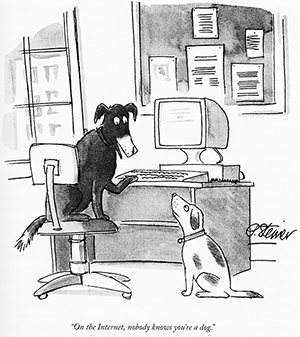
Exactly. The old saying was "The beauty of the Internet is nobody knows if you're a dog." ... except they didn't mean dog, and we never said why it might matter what you are or what other people were assuming you were absent further information.

>> except they didn't mean dog

The quote is from a 1993 New Yorker cartoon which literally has two dogs talking.

See the original image:

https://upload.wikimedia.org/wikipedia/en/f/f8/Internet_dog....

'Dog' could be a placeholder, but the cartoon showed dogs.

Re: Tell HN: DEI initiatives undermine the self esteem of PoC within a company

#233

Interestingly enough, Pew Research ran a study[0] a few years back which found that the majority of whites, blacks, and Hispanics reject race-conscious hiring—even if it results in less diversity. I can only imagine what it would feel like to be a PoC in a company that has openly stated that their goal is to achieve a certain racial/ethnic composition regardless of standards. How would I not always have a sneaking su…

> Interestingly enough, Pew Research ran a study[0] a few years back which found that the majority of whites, blacks, and Hispanics reject race-conscious hiring—even if it results in less diversity.

Ideologues who are a tiny minority, which is overwhelmingly white, don't care tho.

The Atlantic - Americans Strongly Dislike PC Culture - https://archive.ph/OXs6F

It's a bit sad how little discussion it generated, because this data should be pretty damning.

> 25 percent of Americans are traditional or devoted conservatives, and their views are far outside the American mainstream. Some 8 percent of Americans are progressive activists, and their views are even less typical. By contrast, the two-thirds of Americans who don’t belong to either extreme constitute an “exhausted majority.” Their members “share a sense of fatigue with our polarized national conversation, a willingness to be flexible in their political viewpoints, and a lack of voice in the national conversation.”

> So what does this group look like? Compared with the rest of the (nationally representative) polling sample, progressive activists are much more likely to be rich, highly educated—and white. They are nearly twice as likely as the average to make more than $100,000 a year. They are nearly three times as likely to have a postgraduate degree. And while 12 percent of the overall sample in the study is African American, only 3 percent of progressive activists are.

> While 83 percent of respondents who make less than $50,000 dislike political correctness, just 70 percent of those who make more than $100,000 are skeptical about it.

8 percent of US population, who knows how tiny proportion of EU population (we're also on the Internets, you know). And they constantly pretend their views are default, and try to marginalize others online. With some success, sadly.

Also, they blatantly discriminate against neurodivergent people - and if there's a single obviously beneficial diversity program, it'd be increasing neurotype diversity. Ways of thinking, not surface characteristics.

Example: Damore, who was an aspie. You know, the disability where you have trouble with unclear communication that normies rely on. Which causes sth like 90% afflicted to be unemployed - because people insist on ignoring their issues. Tech is one of the areas where they can thrive - except in the name of "diversity", left wants to push them out. I don't understand how's that coherent. Who decides which identity group are worthy of protection?

See "The Neurodiversity Case for Free Speech": https://static1.squarespace.com/static/58e2a71bf7e0ab3ba886c...

> Administrators assume that the most vulnerable ‘snowflakes’ are always listeners, and never speakers.

> Autism spectrum disorders are central to the tension between campus censorship and neurodiversity. This is because there’s a trade-off between ‘systematizing’ and ‘empathizing’. Systematizing is the drive to construct and analyze abstract systems of rules, evidence, and procedures; it’s stronger in males, in people with autism/Asperger’s, and in STEM fields. Empathizing is the ability to understand other people’s thoughts and feelings, and to respond with ‘appropriate’ emotions and speech acts; it’s stronger in females, in people with schizophrenia spectrum disorders, and in the arts and humanities. Conservative satirists often mock ‘social justice warriors’ for their ‘autistic screeching’, but Leftist student protesters are more likely to be high empathizers from the arts, humanities, and social sciences, than high systematizers from the hard sciences or engineering.

> Consider the Empathy Quotient (EQ) scale, (...) it seems like a higher EQ score would strongly predict ability to follow campus speech codes that prohibit causing offense to others. People on the autism spectrum, such as those with Asperger’s, score much lower on the EQ scale. (Full disclosure: I score 14 out of 80.) Thus, aspies simply don’t have brains that can anticipate what might be considered offensive, disrespectful, unwanted, or outrageous by others – regardless of what campus speech codes expect of us.

> From a high systematizer’s perspective, most ‘respectful campus’ speech codes are basically demands that they should turn into a high empathizer through sheer force of will.

> The ways that speech codes discriminate against systematizers is exacerbated by their vagueness, overbreadth, unsystematic structure, double standards, and logical inconsistencies – which drive systematizers nuts. For example, most speech codes prohibit any insults based on a person’s sex, race, religion, or political attitudes. But aspie students often notice that these codes are applied very selectively: it’s OK to insult ‘toxic masculinity’ and ‘patriarchy’, but not to question the ‘wage gap’ or ‘rape culture’; it’s OK to insult ‘white privilege’ and the ‘Alt-Right’ but not ‘affirmative action’ or ‘Black Lives Matter’; it’s OK to insult pro-life Catholics but not prosharia Muslims. The concept of ‘unwelcome’ jokes or ‘unwelcome’ sexual comments seems like a time-travel paradox to aspies – how can you judge what speech act is ‘unwelcome’ until after you get the feedback about whether it was welcome?

> When a policy is formally neutral, but it adversely affects one legally protected group of people more than other people, that’s called ‘disparate impact’, and it’s illegal. People with diagnosed mental disorders qualify as ‘disabled’ people under the 1990 Americans with Disabilities Act (ADA) and other federal laws, so any speech code at a public university that imposes disparate impact on neurominorities is illegal.
Re: Tell HN: DEI initiatives undermine the self esteem of PoC within a company

#234

Earlier quoted context omitted.

> So what does one do if you wish to have a level floor? Let me offer you a different metaphor about levels :-) In Greek mythology, there was a character named Procrustes. He had an iron bed of a certain size, to which he strapped his captives, and if they happened to be taller than the bed was long, he cut off their legs to fit the bed; whereas if they were shorter, he stretched them to fit the bed tearing their sin…

I appreciate your analogy and I will politely remind you that in American history, members of certain classes did indeed have limbs cut off or their body parts stretched for arbitrary reasons. In fact, this practice only really ended in the 1960s; controversially, one might even say that this practice continues to today. So what do we do when confronted with an anecdote from antiquity versus system inequities from ou…

> So what do we do when confronted with an anecdote from antiquity versus system inequities from our modern era?

I guess, in the spirit of the analogy, your options are to either stop cutting off body parts from anyone, or to start cutting them off those who look like people who engaged in body cutting two or more generations ago. DEI prefers the second option. Some people would rather see the first.

Re: Tell HN: DEI initiatives undermine the self esteem of PoC within a company

#235

Earlier quoted context omitted.

No, it was decided to chastise the downtrodden minority class.

Yes - allowing blacks in America to attend college and move into neighborhoods without the threat of being killed was an act designed to chastise them. I think posts of this nature (including OP) reflect a fear of not belonging to the dominant ‘caste’ and of being seen as either losing status (dominant caste men not getting jobs they are ‘the best’ for); or, alternatively, lower caste men wanting to be seen as valuab…

[dead]

Re: Tell HN: DEI initiatives undermine the self esteem of PoC within a company

#236
There are two possible goals. Affirmative action or color-blind meritocracy. Both will lead to diverse hiring practices (using the term diverse loosely - people who are not like those hiring them). Affirmative action makes sense to get momentum going but becomes its own worst enemy when acted upon for perpetuity. This makes it hard when designing policy because inevitably years will go by and you still haven't reached your diversity goals. Is this because your company is still 'biased' somewhere deep down or is it indicative of real group level differences that have deeper causes than your affirmative action policy can address? In our current navel gazing culture, we will always assume the former and the policy grows in scope.

Our companies can't always fix these group level differences, they aren't even always 'problems' (for example, men and women are different and have different strengths and weaknesses, will tend to be interested in different fields, etc.)

In my view the way forward is color-blind meritocracy. Tech needs to look closely at the symphony 'blind' interview techniques and be very self-critical of 'culture fit': https://abilitymap.com/articles/recruitment/blind-hiring/

Re: Tell HN: DEI initiatives undermine the self esteem of PoC within a company

#237

Earlier quoted context omitted.

>I think the UC university system has it right because they ban racial preferences for admitting students. The UC system only did so because they were mandated to by law (specifically a voter initiative), and they still try to use as many proxies for race as possible in order to try and be racist in their admissions policies.

> and they still try to use as money proxies for race But that's completely legitimate. If black people (for example) are systemically poorer than white people as a group, it makes sense to give them more help. It's favoring a wealthy black person over a poor white person, that's arguably problematic.

But that's completely legitimate. If [Asian|Jewish] people (for example) are systemically [better at university] than white people as a group, it makes sense to [hold them to much higher standards than white people in university admissions].

Re: Tell HN: DEI initiatives undermine the self esteem of PoC within a company

#238
I really strongly agree, but I'm a white man, so it can be difficult to confidently have a reasonable conversation about, or maybe I really shouldn't care/be talking at all.

I think it was the actor Morgan Freeman who in an interview answered something like 'how do we fix racism/diversity' with 'stop talking about it'.

But I'd go further, I find 'PoC' (person/people of colour) which you used yourself a really strange term, I think I'd hate it. 'Why aren't I just a P? Those white guys aren't called Pw/oC.' Your prerogative, of course.

Trends come and go, I suppose - it just seems so close to 'coloured', which has itself been both a preferred 'PC' term and considered racist at different times. It's so similar to PoC that I'm honestly not sure where it stands now, I wouldn't use it.

When the distinction actually does matter, do we need such euphemisms? At least in the UK, though 'PoC' seems to be catching on a bit, people are and have long been happy with white/brown/black, IME.

I'm not a 'manager in an influential company' but if I am ever running the show I don't even want a hush-hush programme - just hire good people and shut up about their heritage/preferences IMO. I realise there's a pipeline problem, but I think you help fix that by funding and otherwise supporting the early stages of it, not by being lax on merit or setting quotas for your late-stage admission process.

Re: Tell HN: DEI initiatives undermine the self esteem of PoC within a company

#239
post #43

Earlier quoted context omitted.

> actually hire some folks from diverse backgrounds Because you’re trying to hire from a small pool of candidates (minority software developer or whatever) that EVERY OTHER tech company is trying to get in a desperate attempt to not look bad (because not having a sufficient number of minorities on staff is a sin). It’s simply a question of numbers. There’s only so many minorities, and only a fraction of them are suff…

Yeah I look at it from a top level. Say that in the tech industry, 20% (totally made up number BTW) of your workers are black. It would be possible for some companies to have >20% of their workforce be black, but if you look at the top employers (GOOG, AMZN, MSFT, AAPL, etc), there would be physically impossible for them to hire >20% black workers because there are simply not enough of them out there in the broader w…

>TL;DR: Diversity quotas are hard

Diversity quotas are wrong.

If you hire the black candidate because you have a quota to fill. How is that morally different to hiring a white person just because they're white?

The only situation where I can think of quotas being a 'good' is to rectify a past self sustaining imbalance. If you made the case that the police are racist, because they're all white, therefore black people don't want to join, I would say that's a good candidate. But it isn't a good thing in and of itself, and shouldn't be an ongoing thing. Because it's corrosive in its own right.

I would rather Google/apple/Amazon put effort into education if they feel there's an issue. I would guess the issue is one of poverty rather than colour per se. Targeting and helping schools in poor areas would actually be helping where it mattered, giving people the best start in life whatever their colour, rather than someone who already had that start, but happens not to be white.

Re: Tell HN: DEI initiatives undermine the self esteem of PoC within a company

#240

I'm seeing a lot of claims here that DEI initiatives are about actively hiring under-qualified under-represented candidates to change the demographics of the company. I've sat through a lot of DEI sessions at work (as have many of my friends), and I've yet to hear of anyone actually _hiring_ under-qualified candidates for the sake of a quota. The DEI sessions I've sat through have focused heavily on the I--inclusion.…

>actively hiring under-qualified

Oh it's absolutely been done. I have very strict color and gender-blind hiring standards, because I want to hire the actual best people for the job. My filtering of candidates has absolutely been overruled by (white) upper management, because they needed to make the department I was in more $diverse, for whatever that means.

The punchline is that I'm not white.

I've since moved on from that firm, but I've run into this elsewhere. Really leaves a bad taste in ones' mouth, and hits the demoralization hard. The doublespeak is miserable. But I suppose I have literally these policies to thank for forcing me to strike out on my own to build something actually better.

Post reply on HN