random rant not really related to op but spurred by it: i know it will probably never happen, but it would be 'truly epic' if hard PCIe endpoints became as ubiquitous as say, SPI peripheral blocks, within MCUs/MPUs and the general silicon jelly-bean world. just a very high speed, very low latency, very widespread, very standard, very boring communication channel. and ofcourse an atmega328p can't keep up with the full…
Syzygy: An open standard for low cost, compact and high-performance peripherals
21–30 of 33 posts
Re: Syzygy: An open standard for low cost, compact and high-performance peripherals
#22Earlier quoted context omitted.
PCIe doesn't have to be over an edge connector. PMC and XMC standards use board-to-board stacking. You can also do PCIe over cabling. What's the point of low speed single ended I/O into an FPGA module? Seems like a waste of effort.
I think “low speed” is quite a relative term here. PCIe serdes lanes are for very high data rate communication (> 1gbps per lane). This is the realm of the Syzygy XCVR standard. The lower speed Syzygy standard, while not operating at these speeds, is capable of much higher rates than a typical microcontroller. There are many peripherals with I/O requirements beyond a simple LED or SPI device, but below that of a PCIe…
Re: Syzygy: An open standard for low cost, compact and high-performance peripherals
#23I am just aghast at how slow so much of the computing world moves. Cortex A53 is twelve years old, & still rampantly abundant & the go to option, or it's barely improved at all A55. We still see lots of A7's too for lower power, only barely beginning to be replaced by A32. The M7 has been a significant boost but the M3/4 are enduring. ADC/DAC have gotten a bit better for microcontrollers, but we are so far away from bandwidth & connectivity being competed on, being competitive.
This was a more hopeful future.
Re: Syzygy: An open standard for low cost, compact and high-performance peripherals
#24Syzygy imo largely failed to be adopted because microcontrollers (& app processors) haven't improved all that much. We are barely seeing a lane or two of pcie 2 appear. I am just aghast at how slow so much of the computing world moves. Cortex A53 is twelve years old, & still rampantly abundant & the go to option, or it's barely improved at all A55. We still see lots of A7's too for lower power, only barely beginning…
Things are moving very fast imo. MCUs can do 1080p at 30fps now and not just from faster hardware but with some impressive additions to instruction sets!
Edit: After re-reading I see that you're talking about adoption rates, in which case, fair points.
Re: Syzygy: An open standard for low cost, compact and high-performance peripherals
#25random rant not really related to op but spurred by it: i know it will probably never happen, but it would be 'truly epic' if hard PCIe endpoints became as ubiquitous as say, SPI peripheral blocks, within MCUs/MPUs and the general silicon jelly-bean world. just a very high speed, very low latency, very widespread, very standard, very boring communication channel. and ofcourse an atmega328p can't keep up with the full…
I may be way off here, but doesn't USB do what you want? Like if I have a Teensy and I want to plug a USB device into it, isn't that relatively simple? And fast?
Re: Syzygy: An open standard for low cost, compact and high-performance peripherals
#26Syzygy imo largely failed to be adopted because microcontrollers (& app processors) haven't improved all that much. We are barely seeing a lane or two of pcie 2 appear. I am just aghast at how slow so much of the computing world moves. Cortex A53 is twelve years old, & still rampantly abundant & the go to option, or it's barely improved at all A55. We still see lots of A7's too for lower power, only barely beginning…
Re: Syzygy: An open standard for low cost, compact and high-performance peripherals
#27Earlier quoted context omitted.
> What's the point of low speed single ended I/O into an FPGA module? Hardware interfacing with the physical world. Driving small numbers of LEDs, h-bridge drivers, load switches, regulator control signals, reading buttons, accelerometers, gyroscopes, magnetometers, PWM controllers, GPS, ...
That's what microcontrollers are for. FPGAs are harder to program and use a lot more power. So the juice needs to be worth the squeeze!
Re: Syzygy: An open standard for low cost, compact and high-performance peripherals
#28Earlier quoted context omitted.
I think “low speed” is quite a relative term here. PCIe serdes lanes are for very high data rate communication (> 1gbps per lane). This is the realm of the Syzygy XCVR standard. The lower speed Syzygy standard, while not operating at these speeds, is capable of much higher rates than a typical microcontroller. There are many peripherals with I/O requirements beyond a simple LED or SPI device, but below that of a PCIe…
Piggy backing on this, image sensors using CSI are quite common. I don't know if anyone has this application, but theoretically if you wanted more than a few (I think even higher end processors cap out at 4) video streams in comes.... FPGAs. Maybe the newer Qualcomm XR chipsets can deal with that but an FPGA seems more attainable.
Re: Syzygy: An open standard for low cost, compact and high-performance peripherals
#29random rant not really related to op but spurred by it: i know it will probably never happen, but it would be 'truly epic' if hard PCIe endpoints became as ubiquitous as say, SPI peripheral blocks, within MCUs/MPUs and the general silicon jelly-bean world. just a very high speed, very low latency, very widespread, very standard, very boring communication channel. and ofcourse an atmega328p can't keep up with the full…
I'm hoping UCIe starts to fix this. It's touted as being something that can combine the low power with the high speed. As is PCIe is a relatively high power for anything that doesn't need the speed. You need to be moving pretty well past normal MCU interfaces (spi, uart, etc) before you see the power trade off. As is, PCIe would add sizable die area consumption, raise power consumption by an order of magnitude, and l…
We are already drowning in transistors, I am not convinced by your area argument, esp in the face of shrinking nodes, we have more area than we know what to do with.
https://eps.ieee.org/images/files/TC_article_Universal_Chipl...
https://www.hpcwire.com/2022/05/11/intel-says-ucie-to-outpac...
I'd love to see UCIe scale down to SPI. I also agree on more pervasive use of Ge would be nice.
Re: Syzygy: An open standard for low cost, compact and high-performance peripherals
#30Earlier quoted context omitted.
I'm hoping UCIe starts to fix this. It's touted as being something that can combine the low power with the high speed. As is PCIe is a relatively high power for anything that doesn't need the speed. You need to be moving pretty well past normal MCU interfaces (spi, uart, etc) before you see the power trade off. As is, PCIe would add sizable die area consumption, raise power consumption by an order of magnitude, and l…
PCIe is extremely scalable, from Gen1 to Gen5. There is no reason that you couldn't extend one of the GenX specs down to Gen0 speeds. We are already drowning in transistors, I am not convinced by your area argument, esp in the face of shrinking nodes, we have more area than we know what to do with. https://eps.ieee.org/images/files/TC_article_Universal_Chipl... https://www.hpcwire.com/2022/05/11/intel-says-ucie-to-ou…
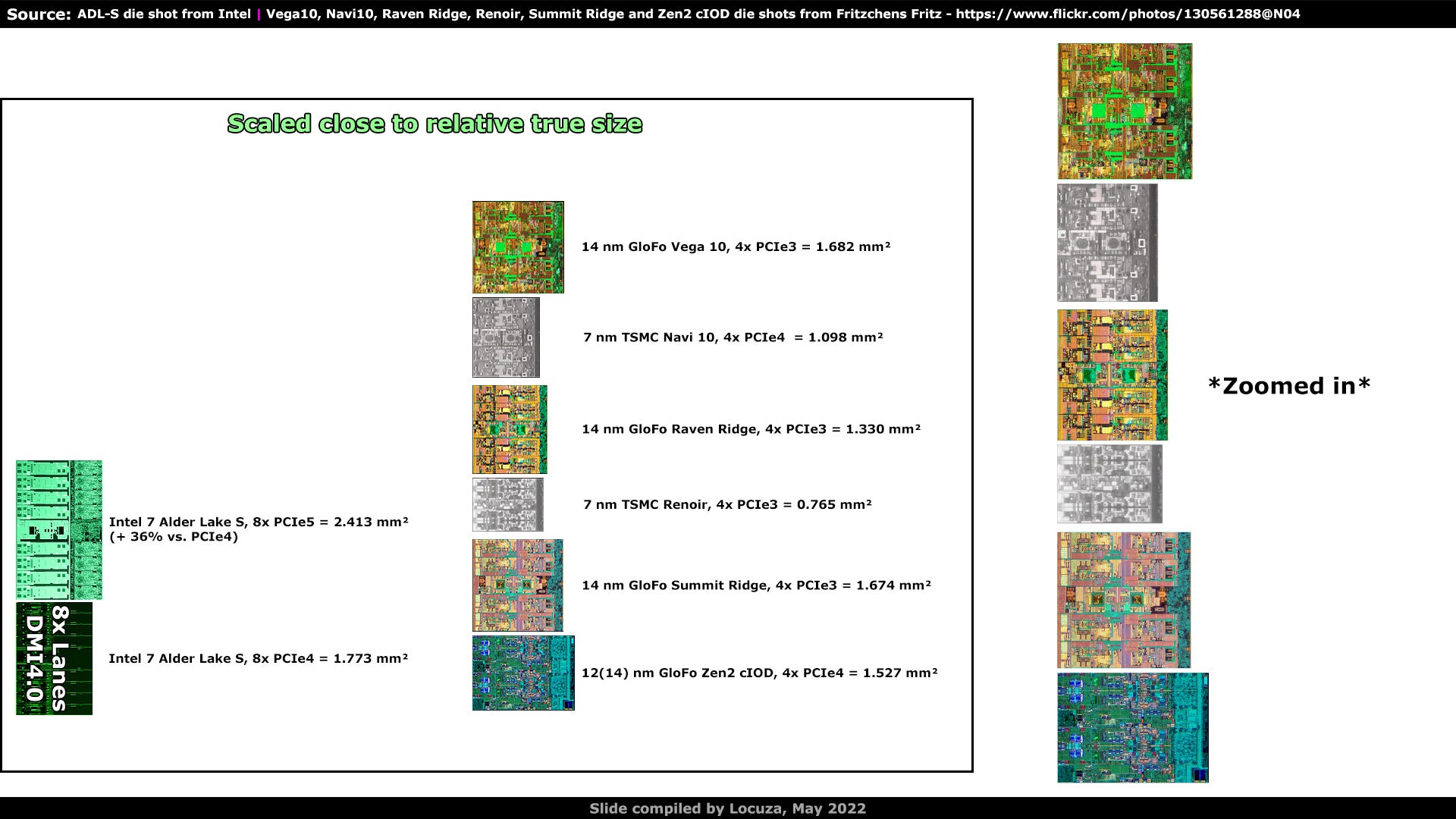
This gross look shows what I believe are some PCIe block die areas.
https://substackcdn.com/image/fetch/f_auto,q_auto:good,fl_pr...
This is roughly half the size of what I've seen to be some of the smallest micros, and those are most likely not on the same lithographies. When you combine the amount of additional RAM/ROM needed to run a PCIe stack, maybe divide by 4 for 1 lane instead of 4 to be generous, you're still likely going to double the die area used. On top of that which I didn't mention earlier is that PCIe transceivers are going to need more per supply circuity. ST's been doing a good job of integrating things in for stuff like DSI but those app notes show more complexity than the aforementioned atmega328p which is so simple it can sometimes be run without decoupling caps on a breadboard.
If you look at die shots for micros, a lot of the time you'll see most of the area is consumed by large arrays of SRAM or flash. And SRAM is known to not scale to lower lithographies. So, I don't expect to see this changing really. To be PCIe compliant you'll likely need to have the ability to store a full TLP. On a 328p, that could double if not more the SRAM needed. So the chip would get idk ballpark 3x bigger with all the stuff included? I just don't see manufacturers wanting to do this, which is likely why they haven't. There are very few cortex M chips with PCIe that come to mind. Some more cortex Rs. I figure if it was really the silver bullet, somebody would've done it by this point.