Live data from Hacker News

The Octonion Math That Could Underpin Physics

quantamagazine.org

171–180 of 192 posts

Re: The Octonion Math That Could Underpin Physics

#171

It's rather amusing that the author assumes that non-associtiave objects are "weird" for physicists (or at least that was my reading), since the velocity addition formula is in general non-associative and that has been extensively studied. (I remember three separate occasions in my undergrad particle physics class where we actually went through all the calculations involved with the velocity addition formula and fina…

The other thing that contains non-associative elements is logic. Due to the Curry-Howard correspondence, that means functional programming too.

So this quote about mathematicians seems a bit off. Baez is talking about mathematical physicists, I guess, not logicians and computer scientists. I know he is not a functional programmer from various online remarks he has made. So maybe it's more of a personal perspective that we shouldn't take too seriously.

'“Nonassociative things are strongly disliked by mathematicians,” said John Baez, a mathematical physicist at the University of California, Riverside, and a leading expert on the octonions. “Because while it’s very easy to imagine noncommutative situations — putting on shoes then socks is different from socks then shoes — it’s very difficult to think of a nonassociative situation.” If, instead of putting on socks then shoes, you first put your socks into your shoes, technically you should still then be able to put your feet into both and get the same result. “The parentheses feel artificial.”'
Re: The Octonion Math That Could Underpin Physics

#172
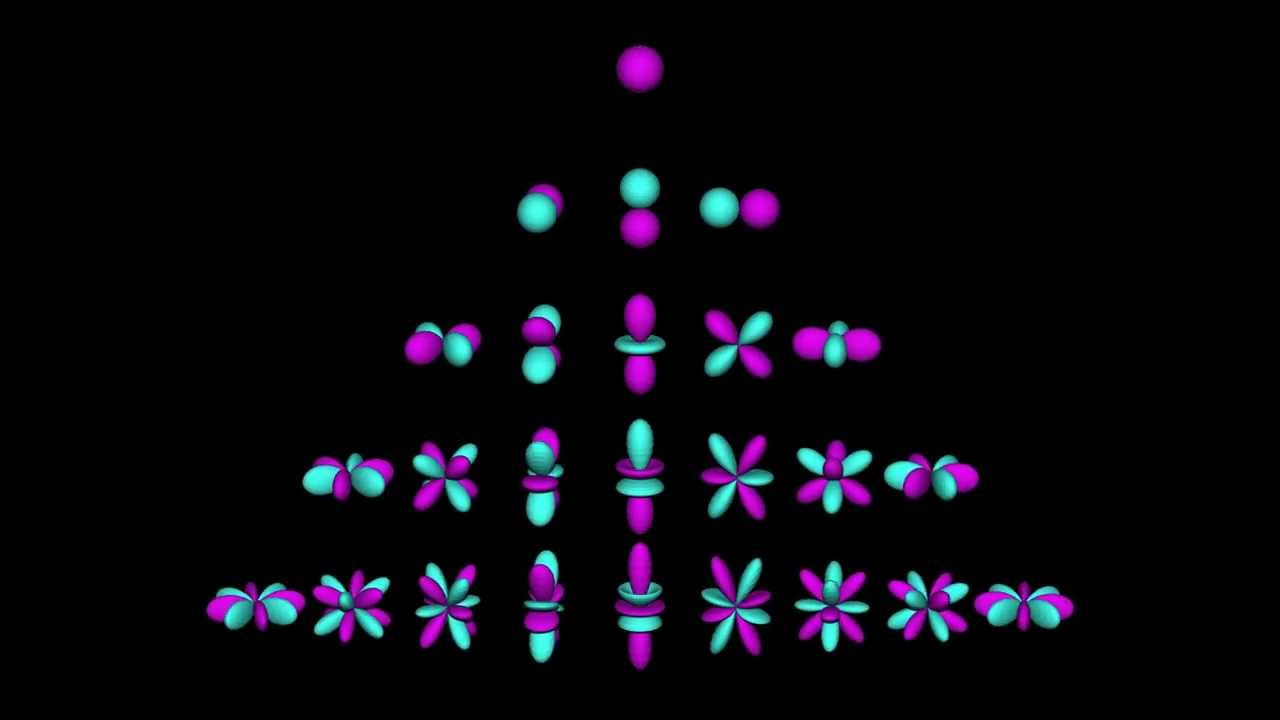
This reminds me a bit of atomic orbitals and how they're based on spherical harmonics. I was curious why there were e.g., eight electron 'sockets' in the second shell. Eight seemed like a very arbitrary number to me and my high school chemistry teacher's inability to explain at the time did it's share to put me off chemistry.

Many years later I remembered my old question and started looking it up. It turns out that eight is the sum of 1+3+3+1 perhaps similarly to what's in the article.

Spherical harmonics ends up giving rise to a three dimensional 'overtone' series (borrowing from my understanding of music theory). In the first order there's only one mode of vibration. In the second order there are three additional modes. The summands above are something like positive and negative degrees of freedom for each mode in the second shell.

Here's a diagram of what the modes look like in each order:

https://i.ytimg.com/vi/OkDYbIhisZE/maxresdefault.jpg

...and here's an animation of a sphere undergoing the differing modes of vibration:

https://youtu.be/EcKgJhFdtEY

If I understand correctly, the math related to atomic orbitals can be described with 3 dimensions of space: x, y and z plus one more orthogonal dimension of frequency/time which would mean quaternions would be most directly applicable?

Re: The Octonion Math That Could Underpin Physics

#173

I think this is the first article I've ever read about the octonions that didn't include the following John Baez quip: "There are exactly four normed division algebras: the real numbers ($\R$), complex numbers ($\C$), quaternions ($\H$), and octonions ($\O$). The real numbers are the dependable breadwinner of the family, the complete ordered field we all rely on. The complex numbers are a slightly flashier but still…

Is there an easy explanation of what problems quaternion or octonions solve? Imaginary numbers are needed to take the square root of a negative number, and complex numbers result from combining the new numbers with the real numbers. Complex numbers also allow solving roots that aren't found in just real numbers. But I have no similar comparison of what I can do with a quaternion or octonion that I can't do with a com…

> Imaginary numbers are needed to take the square root of a negative

No, they are not. That problem is not well defined. A symbol is not a solution.

Complex numbers are needed to solve the polynoms of a higher degree. Eg. x^4+x^2=-1 can be simplified to y^2+y=-1 with y=x^2 which wouldn't have a solu

Re: The Octonion Math That Could Underpin Physics

#174
The really interesting part in all this, is that we're still reduced to bouncing values off of imaginary numbers to obtain accurate readings.

We toss our known quantities into a void, anticipating that if some impossible, imaginary thing really can fill the gap, and if or when it does, we'll catch the rebound off of it, and the rest of the universe proceeds predictably.

Somehow, we're always put into a position where we have to close our eyes, fly blind for some undisclosed intervening moment of unspecified length, and when we open our eyes again, we're grounded by familiar territory again.

It really is kind of stultifying.

Re: The Octonion Math That Could Underpin Physics

#175

I think this is the first article I've ever read about the octonions that didn't include the following John Baez quip: "There are exactly four normed division algebras: the real numbers ($\R$), complex numbers ($\C$), quaternions ($\H$), and octonions ($\O$). The real numbers are the dependable breadwinner of the family, the complete ordered field we all rely on. The complex numbers are a slightly flashier but still…

For the curious, John Baez has written about octonions pretty extensively: http://math.ucr.edu/home/baez/octonions/

Also, Joan Baez's cousin. And her father, Albert Baez, explaining elliptictal orbits: http://www.youtube.com/watch?v=_qpKhCa64Eo

Re: The Octonion Math That Could Underpin Physics

#178

Earlier quoted context omitted.

I guess that's a good overview. It's related to the phenomenon of overfitting in machine learning: you can always easily find a sufficiently complex (or complicated, large if you prefer) theory fitting all data points. Because this theory simply encodes each observed case (including progressive sophistications of encoding), you naturally expect it to fail on unobserved cases -- it makes no effort at generalization. T…

> Honestly I haven't seen attempts at making this process more rigorous, when applied to physics. Marcus Hutter has expressed this idea quite well ( https://arxiv.org/pdf/0912.5434 ) arguing that (a) smaller/simpler theories have more predictive power and (b) the "size" of a theory includes the complexity of its equations and the parameters needed to specify some result. The latter is important because some theories…

Interesting. Apparently he needs to assume a particular multiverse theory to prove it. While I don't object to those on principle, I don't believe they're needed to prove heuristic, good enough versions of Ockham’s Razor that work in the real world (albeit without guarantees), based on the arguments outlined on the previous comments.

> The latter is important because some theories trade off between these two: e.g. a multiverse theory might have simple equations ("every possibility happens somewhere") but require very precise "coordinates" to pin-point the actual possibility that we observe.

I think this is an important observation that's quite obvious for ML researchers et al but again seems to escape current physics discussions. An example is the endless drama about "Fine tuning": if your new theory requires many less bits for equation description, that it requires fine tuning is irrelevant as long as the additional model parameter precision uses less bits -- then it should be the preferred candidate.

W.r.t. [computational] multiverse theories (and variants such as Tegmark's MUH, Schimidhuber's, and others), I do believe they're an inevitable progression of physics/philosophy. I just think it's a bit pretentious to have any certain about a particular flavor. I feel there's still much philosophical and mathematical ground to be covered; it tests the limits of our imagination. It seriously feels like a very important step for humanity at large though -- finally approaching metaphysical theories that actually make sense, and explain the basis of much about humanity, existence, ethics, etc. I think it's an important void to be filled after the decline of religion, hopefully in coonjunction with the spread of humanism.

Re: The Octonion Math That Could Underpin Physics

#179
post #97
post #14

A layman's quest to understand wtf this is... >In mathematics, the octonions are a normed division algebra over the real numbers . wtf is a normed division algebra?? >In mathematics, Hurwitz's theorem is a theorem [...] solving the Hurwitz problem for finite-dimensional unital real non-associative algebras endowed with a positive-definite quadratic form. ... right. I have the same problem when I try to understand any…

unital -> there is a multiplicative identity 1 such that 1.a = a for all a. normed -> there is a norm. A way of saying how big an element is. In the reals |x| - x if x is positive and -x if x is negative. In the complex numbers |a+bi| = (a^2 + b^2)^(1/2) Division -> Division (except possibly by zero) is always possible. That means for a and b not zero there exists c such that a=cb (c is a divided by b) I could be wro…

I think division is normally framed rather as the existence of multiplicative inverses for all non-zero elements of the ring. That is, R is a division ring if

a) there exists a 1 in R

b) for all x in R, there exists y in R such that x * y = 1.

I'm pretty sure these are equivalent.

Proof:

(==>) Let a = 1, and b in R be arbitrary. Then there exists a c such that b * c = 1. So inverses exist!

(<==) Let a and b in R be arbitrary. Then a = a * b^-1 * b, so c = a * b^-1. QED.

Re: The Octonion Math That Could Underpin Physics

#180

Earlier quoted context omitted.

> Einstein never accepted quantum mechanics Wait? Since when did Einstein not accept Quantum Mechanics? He won the Nobel Prize for his work in discovering an important part of Quantum Mechanics. Einstein rejected the Copenhagen Interpretation of Quantum Mechanics. That's not the same thing as rejecting Quantum Mechanics. I've seen no claims that he would object to either the Everett or Bohm Interpretations of QM. (Bu…

Well, he never accepted non-locality. And it turns out, quantum mechanics is indeed non-local.

In the Everett interpretation, everything is local.
Post reply on HN