Live data from Hacker News

AI isn’t good enough

skventures.substack.com

151–160 of 374 posts

Re: AI isn’t good enough

#151
post #137
post #18

This entire piece is based on one massive, unsupported assertion, which is that LLM progress will cease. Or, as the author puts it, "we are at the tail end of the first wave of large language model-based AI... [it] ends somewhere in the next year or two with the kinds of limits people are running up against." I want to know only one thing, which is what gives him the confidence necessary to say that. If that one stat…

The current crop of LLMs is like Paleozoic megafauna, or like Egyptian Pyramids. It takes a few relatively simple approaches and stretches them wildly, using colossal computing resources. Live systems in nature seem to solve similar problems with way less compute available. There should be better architectures. Also, as somebody said, every exponential growth curve is a lower part of a sigmoid. LLMs will plateau at s…

> There should be better architectures.

The drumbeat of progress has been quite steady. On log charts.
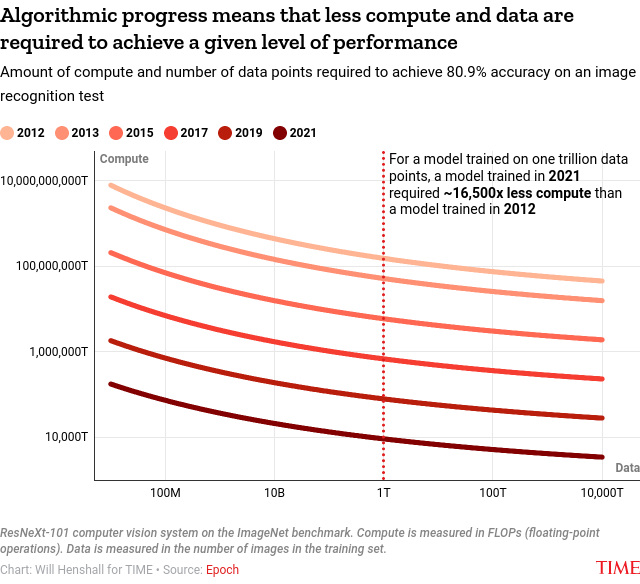
https://files.catbox.moe/w93was.png

Re: AI isn’t good enough

#152

Earlier quoted context omitted.

Anyone who has worked a bit with a top LLM thinks that they learn world models. Otherwise, what they are doing would be impossible. I've used them for things that are definitely not on the web, because they are brand new research. They are definitely able to apply what they've learnt in novel ways.

If they learn world models, those world models are incredible poor, i.e., there is no consistency of thought in those world models. In my experience, things outside coding quickly devolve into something more like "technobabble" (and in coding there is always a lot of made-up stuff that doesn't exists in terms of functions etc.).

It's like if a squirrel started playing chess and instead of "holy shit this squirrel can play chess!" most people responded with "But his elo rating sucks"

Re: AI isn’t good enough

#153
post #18

This entire piece is based on one massive, unsupported assertion, which is that LLM progress will cease. Or, as the author puts it, "we are at the tail end of the first wave of large language model-based AI... [it] ends somewhere in the next year or two with the kinds of limits people are running up against." I want to know only one thing, which is what gives him the confidence necessary to say that. If that one stat…

> This entire piece is based on one massive, unsupported assertion, which is that LLM progress will cease. Which is countered by...the assertion that it won't? LLMs won't get intelligent. That's a fact based on their MO. They are sequence completion engines. They can be fine tuned to specific tasks, but at their core, they remain stochastic parrots. > I want to know only one thing, which is what gives him the confide…

> LLMs won't get intelligent. That's a fact based on their MO. They are sequence completion engines.

A system that could perfectly predict what I would do in response to any particular stimuli, as a continuing sequence, would be exactly as intelligent as me.

> They can be fine tuned to specific tasks, but at their core, they remain stochastic parrot

Othello GPT was an attempt at answering this exact question, it's a simplified setup and appears to learn a world model: https://thegradient.pub/othello/

Re: AI isn’t good enough

#154

Earlier quoted context omitted.

AI has been around the corner since the 1950s, this is the historical evidence for the pessimistic stance against over optimistic predictions. LLMs are a huge stride forward, but AI does not progress like Moore's law. LLM have revealed a new wall. Combining multi agents is not working out as hoped.

Perhaps without intending to, you've cited a pretty appropriate example of overconfident pessimism. Philosopher Hubert Dreyfus is most responsible for this portrayal of AI research in the '50s and '60s. He made a career of insisting that advances in AI would never come to pass, famously predicting that computers couldn't become good at chess because it required "insight", and routinely listing off what he believed we…

There is no doubt that some leading AI proponents in the 1960s were overconfident.

Re: AI isn’t good enough

#155

Earlier quoted context omitted.

If they learn world models, those world models are incredible poor, i.e., there is no consistency of thought in those world models. In my experience, things outside coding quickly devolve into something more like "technobabble" (and in coding there is always a lot of made-up stuff that doesn't exists in terms of functions etc.).

It's like if a squirrel started playing chess and instead of "holy shit this squirrel can play chess!" most people responded with "But his elo rating sucks"

I don't understand why anyone was surprised by computers processing and generating language or images.

Re: AI isn’t good enough

#156
post #150

Earlier quoted context omitted.

The biggest evidence that LLMs can’t reason is hallucinations. If it could reason it would have rejected fictional generated output that make no sense.

Maybe it’s more accurate to say that LLMs lack (self-)awareness. Because when you point out things that make no sense, they do have some limited ability to produce reasoning about that. But I agree that this lack of awareness is a serious and maybe fundamental deficit.

And how often does it get that wrong too?

It’s more likely it’s just, once again, generating the most probable answer - and if you shake the magic 8 ball enough you will get the answer you were expecting.

Re: AI isn’t good enough

#157
AI won't work to reeingineer society, just like the last 100 "latest things" didnt. There is a massive undercurrent that always goes in the opposite direction of technology advancement: tradition!

You need new people growing up and living in a new paradigm to get these changes, you cant just ask (or expect) people who have lived their life one way to change completely to some other way of living

Re: AI isn’t good enough

#158
post #137
post #18

This entire piece is based on one massive, unsupported assertion, which is that LLM progress will cease. Or, as the author puts it, "we are at the tail end of the first wave of large language model-based AI... [it] ends somewhere in the next year or two with the kinds of limits people are running up against." I want to know only one thing, which is what gives him the confidence necessary to say that. If that one stat…

The current crop of LLMs is like Paleozoic megafauna, or like Egyptian Pyramids. It takes a few relatively simple approaches and stretches them wildly, using colossal computing resources. Live systems in nature seem to solve similar problems with way less compute available. There should be better architectures. Also, as somebody said, every exponential growth curve is a lower part of a sigmoid. LLMs will plateau at s…

>Live systems in nature seem to solve similar problems with way less compute available

Do they really? They're certainly more energy-efficient in business-as-usual mode, but a human brain has 86 billion neurons, 600+ trillion synapses(!), and each instance takes 15-20+ years to train to do complex logical tasks. Even if the per-cell work is tiny (and, is it? cells are amazingly complex), 86 billion (or 600+ trillion) times 20 years is a lot of computation.

Re: AI isn’t good enough

#159
Great article. Although I am not sure if we really are reaching the value limits of the current LLMs, as the author mentions. Some fields as legal litigation are being disrupted as much as call centers have, but the change is happening in a much slower fashion, for many reasons. The productivity gain in these fields is potentially high, but so is human displacement. Relevant fact to consider

Re: AI isn’t good enough

#160

Earlier quoted context omitted.

I can take a bet that it haha already failed - the hype cycle has already made a promise that LLMs can’t keep. Hallucinations to the normal person are a bug. The issue is that only humans can hallucinate. We know there is a “reality”. For an LLM, everything it does is a hallucination. That’s why you have more POCs than production goods. Your “hallucination rate” is unknown. Yesterday Ars has an article that described…

The bigger problem is that an accurate LLM is such a massive speed up in coding (an order of magnitude, hypothetically at least), that there is zero incentive to share it. All American programming tech has relied on an time-and-knowledge gap to keep big companies in power. Using visual studio and c++ to create programs is trivial or speedy if you have a team of programmers and know what pitfalls to avoid. If you're a…

[deleted]
Post reply on HN