Live data from Hacker News

The Weird Nerd comes with trade-offs

writingruxandrabio.com

141–150 of 505 posts

Re: The Weird Nerd comes with trade-offs

#141
post #126

Earlier quoted context omitted.

The line you draw between "weirdness" and "neurodivergence" is interesting. Would neurodivergence have to be native (so, not grown "naturally") and at which point does weirdness fit on the spectrum ? Recently I think people are more receptive to lower degrees of neurodivergence. I see it the same way people understand that you have a gradation between having difficulties climbing stairs and not being able to walk. We…

The phrase has sounded weird to me for some time but here it strikes me as especially so: "the spectrum" Just one spectrum, 2 dimensions? Is that all we get? It's a linguistic short-cut, I get that, but I wonder how useful it is, how much nuance it conceals.

Yes, 2 degrees, because autism is a neural "over-connectedness" in the brain that leads to common physical and mental symptoms like toe walking, double hair whorl, sensitivity to sound, etc.

The spectrum can essentially be thought of has the degree of neural "over-connectedness".
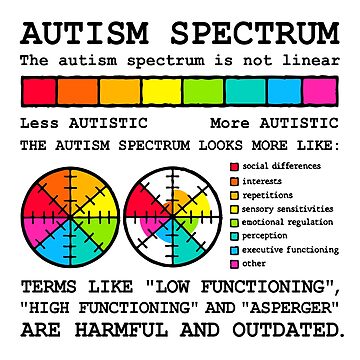
Re: The Weird Nerd comes with trade-offs

#142

While I agree with the notion of the article, please stop calling gifted, driven, and non-conforming people "weird nerds." Both terms have negative connotations.

The intent is to de-stigmatize the labels. I consider myself a "weird nerd". I find the use of the label affirming. Perhaps ASD or other symptom descriptive way to describing things would be more "correct". However "weird nerd" is what the other parts of society use to describe these terms. Using the term to describe the positive aspects of these symptoms helps to take the sting out.

If we're gonna find a better way to work together we need something neutral so that there's no reason to miscategorize yourself. I definitely prefer "weird nerd," to anything that feels like a diagnosis or like praise.

In education they call this "twice exceptional".

Re: The Weird Nerd comes with trade-offs

#143

Earlier quoted context omitted.

The line you draw between "weirdness" and "neurodivergence" is interesting. Would neurodivergence have to be native (so, not grown "naturally") and at which point does weirdness fit on the spectrum ? Recently I think people are more receptive to lower degrees of neurodivergence. I see it the same way people understand that you have a gradation between having difficulties climbing stairs and not being able to walk. We…

At some point the question is “why?”. We can keep atomizing human variability into smaller, more graduated buckets of neurodivergence, but what’s the point, esp. for those that don’t really suffer negative impacts, and for which there isn’t really any remedy besides acceptance?

so that people can identify themselves as being part of a group, and then find others who are also part of that group, just to have a community for support. if I want to find a group of left handed pansexuals who are into Pokemon Go, the Internet facilitates finding your exact flock.

Re: The Weird Nerd comes with trade-offs

#144

It feels like more and more areas of life are regressing to the mean in terms of how status is distributed. The mean being some sort of centralized cabal-like structure (perhaps autonomously/accidentally centralized, like an algo) doling out status. By design, it is highly uneven, quasi-random (there are things that make you eligible but there are no guarantees), and their authority to do so unquestioned. Take social…

Thanks for a thoughtful comment

Re: The Weird Nerd comes with trade-offs

#145
post #104

I have a lot of experience working with the weird nerd archetype and watching them navigate large orgs. First it's absolutely true that orgs that purport to support weird nerds will revert back to rewarding politicians. I've seen it happen, and typically has to do with who is doling out money. However, in my experience the vast majority of brilliant nerds way overextend themselves, and are much too confident outside…

However, in my experience the vast majority of brilliant nerds way overextend themselves, and are much too confident outside their domain. They're also much more likely to be jerks and will tumble from conflict to conflict until they get their way by attrition or status. Conflicts are strangely more personal because so much ego is tied up into it. They're more likely to assume they're right in every (non-tech/science related) situation.

Your next paragraph gives advice to the weird nerds, but this is practically a genre. What I haven’t seen much of is advice to an organization about how to deal with what you’re pointing out here.

You have an employee that’s brilliant in technical area X but also has very strong and very wrong opinions about how the company ought to structure its cap table, pay its cleaning staff, and market to potential customers. He gets into constant arguments about these things. What do you do?

Re: The Weird Nerd comes with trade-offs

#146

Earlier quoted context omitted.

The line you draw between "weirdness" and "neurodivergence" is interesting. Would neurodivergence have to be native (so, not grown "naturally") and at which point does weirdness fit on the spectrum ? Recently I think people are more receptive to lower degrees of neurodivergence. I see it the same way people understand that you have a gradation between having difficulties climbing stairs and not being able to walk. We…

You didn't use this word specifically but this whole conversation has the underlying prior of the "everything is a spectrum" mindset. In that context, everyone is neurodivergence because, afterall it's a spectrum we're all on and nobody is going to be deadest average. At some point we have to define at what point these spectrums become clinical. The kind of language you see in the DSM for stuff like this is "does it…

Autism is a result of neurons failing to "trim" or being over-connected. Being "on the spectrum" refers to the degree of above average physical over-connection of neurons. The opposite, when neurons fail to connect or lose too many connections is called schizophrenia.

People that are between the two, the vast majority of people, are not said to be either autistic or schizophrenic (you can't be both at the same time but can go from autistic to schizophrenic with a degenerative disease). Everyone is not "on the spectrum" for autism, again by definition no one that is schizophrenic is "on the spectrum" for autism at all so your comment is nonsensical.

Re: The Weird Nerd comes with trade-offs

#147

> In 2011, the average age at which a biomedical scientist gets their first R01 grant to establish their independent career as a PI is 42 This is ridiculous! The best researchers won't be much better at 45 than 25, so it's just wasting 20 years getting "experience" and moving up the ladder. But by nature of getting that experience, they're going to give up on actual innovation.

The best researchers won't be much better at 45 than 25

To get great research done you have to be great manager who can prioritise time and resources, balance a budget, forge connections with other researchers, get the most out of the people working for you and know where and how to get even more funding to keep the research going after the initial round of research dries up. Those 20 years might not make you a better 'scientist', but hopefully they will make you better at all the other 'soft' skills that are required for successful scientific research. At 25 you should be focusing on the science and doing research and not have to bother with all that 'crap'.

Re: The Weird Nerd comes with trade-offs

#148

Earlier quoted context omitted.

I read the article as acknowledging this pressure by arguing that Weird Nerds should not be forced into people management positions. Without the workplace pressure on Weird Nerds to become people managers, would they still manage people? Maybe not. I can’t speak for academia, but in tech companies I’ve worked at I’ve seen a marked improvement in management when there’s a tech track for engineer advancement such that…

Even if you’re not doing performance reviews there’s still a need for directing people technically when the work exceeds what one person(even a 10xer(if such a thing really exists), and that’s where you need some minimum amount of EQ

I think the contention is that playing political games, as quoted in the article, is beyond the minimum amount of EQ normally expected for a non-management role.

Problem is that many places design their ladder such that non-managers are expected to do manager-like work past a certain level. This is to much dismay of those people who are not trained in management skills, and most of the skills they have acquired thus far are no longer being put to good use. These Weird Nerds may very well understand that being at the next level means making impact that exceeds what one person can do alone, nonetheless they will become increasingly unhappy at those roles. Maybe they will leave, maybe they will avoid getting promoted to higher levels in the first place.

Re: The Weird Nerd comes with trade-offs

#149
post #126

Earlier quoted context omitted.

The line you draw between "weirdness" and "neurodivergence" is interesting. Would neurodivergence have to be native (so, not grown "naturally") and at which point does weirdness fit on the spectrum ? Recently I think people are more receptive to lower degrees of neurodivergence. I see it the same way people understand that you have a gradation between having difficulties climbing stairs and not being able to walk. We…

The phrase has sounded weird to me for some time but here it strikes me as especially so: "the spectrum" Just one spectrum, 2 dimensions? Is that all we get? It's a linguistic short-cut, I get that, but I wonder how useful it is, how much nuance it conceals.

Picture a color wheel instead of a continuum.

Here's an image that shows what I mean: https://ih1.redbubble.net/image.4683716510.9542/raf,360x360,...

Re: The Weird Nerd comes with trade-offs

#150
post #104

I have a lot of experience working with the weird nerd archetype and watching them navigate large orgs. First it's absolutely true that orgs that purport to support weird nerds will revert back to rewarding politicians. I've seen it happen, and typically has to do with who is doling out money. However, in my experience the vast majority of brilliant nerds way overextend themselves, and are much too confident outside…

> assuming emotional intelligence isn't an innate skill it's a skill like any other, so if you put in dedication and practice, you can get better at it, just like practicing leetcode. whether or not an individual wants to do so is on them.

While I think this is true, some people have it harder than others. So sure, anyone can learn emotional intelligence, but if it's 2x the effort for someone the ROI is much worse.
Post reply on HN