Live data from Hacker News

Cryptocurrency in the 2020s

blog.coinbase.com

141–150 of 278 posts

Re: Cryptocurrency in the 2020s

#141

Earlier quoted context omitted.

Most people? Personal loan rates are closer to 7-8% on average I think. The fed funds rate is the very basic rate of economic activity. I mean, you obviously included the caveat about the spreads for retail products. What did you think those spreads looked like?

The effective cost of borrowing is going to be considerably higher than 6% if a regular person is trying to pay for their living expenses with the principal of a loan denominated in cryptocurrency. Think about exchange fees, taxes for any appreciation/depreciation upon sale, the cost of tracking/filing the taxes etc. As I said it seems like most of the DAI borrowing is being done by people taking out margin loans to…

> The effective cost of borrowing is going to be considerably higher than 6% if a regular person is trying to pay for their living expenses with the principal of a loan denominated in cryptocurrency. Think about exchange fees, taxes for any appreciation/depreciation upon sale, the cost of tracking/filing the taxes etc.

I agree with that entire paragraph, so the rest of your comment is moot in terms of debate. However, I was just saying that on its face, 6% inside the USA is a good rate for loans.
Re: Cryptocurrency in the 2020s

#142

Earlier quoted context omitted.

I find it hilarious you think Coinbase CEO Brian Armstrong doesn't "know what Bitcoin is for." Maybe you don't know what it is for. People that are sane like Mr. Armstrong and Satoshi Nakamoto intended it to be used as a currency. If Satoshi is still alive I'm sure he was quite disappointed when Bitcoin decided to not scale past its blistering 7 transactions per second. "Bitcoin can already scale much larger than tha…

Bitcoin is continuing to scale, but it's doing so with the Lightning Network instead of by increasing block size. I'm not super familiar with Bitcoin's tech, but that seems sensible to me. The blockchain is already 250 GB at 7 transactions per second. If you multiplied that by 100, you still have orders of magnitude less transactions per second than credit card processors, but the hardware requirements are now high e…

Correct me if I'm misunderstanding things, but Lightning Network means off-chain transactions, right? Which can be be reneged on if one party is malicious, meaning they'll only occur between trusted parties? And in practice, that means traditional financial services companies and their KYC-compliant customers, which is the exact 180 degree opposite of the originally envisioned use case.

From where I sit, it seems like BTC was designed to be a currency that would free us from financial regulation, it has failed on both counts, and crypto enthusiasts are trying to turn it into an over-elaborate debit card because the alternative is for it to become a historical curiosity.

Re: Cryptocurrency in the 2020s

#143

Earlier quoted context omitted.

I find it hilarious you think Coinbase CEO Brian Armstrong doesn't "know what Bitcoin is for." Maybe you don't know what it is for. People that are sane like Mr. Armstrong and Satoshi Nakamoto intended it to be used as a currency. If Satoshi is still alive I'm sure he was quite disappointed when Bitcoin decided to not scale past its blistering 7 transactions per second. "Bitcoin can already scale much larger than tha…

Every single crypto that has tried to pass that limitation has remained centralised in one way or another. You can either: 1) have centralisation 2) assume storage space will expand exponentially since the entire point of bitcoin is many many copies of its ledger 3) come up with a new method more secure than PoW but still decentralised Good luck with (3). (1) and (2) are not good choices. So they moved it off the cha…

I'm not sure what you mean by "assume storage space will expand exponentially", since there is only a limited number of potential active crypto-currency users, making a small number of daily transactions (ignoring things like High Frequency Trading), recorded in a blockchain that grows linearly over time.

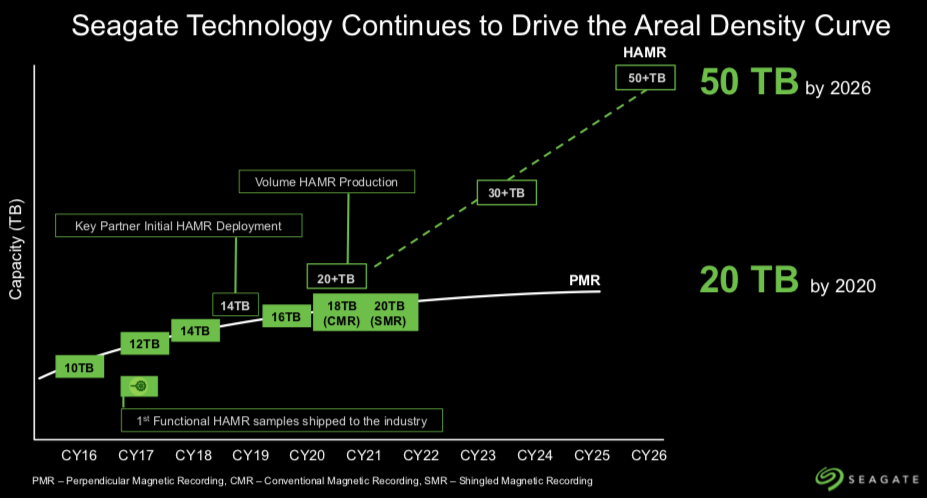
Would you say that the credit card network, or PayPal, has exponentially increasing storage requirements? It's possible for Bitcoin (for example) to be decentralised and useful to the world and only require linearly increasing storage space.

Fortunately it seems that storage technology will continue to scale linearly over the coming years too:

https://images.anandtech.com/doci/15064/seagate-roadmap.png

Re: Cryptocurrency in the 2020s

#144
post #28

Earlier quoted context omitted.

> anonymity/privacy Nope. Bitcoin and others don't solve this at all. They're a literal permanent ledger of every single transaction you've ever made. Other coins might be better at anonymity, but BTC and its derivatives are certainly not.

Quite easily solved. There are plenty of services that will put your coin through an anonymizer, much like a VPN, or Tor.

There is also coinjoin which is a service that mixes your coins with other participants. I also heard the Lightning network which operates on some kind of application level provides some kind of extra obfuscation.

Re: Cryptocurrency in the 2020s

#145
post #28

Earlier quoted context omitted.

> anonymity/privacy Nope. Bitcoin and others don't solve this at all. They're a literal permanent ledger of every single transaction you've ever made. Other coins might be better at anonymity, but BTC and its derivatives are certainly not.

Quite easily solved. There are plenty of services that will put your coin through an anonymizer, much like a VPN, or Tor.

This is not what anonymity looks like brother. Your IP address is not what links you to your bitcoin. It's your bitcoin address. And since we have a running ledger of all transactions, anyone can write a small script to trace your coins once they know even one of your addresses.

The work around for this is what they call a coin tumbler - it takes your coins and those of say 5 more people, mixes them up real nice by moving them around a couple of wallets in many complicated transactions and then hands them back to a wallet you want from thousands of these mixed up addresses.

Re: Cryptocurrency in the 2020s

#146
post #8
post #5

Earlier quoted context omitted.

> ... did you not notice the everyone doing their own ICO when bitcoin was 20k? Are you saying it will happen again? I don't think that's what they're saying. I suspect it'll be more like support for existing major cryptocurrencies like Ethereum and Bitcoin. Either for payments or smart contracts, or other decentralized book-keeping. I'm not convinced about "almost every tech startup", but I do think it'll become mor…

There is like ~5 million people using crypto right. I could see this being possible if that number was closer to 500+ million

At 500M it's already mainstream.

Re: Cryptocurrency in the 2020s

#147
This is a post written by a crypto company, which has all its interest in keeping it alive. Hopefully 2020 will be a watershed movement in crypto world and people will stop calling a peer to peer distributed exchange mechanism by names similar to money.

Crypto is not money and company like coinbase thrive on that information asymmetry because a normal person do not understand that cryptocurrency is not really a money,but a network of computers trying to fix some arbitrary value to a sequence of string which are worthless in themselves if not widely used for exchange of goods and services.

Hopefully in 2020 peer to peer exchange of good and services evolve and companies like coinbase don’t need to exist (this was the true purpose of distributed currency to get rid of companies like coinbase and being hold hostage by them by keeping wallets under their supervision without liability unlike the way bank maintains account with liability and protection).

Re: Cryptocurrency in the 2020s

#148
post #99

Earlier quoted context omitted.

Who eats the cost when one of these borrowers defaults?

A default is not possible. The loans are fully secured by Ethereum. If collateral dips below an acceptable threshold, the collateral is liquidated and the debt is payed back to the system in full

What’s the point of the loan then? Why not just use the collateral at 0%?

Re: Cryptocurrency in the 2020s

#149

Earlier quoted context omitted.

I remember people scoffing at the internet like there no legitimate use-cases for it. "Yeah, we have places for information, it's called Grolier's Encyclopedia on CD-ROM, and it's cheap!". "I already have yellow pages delivered for free by C&P Bell". While cryptocurrency may be quite a bit more narrow, blockchain is most likely a far more interesting technology.

> blockchain is most likely a far more interesting technology. Why? Really, I would like to know why you think this. Append-only data structures have existed almost since the dawn of computing. Making it distributed and trustless doesn't seem to solve any real problems, which is why over a decade since they entered the public consciousness they are used for almost nothing interesting, and nothing that couldn't be don…

> Making it distributed and trustless doesn't seem to solve any real problems

Tell that to all the people that are either denied bank accounts, denied loans, have had their Paypal accounts frozen or funds held for apparently no reason, etc.

> which is why over a decade since they entered the public consciousness they are used for almost nothing interesting, and nothing that couldn't be done better in a centralised system

The infrastructure and tools are being developed. And please don't say you've been hearing that for 10 years. Literally everything needs to be recreated from the ground up for a new protocol and financial system. This takes a lot of discussion on proposals, development, and testing. Not to mention that all improvements are being done on a live system so everything needs to be backwards compatible.

Re: Cryptocurrency in the 2020s

#150
post #10

Earlier quoted context omitted.

I remember people scoffing at the concept of 100 dollars per bitcoin like it couldn't possibly happen.

yea except that something cannot scale at such a rapid rate forever. Bitcoin and the rest of the market is sooo much bigger than it was back in 2013 when it was at $100. It requires so much money to make Bitcoin go up 50%.

That's also why the rate is slowing and 1000x is no longer a thing.
Post reply on HN