Live data from Hacker News

Gravitricity

gravitricity.com

121–130 of 222 posts

Re: Gravitricity

#121
post #115
post #50

Earlier quoted context omitted.

What advantage does this provide over combining all your weights together into one big one? If you want to limit the tension on the cable, just use more cables. You shouldn't be so confident that you know the only "sane" way to design such a thing. It's not a field anyone has experience in. These are only guesses.

Well, it does mean your cables and dynamo can be smaller. But then you've got a new problem of coupling the cables to the load at the bottom and somehow storing loads at the top that the cables must reach past/through.

You have a shaft 1km or 1.5km deep. You can afford to stack a lot of weights vertically. Imagine each has a hole running through the middle, where the cable runs, and a mechanism whereby the weight can engage/disengage from the cable. The cable forms a circular loop that passes through all the weights from the top of the shaft to the bottom, then circles around past a large pulley and back to the top, completing the loop.

At the top of the shaft there would be hefty prongs that retract when the weight needs to start dropping, and when the weight returns during a recharge cycle, the prongs reinsert themselves in to the shaft when the weight is lifted back into position.

Most likely each weight would have a "C" cross section with a nearly closed mouth -- just a slot from the edge of the weight to the larger central opening so that the weight can be removed/replaced from the cable if needed.
Re: Gravitricity

#122

Earlier quoted context omitted.

Actually an inclined plane and a hole in the ground are identical in terms of their energy storage, both are a function of their highest and lowest points. Which suggests a very simple implementation which is to run a pair of rails up the side of a mountain and but the winder/generator at the top and tie it off to the end of a rail car filled with rocks. Sure you would give up some efficiency with the friction of rai…

External rails on a mountain don't allow for the optional compressed air part of the system that (according to the page) can double the efficiency of the system at less than double the cost.

Also it uses way more valuable surface area. Especially when you consider the safety measures that would be required.

Re: Gravitricity

#123
post #99

Earlier quoted context omitted.

To be fair, there are many, many more Show HNs which wound up going nowhere.

That's the hard part though, isn't it? Telling the difference between bad ideas and good ones. Even professionals at it (AKA venture capitalists) get it wrong all the time. So the questions is- knowing that you don't know whether you're looking at a bad idea or a good one, how should you behave?

The responses in that Dropbox thread were pretty solid though. To all the naysayers, I mean. It's sort of a ritual format to test any new idea with the back and forth. That in and of itself isn't a problem.

Real problems: Dismissive people who don't/can't/wont listen to good responses. Good founders/ideas but just really bad at communicating. Those are basically the type i and type ii errors of this format.[1]

_____

[1] A grey area exists in some other areas too (some people just get 'lucky'; others for good reason can't disclose everything the key answers/insights for competitive reasons)

Re: Gravitricity

#124

The key figure of merit for comparing energy storage is not $/KWh, but rather $/KWh*Number of cycles. Li-ion only has about a 1000 cycles. Assuming one cycle per day (solar charge during day+discharge during night) in 50 years there are 18000 cycles. The figure of merit for Li-ion is 250x1000=2.5e5. My estimate (and those of others) is that this costs up to about $2000/KWh. So the figure of merit for this is 1000x180…

Sandia National Labs has done the math but it's quite the PDF at 340 pages describing just about every variety of energy storage:

http://www.sandia.gov/ess/publications/SAND2013-5131.pdf

Re: Gravitricity

#125

Earlier quoted context omitted.

One major advantage this would have over chemical batteries (Lithium-Ion or otherwise) is that it should allow for many, many more cycles. You would have to replace cables and motors and such at some point, but the expensive components - the hole and the weight - should last near-indefinitely. It certainly appears more expensive than pumped storage, but as they say, it doesn't require a convenient mountain and lake.…

Now that you mentioned a mountain... Why again is a hole needed? Edit: I mean that an inclined rail could be just as good as a hole, and way cheaper.

Peak-power output would be less for an inclined rail (vs the vertical shaft solution).

Re: Gravitricity

#126

This is just rampant speculation - but what if they used depleted uranium as the weight? They could get paid to take the material off others hands (instead of buying lead) and it's almost 70% more dense.

Wouldn't the initial cost savings be offset by the ongoing challenges of dealing with a big moving chunk of hazmat?

Re: Gravitricity

#127

Let's do out the math on this... A subway tunnel might have a diameter of about 6 meters, so cross section = 3 * 3 * pi = 28 square meters. Digging subway tunnel through rock costs about $100M per kilometer. On the one hand, these holes would be vertical, which is harder than horizontal; on the other hand, they wouldn't need ventilation and train tracks and stuff. Let's handwave and say it's $100M for a 1 km deep hol…

>On the one hand, these holes would be vertical, which is harder than horizontal

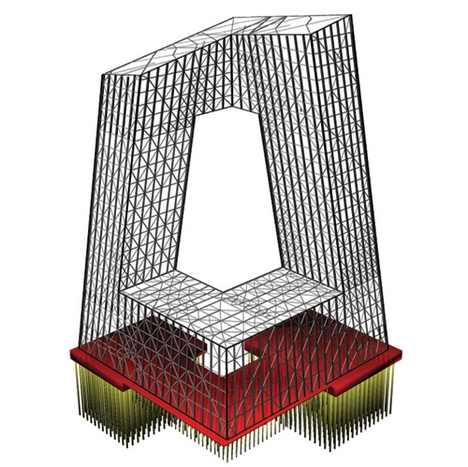
I don't think this is the case. We dig vertical holes all the time for wells, geothermal, and pilings for buildings: http://www.bdonline.co.uk/Pictures/web/r/r/g/CCTV_17_foundat...

Look at all of them! For one building!

Re: Gravitricity

#128

Let's do out the math on this... A subway tunnel might have a diameter of about 6 meters, so cross section = 3 * 3 * pi = 28 square meters. Digging subway tunnel through rock costs about $100M per kilometer. On the one hand, these holes would be vertical, which is harder than horizontal; on the other hand, they wouldn't need ventilation and train tracks and stuff. Let's handwave and say it's $100M for a 1 km deep hol…

What about depleted Uranium? 19G / cm^3, 1.7 the density of lead. No idea what the cost is, but I can't imagine that waste material would be that costly.

Re: Gravitricity

#129
post #57

Seems like this would be more cost effective as a component of sky-scrapers. Generator on top, series of weights on rails down the sides.

No, the additional load is not worth it. It would be one of the least sustainable things you could do due to all of the heavier columns you'd have to use.

Re: Gravitricity

#130

Let's do out the math on this... A subway tunnel might have a diameter of about 6 meters, so cross section = 3 * 3 * pi = 28 square meters. Digging subway tunnel through rock costs about $100M per kilometer. On the one hand, these holes would be vertical, which is harder than horizontal; on the other hand, they wouldn't need ventilation and train tracks and stuff. Let's handwave and say it's $100M for a 1 km deep hol…

This is wrong.

1. Digging mine shafts is dramatically cheaper than structal tunnels. They dig exploratory shafts frequently to roughly these depths for well under $1m

2. Using a disused mineshaft would have a negative cost associated with it because the security associated with keeping it safe is non zero.

Post reply on HN