Live data from Hacker News

Opera moves to WebKit

my.opera.com

111–120 of 295 posts

Re: Opera moves to WebKit

#111

I worked for Opera the summer of 2010 and I've also been using the browser the last couple of years. Compared to Google, Apple, Microsoft - it is important to understand that Opera is a small, very small, company. I'm very happy to see their resources better used to innovating and improve their exiting product, rather than trying to catching up to the other browsers. A big loss for the general state of rendering plat…

I don't think it's a loss, I wouldn't mind if every browser switched to Webkit. Problems with cross-browser rendering differences would be gone, all browsers would use the same newest technologies and the engine would evolve much faster.

There is a big difference between a standard and an implementation. If you only have one implementation (webkit), then developers will start being lazy and depending on certain quirks of that implementation. You reach a point where these quirks can't be changed, otherwise half the internet will stop working. Having multiple rendering engines means these quirks are more likely to be fixed, and not relied upon. It's also impossible to say if webkit will still be the dominant engine in 5-10 years.

For the same reason, this also leads to degradation, and slows down the evolution of the engine. A good example is gcc vs clang. For years gcc was the compiler for *nix, then clang comes along. This led to a new found enthusiasm to make parts of gcc better. The same happened for firefox when chrome came along. and works the other way. We even have half-decent IE releases now.

Re: Opera moves to WebKit

#112
To all who want to compare webkit being dominant with IE: don't. IE was closed source, and most important of all: it was not developed for a long time after IE6. WebKit development is very active, there are several companies involved and there is still a lot of work they are willing to do in bringing it forward.

Re: Opera moves to WebKit

#113

Earlier quoted context omitted.

On the other hand, if all browsers just used webkit then maybe we'd finally get "write once, run anywhere" JS, CSS, etc.

Yes, because when IE was the dominant browser that was totally the case. Don't forget that on mobile platforms, not including Windows Phone, WebKit is already the standard engine. Safari, Android's stock browser and Chrome all use WebKit and developing for mobile is a ghetto , especially because each version has their own quirks and bugs (and there are dozens of Android stock browser variations in active use at any g…

IE wasn't open source and wasn't maintained on any other platforms than Windows (the Mac and Solaris versions were woeful).

WebKit can be maintained, forked etc as the world pleases.

Re: Opera moves to WebKit

#114

This is how it works - open source quality created by enthusiastic community wins proprietary crap produced by wage coders counting hours and lines of code. This is how the end of the era of proprietary software (NOK, MSFT, ORCL, SAP, even AAPL) will look like.

Except that Apple and Google are some of the main open source developers behind WebKit. Of course Opera has been outgunned.

This is complicated. Google tries to create (or emulate) something like community of individual engineers which rests on principles like "do no evil" or whatever. An order of some kind. It works. So, we could say that contributions are of individuals, not of Google. Even if contributors get paid for full-time, it is their own intention in the first place. At least it is what they want things to look like.

As for Apple, there are probably just programmers on a payroll. Apple has a different culture. It is a Steve's workshop, where they "invent" things, or whatever they think these days.

Re: Opera moves to WebKit

#115
Opera value preposition was in that they provided a complete solution (rendering engine, network stack, filesystem integration, security, customizable UI, etc.) People and companies often picked up WebKit for their hardware platform without realizing how much stuff is there besides the renderer itself. As a result, they had to spend more time on porting the rest of the stack and were late to market. That's, for example, what happened to Nokia with Symbian Webkit and their clone of Mini.

Opera provided SDK and offered custom development services around their platform for a good price. Honestly, I don't think that their business model would suffer much because of the switch.

The primary benefit of Presto are very modest hardware requirements. It can run on almost every hardware platform (even something that doesn't have a proper port of Linux core and GCC). That used to be pretty important in 1999, in 2005 and even in 2009, but in recent years it gets a lot cheaper to grab a good enough ARM core for your device, slap either a small Linux kernel, or even Android on top of it; rather than having a dedicated team of engineers struggling with something that barely runs an odd build of Watcom C compiler.

Opera was always moving against the mainstream. They optimized for worst hardware while it was getting better. They optimized for limited bandwidth with Mini while network speeds were rapidly increasing. They optimized for memory consumption with Futhark while Mozilla and Google were busy breaking JavaScript speed records.

None of that were bad moves per se, but this company is very different from its competitors. Maybe that's the main reason why it survived and has been moderately successful during all these years.

As a result, their userbase also moved over time. They got popular in Easter Europe in late 90s, moved to South East Asia and South America in the middle of 00th, and now are very popular in Africa. They used to be pretty big on desktop, then moved to mobile, and now to embedded and devices market.

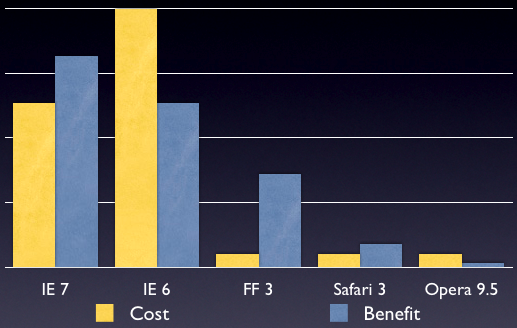
I remember seeing a number of blog posts where web developers dismissed the importance of Opera, saying that only Russians and people from Africa are using it and they are not the ones who click on ads and make purchases. Wbedevs criticized poor developer tools, poor graphic performance, weird bugs. Google always tried to persuade Opera users to switch (http://my.opera.com/ODIN/blog/google-browser-sniffing-and-th...), Yahoo pulled it from their Grade Browser Support (http://www.yuiblog.com/blog/2009/10/16/gbs-update-2009q4/), John Resig's slide got picked up by masses (http://ejohn.org/images/cost-benefit.png).

One thing where Opera shines is a UI innovations. When Chome was released I counted about 30 big and small things that they wisely borrowed from Opera UI. That was almost five years ago and Opera was moving fast, too. Mouse gestures, broad customizability, passionate users and some of the greatest people working in the company. I'm pretty certain that Opera's future is bright and shiny!

---- Former Opera employee and devoted user, speaking for myself, obviously.
Re: Opera moves to WebKit

#116
post #105
post #85

Earlier quoted context omitted.

Since webkit is opensource and largely a collaborative effort, I think the monoculture will be a good thing. Instead of having multiple vendors working on multiple competing products, they can now work on multiple competing features.

Since webkit is opensource and largely a collaborative effort, I think the monoculture will be a good thing How does one follow from the other? Technical monopolies are good if they're opensourced? I couldn't disagree with this more strongly.

A monopoly is bad for competition, but do we need competition in a market where pricing is irrelevant? It's better to have all vendors collaborating on a standard engine than multiple proprietary ones. What are the negatives?

Re: Opera moves to WebKit

#117
As I stated on the other thread: It's a wise move for Opera. Now they can hire webkit-engineers from anywere without heavy training on their own private model.

Re: Opera moves to WebKit

#118
post #105

Earlier quoted context omitted.

Since webkit is opensource and largely a collaborative effort, I think the monoculture will be a good thing How does one follow from the other? Technical monopolies are good if they're opensourced? I couldn't disagree with this more strongly.

A monopoly is bad for competition, but do we need competition in a market where pricing is irrelevant? It's better to have all vendors collaborating on a standard engine than multiple proprietary ones. What are the negatives?

You need competition for technical evolution. Pricing has nothing to do with this.

As pointed out elsewhere in this thread, a WebKit monoculture will stifle technical innovation in web rendering engines, because they'll be constrained with being (bug-)compatible with WebKit.

Re: Opera moves to WebKit

#119

Earlier quoted context omitted.

On the other hand, if all browsers just used webkit then maybe we'd finally get "write once, run anywhere" JS, CSS, etc.

Yes, because when IE was the dominant browser that was totally the case. Don't forget that on mobile platforms, not including Windows Phone, WebKit is already the standard engine. Safari, Android's stock browser and Chrome all use WebKit and developing for mobile is a ghetto , especially because each version has their own quirks and bugs (and there are dozens of Android stock browser variations in active use at any g…

IE was dominant on one OS. It wasn't dominante on anything else than Windows world. Please, and that dominion lasted no more than 10 years. It ended with Android and iOS.

Re: Opera moves to WebKit

#120

Smart move. I don't know a single web dev who tests on Opera anymore. I personally stopped worrying about it for any of my products when it hit 1.6% market share, and that was five years ago. They're essentially not supported by anybody, and haven't been for a long time. ... But that's never mattered, since they have always known it. And they went out of their way to make sure they rendered exactly like the dominant…

[deleted]
Post reply on HN