Opera value preposition was in that they provided a complete solution (rendering engine, network stack, filesystem integration, security, customizable UI, etc.) People and companies often picked up WebKit for their hardware platform without realizing how much stuff is there besides the renderer itself. As a result, they had to spend more time on porting the rest of the stack and were late to market. That's, for example, what happened to Nokia with Symbian Webkit and their clone of Mini.
Opera provided SDK and offered custom development services around their platform for a good price. Honestly, I don't think that their business model would suffer much because of the switch.
The primary benefit of Presto are very modest hardware requirements. It can run on almost every hardware platform (even something that doesn't have a proper port of Linux core and GCC). That used to be pretty important in 1999, in 2005 and even in 2009, but in recent years it gets a lot cheaper to grab a good enough ARM core for your device, slap either a small Linux kernel, or even Android on top of it; rather than having a dedicated team of engineers struggling with something that barely runs an odd build of Watcom C compiler.
Opera was always moving against the mainstream. They optimized for worst hardware while it was getting better. They optimized for limited bandwidth with Mini while network speeds were rapidly increasing. They optimized for memory consumption with Futhark while Mozilla and Google were busy breaking JavaScript speed records.
None of that were bad moves per se, but this company is very different from its competitors. Maybe that's the main reason why it survived and has been moderately successful during all these years.
As a result, their userbase also moved over time. They got popular in Easter Europe in late 90s, moved to South East Asia and South America in the middle of 00th, and now are very popular in Africa. They used to be pretty big on desktop, then moved to mobile, and now to embedded and devices market.
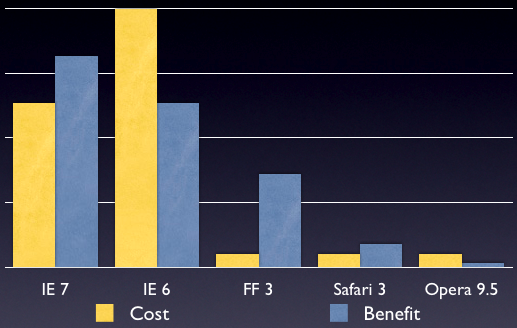
I remember seeing a number of blog posts where web developers dismissed the importance of Opera, saying that only Russians and people from Africa are using it and they are not the ones who click on ads and make purchases. Wbedevs criticized poor developer tools, poor graphic performance, weird bugs. Google always tried to persuade Opera users to switch (http://my.opera.com/ODIN/blog/google-browser-sniffing-and-th...), Yahoo pulled it from their Grade Browser Support (http://www.yuiblog.com/blog/2009/10/16/gbs-update-2009q4/), John Resig's slide got picked up by masses (http://ejohn.org/images/cost-benefit.png).
One thing where Opera shines is a UI innovations. When Chome was released I counted about 30 big and small things that they wisely borrowed from Opera UI. That was almost five years ago and Opera was moving fast, too. Mouse gestures, broad customizability, passionate users and some of the greatest people working in the company. I'm pretty certain that Opera's future is bright and shiny!
----
Former Opera employee and devoted user, speaking for myself, obviously.