Live data from Hacker News

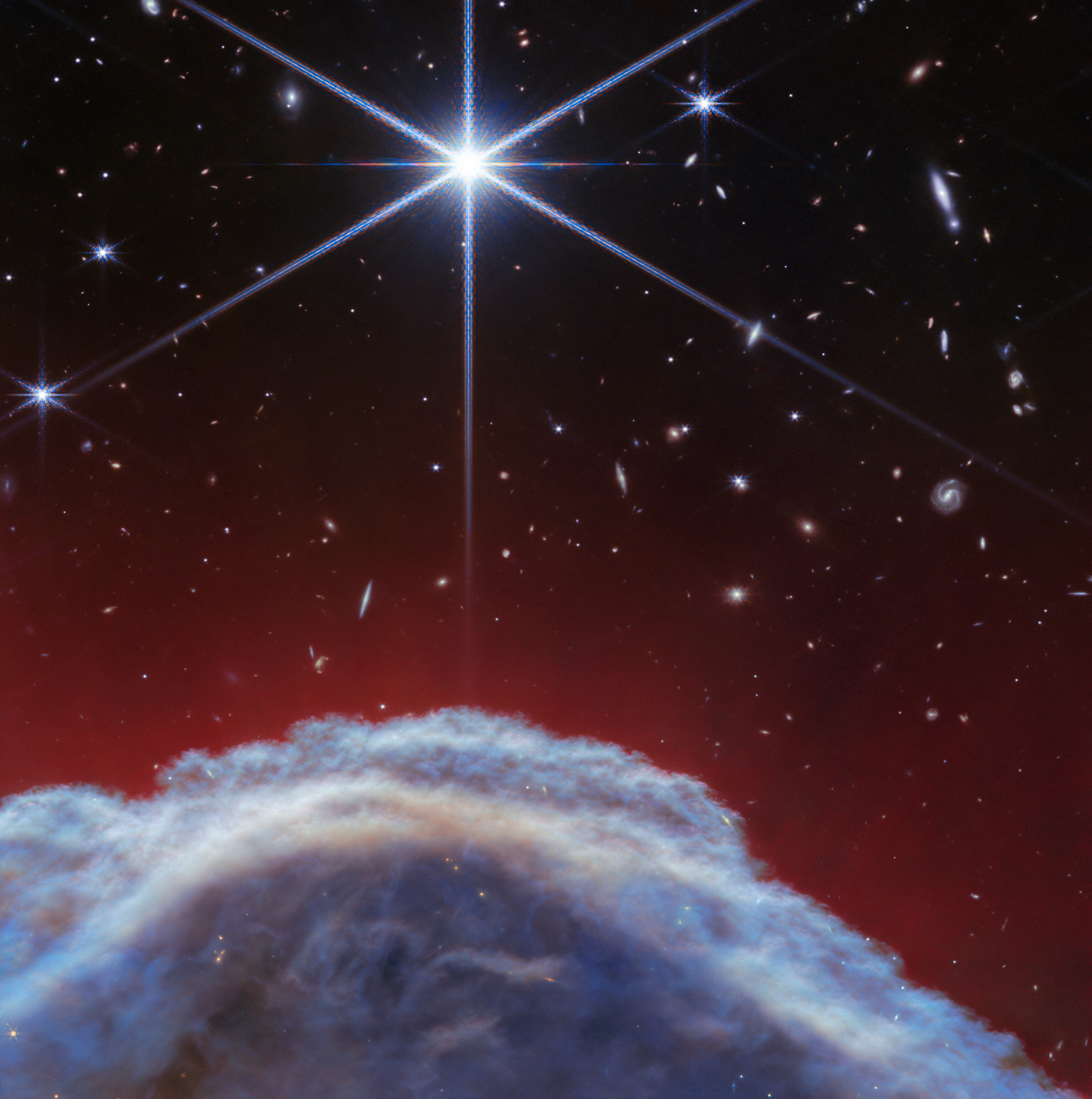
Webb captures iconic Horsehead Nebula in unprecedented detail

esa.int

111–120 of 310 posts

Re: Webb captures iconic Horsehead Nebula in unprecedented detail

#111

The youtube link to a 'zoom' in video to the image: https://www.youtube.com/watch?v=TkVprNB5XbI What is really, really neat to notice isn't just the detail in that final image.... look behind it, and there are whole edge-on spiral galaxies in the distance. Not stars. Galaxies. The nebula is about 1375 light years away. Those galaxies in the distance.... are billions of light years away. It's hard to comprehend.

I found this mesmerizing. Particularly fun is to scrub forward and backward through the video to clarify where exactly you're looking. (I found it worked better on the embedded video in the article than the yt one, not sure why)
Re: Webb captures iconic Horsehead Nebula in unprecedented detail

#112
post #81

Earlier quoted context omitted.

So if the universe has a size then what do you see if you are on the edge of it? Do you see stars to the left and nothing to the right? I mean given the speed of light and the age of the universe and the rate of expansion there are regions inaccessible to us but that doesn't quite mean the universe has a finite size.

The observable universe has a size, the cosmic microwave background is what we 'see' at the 'edge' in terms of photons (~400k years after the big bang). We could see further if we could map out the gravitational wave or neutrino backgrounds (1 sec after the big bang). But for now we can't really say if the universe in its entirety has a finite size.

Fascinating. Do you think it's possible that we can map these out in the next 50 years?

Re: Webb captures iconic Horsehead Nebula in unprecedented detail

#113
post #82

Earlier quoted context omitted.

Replying to the other replies here - this regards the observable universe. Speed of light limits and all that. Of course we have no reason to believe the universe just stops at the point where we happen to lack the ability to observe.

Well, no. The density in the observed universe is used to extrapolate the number of galaxies in the non-observed universe. The size of that universe is extrapolated from the rate of expansion and the time since the big bang. The size and shape of the observable universe also changes. A moving observer, say someone doing 30% of lightspeed, will see further in one direction than another. Accelerate quickly enough and t…

You’re assuming that space was compressed into a single point at the Big Bang. However, this is not implied by the Big Bang or cosmology. All we can truly infer is that the universe was very hot and dense and that spacetime experienced rapid expansion. We do not know the size, extent, or shape of space at that time, and we don’t even know how much matter and energy were present. We only have a notion of the density.

Re: Webb captures iconic Horsehead Nebula in unprecedented detail

#114
post #103
post #30

That's an incredibly detailed image. Every single time I see one of these amazing space pics, it's hard not to get all philosophical and wonder about the size of space & time on cosmic scale, how small our earth is and how insignificant our regular problems are. I don't care if I don't get to see flying cars or AGI in my lifetime but I will be very disappointed if our knowledge of space remains more or less the same…

We are lucky that we live in a sweet-spot era where the universe is old enough that we have 13 billion years to look back on, but young enough that all the galaxies haven’t receded behind the cosmic horizon yet due to the accelerated expansion of the universe. In some billion years, intelligent beings will only have historic records, if anything at all, to look back to how the observable universe used to be filled wi…

I don't understand people that aren't filled with dread with this concept.

And I understand why so many humans fall back to something like religion to cope. It's the only way it seems to become complacent with our role in the cosmic horror.

I know all the intellectual arguments for optimistic nihilism. I vote in elections even though my "one vote" doesn't matter amongst millions, and in some degree my single human life is the same on a timescale of (hopefully) trillions of humans by the time we get to the point of worrying about the receding observable universe.

And yet...

Re: Webb captures iconic Horsehead Nebula in unprecedented detail

#115
post #103
post #30

That's an incredibly detailed image. Every single time I see one of these amazing space pics, it's hard not to get all philosophical and wonder about the size of space & time on cosmic scale, how small our earth is and how insignificant our regular problems are. I don't care if I don't get to see flying cars or AGI in my lifetime but I will be very disappointed if our knowledge of space remains more or less the same…

We are lucky that we live in a sweet-spot era where the universe is old enough that we have 13 billion years to look back on, but young enough that all the galaxies haven’t receded behind the cosmic horizon yet due to the accelerated expansion of the universe. In some billion years, intelligent beings will only have historic records, if anything at all, to look back to how the observable universe used to be filled wi…

What if the only place where intelligent life was ever possible in the universe is being actively made impossible to live in by intelligent beings, which means after they're gone extinct, there'll be no intelligent beings to appreciate its beauty?

Re: Webb captures iconic Horsehead Nebula in unprecedented detail

#116
post #100

Earlier quoted context omitted.

As far as we know, the total universe may have infinite size, and thus contain infinitely many galaxies.

That doesn't necessarily follow - the universe can be infinite in size, but contain a finite amount of matter.

True, I was keeping the reasoning about the average density. A homogeneous universe is still the null hypothesis.

Re: Webb captures iconic Horsehead Nebula in unprecedented detail

#117
post #105

I wonder how dynamic this place is. I know it's light years across, but is there any chance to see movement within the smallest structures if we were to revisit the same image on a ~yearly timescale?

The Crab Nebula changed over time, but it's of course a different kind of "nebula" https://esahubble.org/images/opo9622b/

Maybe the horsehead nebula is different from 1 million years ago.

Re: Webb captures iconic Horsehead Nebula in unprecedented detail

#118
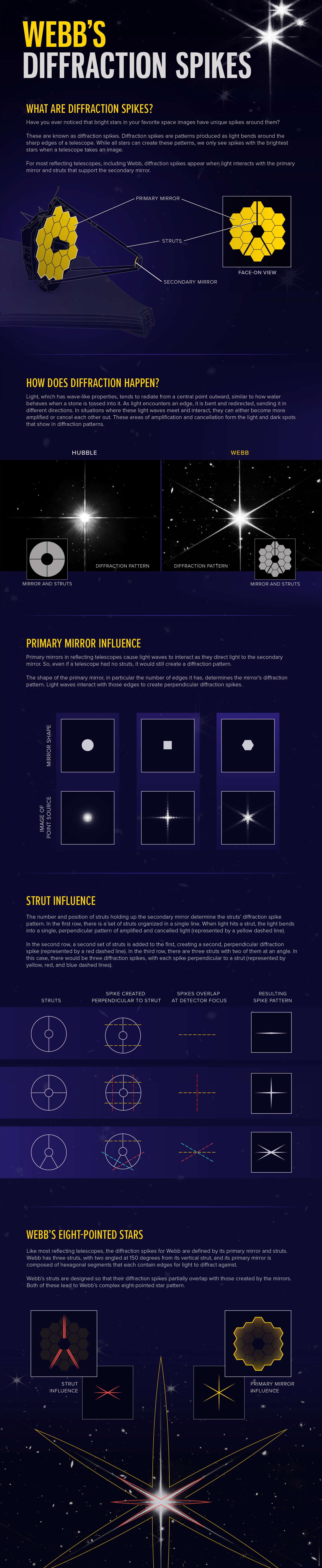
JWST optics makes quite unique diffraction spikes. Not only that there are eight of them, but on full resolution images [1] they have distinct pattern, as if made from separate dashed lines.

Are colors of those tiny lines (mostly red here - although this is false-color image) also diffraction artifacts, or do they correspond to actual spectrum of the stars causing them?

[1] https://www.esa.int/var/esa/storage/images/esa_multimedia/im...

Re: Webb captures iconic Horsehead Nebula in unprecedented detail

#120
post #96

I wonder what the red and blue stripe artifacts are in the lens flares.

The 6+2 spikes around the bright stars is a diffraction pattern created by the edges of the hexagonal mirror segments (the six large spikes) and the three struts that hold the secondary mirror (also six spikes, but four overlap with the mirror spikes).

https://smd-cms.nasa.gov/wp-content/uploads/2023/07/webb-dif...

Post reply on HN