Live data from Hacker News

The US government poisoned alcohol during Prohibition (2010)

slate.com

101–109 of 109 posts

Re: The US government poisoned alcohol during Prohibition (2010)

#101
post #100
post #96

Earlier quoted context omitted.

Exactly. Thankfully nobody is claiming that paracetamol is not killing people - quite clearly, it is. As is MDMA, even if it's quite safe (and fun) to use in most cases.

Well... paracetamol is a modern day denaturing agent. Under DEA influence, paracetamol is included many opiate painkillers to "deter abuse."

Do you have a cite for that?

Most combination meds try to get synergistic benefits - the combination allows you to use lower doses of both active ingredients. (This probably doesn't work, but that was the intent when the meds were created.)
Re: The US government poisoned alcohol during Prohibition (2010)

#102

Denatured alcohol (e.g., ethanol with added methanol to render it undrinkable) is still used today for industrial purposes since it's much cheaper than pure ethanol, which is heavily taxed: https://en.wikipedia.org/wiki/Denatured_alcohol

Denatured alcohol in New Zealand specifically doesn't contain methanol or any other super toxic substances (except ethanol of course), despite being called methylated spirits. It still contains bittering agents, vomiting agents, and some other stuff that's nasty but won't kill you (I think some of it is denatured with petroleum as well at like 1%). Drinking it is gonna make you a bit crook, but it won't kill you any…

Well they used that in the US too. The issue was the criminals were hiring chemists to remove it. So they had to try other chemicals that were more difficult to remove, but also had worse effects.

The goal was never to kill alcoholics, but to prevent them from stealing industrial alcohol. I think the people behind it didn't think anyone would be stupid enough to try to drink or sell this stuff.

Re: The US government poisoned alcohol during Prohibition (2010)

#103

Earlier quoted context omitted.

Denatured alcohol in New Zealand specifically doesn't contain methanol or any other super toxic substances (except ethanol of course), despite being called methylated spirits. It still contains bittering agents, vomiting agents, and some other stuff that's nasty but won't kill you (I think some of it is denatured with petroleum as well at like 1%). Drinking it is gonna make you a bit crook, but it won't kill you any…

Well they used that in the US too. The issue was the criminals were hiring chemists to remove it. So they had to try other chemicals that were more difficult to remove, but also had worse effects. The goal was never to kill alcoholics, but to prevent them from stealing industrial alcohol. I think the people behind it didn't think anyone would be stupid enough to try to drink or sell this stuff.

I think the people behind it didn't think anyone would be stupid enough to try to drink or sell this stuff.

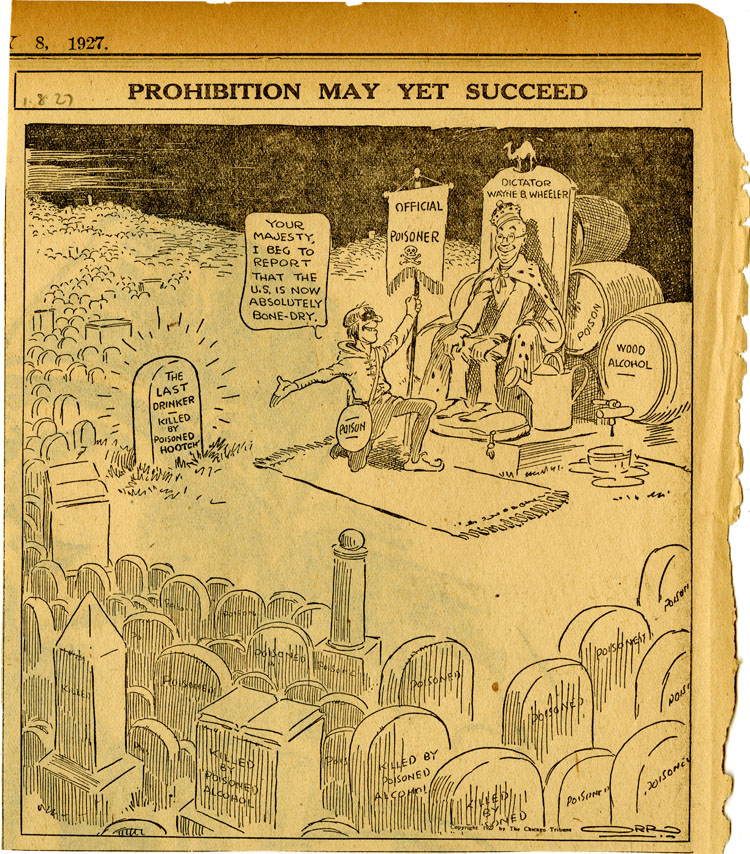
While it might be comforting to believe this, there's strong evidence that while directly killing alcoholics was not the goal, it was a known and acceptable collateral damage. Even after being confronted with the unprecedented number of deaths, the official response from Wayne Wheeler (the leader of the Anti-Saloon League and generally acknowledged architect of Prohibition) was that "The government is under no obligation to furnish people with alcohol that is drinkable when the Constitution prohibits it. The person who drinks this industrial alcohol is a deliberate suicide."

https://books.google.com/books?id=8gAtAgAAQBAJ&pg=PT173&dq=%...

Edit: Here's a political cartoon from 1927 attacking Wheeler for the deliberateness of his approach: http://archive.lib.msu.edu/DMC/tribune/trib00000000/trib0000...

Re: The US government poisoned alcohol during Prohibition (2010)

#104
post #11

Earlier quoted context omitted.

And yet some people (mostly homeless and addicts) find a way to drink it anyway, with such strange methods like filtering through bread crusts. I totally don't understand why article tries to blame government for all those deaths when it was clearly mob trying to make money.

If you take an action and know that there is a direct consequence that will kill people who have not done anything that could justify death (i.e. almost anything short of murder), you can't ignore that consequence. The only way to justify it is to say that for some reason, not acting would be unacceptable. And that is a high bar to clear, one that is obviously not met by the prohibition policy.

But it's not a direct consequence, that's the point. It's an indirect one, completely dependent on other people trying to renature it and drink it - ignoring warning labels like this one: http://www.gettyimages.co.uk/detail/news-photo/warning-label...

Re: The US government poisoned alcohol during Prohibition (2010)

#105
post #11

Earlier quoted context omitted.

And yet some people (mostly homeless and addicts) find a way to drink it anyway, with such strange methods like filtering through bread crusts. I totally don't understand why article tries to blame government for all those deaths when it was clearly mob trying to make money.

Does the bread filtering thing actually work? I just don't see how that could possibly work...

Burnt bread, AKA charcoal.

It just reduces the bad taste, still tastes pretty bad.

Re: The US government poisoned alcohol during Prohibition (2010)

#106

Earlier quoted context omitted.

If you take an action and know that there is a direct consequence that will kill people who have not done anything that could justify death (i.e. almost anything short of murder), you can't ignore that consequence. The only way to justify it is to say that for some reason, not acting would be unacceptable. And that is a high bar to clear, one that is obviously not met by the prohibition policy.

But it's not a direct consequence, that's the point. It's an indirect one, completely dependent on other people trying to renature it and drink it - ignoring warning labels like this one: http://www.gettyimages.co.uk/detail/news-photo/warning-label...

I should have avoided the word 'direct', because of that potential for confusion. What I meant is predictable.

Re: The US government poisoned alcohol during Prohibition (2010)

#107
post #92

Earlier quoted context omitted.

its possible to use force without killing someone you know.

Not on a large scale. Imagine what would happen if you ignored a cop's orders, and failed to recognize his authority as he continued to escalate force.

in england, ten cops would pin you down. same in china. which country are you thinking of that youd somehow end up dead by resisting arrest?

Re: The US government poisoned alcohol during Prohibition (2010)

#108
post #92

Earlier quoted context omitted.

Not on a large scale. Imagine what would happen if you ignored a cop's orders, and failed to recognize his authority as he continued to escalate force.

in england, ten cops would pin you down. same in china. which country are you thinking of that youd somehow end up dead by resisting arrest?

Ok, and then ten of your football hooligan buddies jump in. You are making a mistake in looking at it from a scenario based perspective - one can easily craft any scenario to fit their argument. Also, a ten cop dog pile could certainly kill someone.

> which country...

Any country in which overwhelming nonlethal police force is not unfailingly on hand everywhere... so every country. Consider it from the state's perspective: lose control of the population or kill an unsympathetic troublemaker? History shows us which option is most frequently selected. Good on England for showing restraint, but that doesn't change the fact that every command is suffixed with "... or else I'll kill you."

Re: The US government poisoned alcohol during Prohibition (2010)

#109

Earlier quoted context omitted.

But it's not a direct consequence, that's the point. It's an indirect one, completely dependent on other people trying to renature it and drink it - ignoring warning labels like this one: http://www.gettyimages.co.uk/detail/news-photo/warning-label...

I should have avoided the word 'direct', because of that potential for confusion. What I meant is predictable.

But there's a big difference between consequences that are predictable because of nature (i.e. if I kick this rock it will hurt) and consequences that are predictable because of people's decisions.

The redistillers' resolve to keep selling even if they couldn't renature their product and it would be deadly - should that be treated the same as a force of nature? When should people's decisions be treated as a fact we just have to adapt to?

In my experience, people mostly want their own decisions, or the decisions of the people they agree with, to be treated as facts of nature. But the decisions of people they disagree with, they want to treat as their own free decisions.

Post reply on HN