Live data from Hacker News

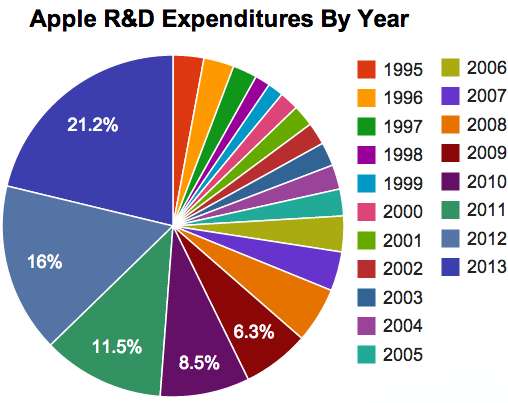
A look at Apple's R&D expenditures from 1995-2013

tuaw.com

11–20 of 71 posts

Re: A look at Apple's R&D expenditures from 1995-2013

#11
post #5
post #3

The article feels a little shallow on the analysis side. For instance I would expect this oddity to be caused by the fact that they aren't a traditional hardware manufacturer (they don't have any fabs and outsource their production) nor are they a traditional software manufacturer (their software focus pales in comparison to Google or Microsoft). Since developing silicon and software are two of the biggest drivers in…

Don't Apple's A7 and other chips count as "developing silicon"? And you don't see Apple focusing on "developing software"?

Yes, but it is abstract development that relies on lower level discoveries. It's like designing a medical treatment that relies on anti-biotics, if no new antibiotics are discovered, and the old ones become less valuable, then new treatments hault.

The A7 is a marvelous chip, but the reason these super smartphones exist is silicon manufacturing prowess. If we could not make these chips smaller and less power hungry, the mobile revolution would not have happened. Apple stood on the shoulders of giants who went before them in this regard.

Intel, IBM, TSMC, et al, plow a lot of money into advancing silicon manufacturing further. Lots of other companies plow billions into tools to support this sector.

In some ways, taking in huge margins on silicon upstream (while the downstream players are squeezed to minimize their margins), without plowing money back into the system, could be seen as somewhat parasitical.

I used to work at IBM Research, and one of the things I used to love doing was reading IBM Systems Journal. Research, like on scanning electron microscopes, measuring quantized magnetic flux in superconducting circuits, new kinds of giant magneto resistive effects, it was all very exciting to know that right down the hall, stuff I'd normally read about in Scientific American, Nature, or other places was being done. IBM T.J. Watson Research was given relative autonomy when I was there, they could spend money without have to justify it as being linked to a product, and I think that was very valuable for long term development.

The new players in Silicon Valley don't seem to have the same commitment to basic R&D, long term R&D. Everything has to be linked to something shiny that can be sold in 2-3 years.
Re: A look at Apple's R&D expenditures from 1995-2013

#12

Not surprising, since most of the core R&D needed happens in the supply chain -- the fabs, the screen manufacturers, the battery makers, sensors, etc. If the iWatch for example, uses new curved battery tech or curved screen, that will have arisen mostly from the R&D done by their partners. With the acquisition of PA Semi, Apple does seem to be doing basic chip R&D now. But the industry as a whole would be no where wi…

I agree generally that there can always be more. The big difference to me is that in putting the product first, Apple is ensuring that they'll remain in a position to continue doing this. The trend is in the right direction though, their revenue for 2013 increased less than 10%[1] but their R&D expenditures have (based on a pretty coarse chart) gone up around 20%.

[1] http://www.wikinvest.com/stock/Apple_(AAPL)/Data/Total_Reven...

Re: A look at Apple's R&D expenditures from 1995-2013

#13
post #5

Earlier quoted context omitted.

Don't Apple's A7 and other chips count as "developing silicon"? And you don't see Apple focusing on "developing software"?

Yes, but it is abstract development that relies on lower level discoveries. It's like designing a medical treatment that relies on anti-biotics, if no new antibiotics are discovered, and the old ones become less valuable, then new treatments hault. The A7 is a marvelous chip, but the reason these super smartphones exist is silicon manufacturing prowess. If we could not make these chips smaller and less power hungry,…

Apple is indirectly plowing billions of dollars into that research via their contracts with Intel and the foundries. If the margins on those contracts aren’t sufficient to provide for further research, that’s on the head of the supplier’s pricing teams, not Apple.

Re: A look at Apple's R&D expenditures from 1995-2013

#14
post #5

Earlier quoted context omitted.

Don't Apple's A7 and other chips count as "developing silicon"? And you don't see Apple focusing on "developing software"?

Yes, but it is abstract development that relies on lower level discoveries. It's like designing a medical treatment that relies on anti-biotics, if no new antibiotics are discovered, and the old ones become less valuable, then new treatments hault. The A7 is a marvelous chip, but the reason these super smartphones exist is silicon manufacturing prowess. If we could not make these chips smaller and less power hungry,…

In detail, that's not quite right about the A7.

Apple designed the A7 themselves. It happens to implement the ARM instructions, but is not an ARM design. The only other player I can think of currently with this in the wild is Qualcomm, and this is one reason Apple and Qualcomm chips maintain a performance edge over other ARM CPUs.

Re: A look at Apple's R&D expenditures from 1995-2013

#15

Earlier quoted context omitted.

Yes, but it is abstract development that relies on lower level discoveries. It's like designing a medical treatment that relies on anti-biotics, if no new antibiotics are discovered, and the old ones become less valuable, then new treatments hault. The A7 is a marvelous chip, but the reason these super smartphones exist is silicon manufacturing prowess. If we could not make these chips smaller and less power hungry,…

In detail, that's not quite right about the A7. Apple designed the A7 themselves. It happens to implement the ARM instructions, but is not an ARM design. The only other player I can think of currently with this in the wild is Qualcomm, and this is one reason Apple and Qualcomm chips maintain a performance edge over other ARM CPUs.

I believe your parent is referring specifically to basic physics/chemistry research toward future process technology, rather than processor design.

Re: A look at Apple's R&D expenditures from 1995-2013

#16

Earlier quoted context omitted.

Yes, but it is abstract development that relies on lower level discoveries. It's like designing a medical treatment that relies on anti-biotics, if no new antibiotics are discovered, and the old ones become less valuable, then new treatments hault. The A7 is a marvelous chip, but the reason these super smartphones exist is silicon manufacturing prowess. If we could not make these chips smaller and less power hungry,…

Apple is indirectly plowing billions of dollars into that research via their contracts with Intel and the foundries. If the margins on those contracts aren’t sufficient to provide for further research, that’s on the head of the supplier’s pricing teams, not Apple.

And if Walmart's employees and Chinese suppliers have their payments squeezed, it's not Walmart's fault? That ignores the pricing power that a large player has. Apple and Tim Cook, as has been noted in the media, are very good at negotiating down their suppliers.

But no matter how you slice it, these downstream suppliers are doing more with less. They have much smaller margins, fund more important R&D which benefits the entire ecosystem, which takes up a much larger percentage of their overall revenues.

The marginal utility of an extra dollar in Apple's cash reserves seems less useful or effective than the marginal utility of a dollar in say, TSMC's coffers.

Re: A look at Apple's R&D expenditures from 1995-2013

#17

Earlier quoted context omitted.

Apple is indirectly plowing billions of dollars into that research via their contracts with Intel and the foundries. If the margins on those contracts aren’t sufficient to provide for further research, that’s on the head of the supplier’s pricing teams, not Apple.

And if Walmart's employees and Chinese suppliers have their payments squeezed, it's not Walmart's fault? That ignores the pricing power that a large player has. Apple and Tim Cook, as has been noted in the media, are very good at negotiating down their suppliers. But no matter how you slice it, these downstream suppliers are doing more with less. They have much smaller margins, fund more important R&D which benefits…

Intel obviously has vastly more negotiating power than any of Walmart’s suppliers. This may or may not be true of other fabs, but even in that space there are only a few suppliers and the costs of switching fabs are enormous; that isn’t true when Walmart is searching for a supplier of plastic adirondack chairs.

Re: A look at Apple's R&D expenditures from 1995-2013

#18

Earlier quoted context omitted.

In detail, that's not quite right about the A7. Apple designed the A7 themselves. It happens to implement the ARM instructions, but is not an ARM design. The only other player I can think of currently with this in the wild is Qualcomm, and this is one reason Apple and Qualcomm chips maintain a performance edge over other ARM CPUs.

I believe your parent is referring specifically to basic physics/chemistry research toward future process technology, rather than processor design.

They're ignoring that Apple (and others) are competing in design at all and claiming the only progress is in fab process. Fab process is very important, but it is most important in x86 land where you don't have many options but to improve fabrication, hence Intel's massive spend there. Beyond that you have the competing groups of TSMC, GlobalFoundries etc. that will spend way more than any non-specialist is going to.

The rest of the processor industry, including the ARM ecosystem where some people get to compete with ARM themselves, is making a lot of progress in working out how to improve the layout of the transistors, such that two designs on the same process can perform quite differently. In the case of the Ax devices and the Krait this is a surprisingly significant margin, and they tend to be at least a whole generation ahead in performance of the designs coming out of ARM. This is not something to be dismissed.

Re: A look at Apple's R&D expenditures from 1995-2013

#19
post #5

Earlier quoted context omitted.

Don't Apple's A7 and other chips count as "developing silicon"? And you don't see Apple focusing on "developing software"?

Yes, but it is abstract development that relies on lower level discoveries. It's like designing a medical treatment that relies on anti-biotics, if no new antibiotics are discovered, and the old ones become less valuable, then new treatments hault. The A7 is a marvelous chip, but the reason these super smartphones exist is silicon manufacturing prowess. If we could not make these chips smaller and less power hungry,…

I should point out A7 was manufactured by Samsung...

It is troubling that the new players in Silicon Valley are not really committed to basic R&D.

Post reply on HN