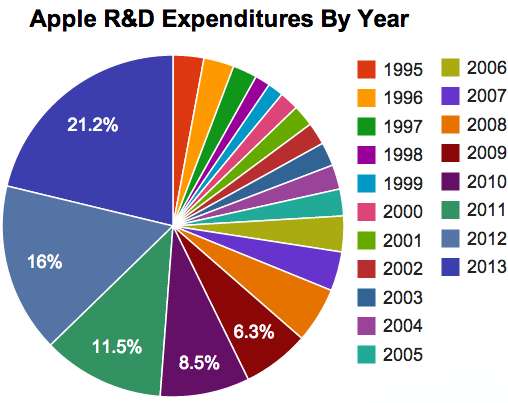
The article feels a little shallow on the analysis side. For instance I would expect this oddity to be caused by the fact that they aren't a traditional hardware manufacturer (they don't have any fabs and outsource their production) nor are they a traditional software manufacturer (their software focus pales in comparison to Google or Microsoft). Since developing silicon and software are two of the biggest drivers in…
Don't Apple's A7 and other chips count as "developing silicon"? And you don't see Apple focusing on "developing software"?
The A7 is a marvelous chip, but the reason these super smartphones exist is silicon manufacturing prowess. If we could not make these chips smaller and less power hungry, the mobile revolution would not have happened. Apple stood on the shoulders of giants who went before them in this regard.
Intel, IBM, TSMC, et al, plow a lot of money into advancing silicon manufacturing further. Lots of other companies plow billions into tools to support this sector.
In some ways, taking in huge margins on silicon upstream (while the downstream players are squeezed to minimize their margins), without plowing money back into the system, could be seen as somewhat parasitical.
I used to work at IBM Research, and one of the things I used to love doing was reading IBM Systems Journal. Research, like on scanning electron microscopes, measuring quantized magnetic flux in superconducting circuits, new kinds of giant magneto resistive effects, it was all very exciting to know that right down the hall, stuff I'd normally read about in Scientific American, Nature, or other places was being done. IBM T.J. Watson Research was given relative autonomy when I was there, they could spend money without have to justify it as being linked to a product, and I think that was very valuable for long term development.
The new players in Silicon Valley don't seem to have the same commitment to basic R&D, long term R&D. Everything has to be linked to something shiny that can be sold in 2-3 years.