Tangential, since it's not what this article is about, but it's worth noting that the apostrophe acts as something of a 27th letter in English.
The 27th Letter
11–20 of 38 posts
Re: The 27th Letter
#12So I wanted to call BS on the statement that 19th century elementary school textbooks had the & character as the final letter of the alphabet, but lo and behold: https://s3.amazonaws.com/s3.timetoast.com/public/uploads/pho...
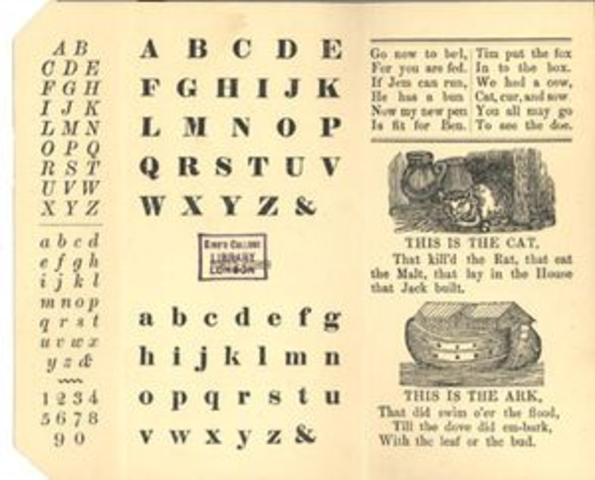
Now this was not universally true, but there seems to be at least some anecdotal evidence that in the mid to late 1800s some English language school age textbooks did indeed have this extra character.
Re: The 27th Letter
#13Earlier quoted context omitted.
It’s used in English, which as far as I’m aware isn’t dead.
Opportunistically and not out of necessity, I think. As far as I know all it means is “and.” If any word deserves a character, it’s “the.”
Yes, but there are nuances, as mentioned in the article:
> In screenplays, two authors joined with & collaborated on the script, while two authors joined with and worked on the script at different times and may not have consulted each other at all.
I sometimes use it to avoid awkwardness in lists, e.g. "I ate fish & chips and drank a cup of tea".
I guess both examples use & as a stronger binder than and.
Re: The 27th Letter
#14Do I need a coffee or is this just stilted:
> In the alphabet recited by nineteenth-century schoolchildren, it followed Z. 'And per se and', they would say, 'and per se and'. A logogram masquerading as a letter, a letter that is also a word—like a and I and even o, but no—a letter that is only a word, the plainest word of all. A word we could do without, to be honest, if we had to. We don’t have to, and thank the language gods for that.
A logogram is only a word or phrase. How could we do without 'and'? How is 'and' the plainest word of all? This is like a bad impression of Douglas Adams or something.
Re: The 27th Letter
#15Do I need a coffee or is this just stilted: > In the alphabet recited by nineteenth-century schoolchildren, it followed Z. 'And per se and', they would say, 'and per se and'. A logogram masquerading as a letter, a letter that is also a word—like a and I and even o, but no—a letter that is only a word, the plainest word of all. A word we could do without, to be honest, if we had to. We don’t have to, and thank the lan…
[deleted]
Re: The 27th Letter
#16So I wanted to call BS on the statement that 19th century elementary school textbooks had the & character as the final letter of the alphabet, but lo and behold: https://s3.amazonaws.com/s3.timetoast.com/public/uploads/pho... Now this was not universally true, but there seems to be at least some anecdotal evidence that in the mid to late 1800s some English language school age textbooks did indeed have this extra char…
[deleted]
Re: The 27th Letter
#17Earlier quoted context omitted.
Opportunistically and not out of necessity, I think. As far as I know all it means is “and.” If any word deserves a character, it’s “the.”
Yes, but there are nuances, as mentioned in the article: > In screenplays, two authors joined with & collaborated on the script, while two authors joined with and worked on the script at different times and may not have consulted each other at all. I sometimes use it to avoid awkwardness in lists, e.g. "I ate fish & chips and drank a cup of tea". I guess both examples use & as a stronger binder than and.
boots & cats and boots & cats
Re: The 27th Letter
#18Earlier quoted context omitted.
Opportunistically and not out of necessity, I think. As far as I know all it means is “and.” If any word deserves a character, it’s “the.”
I believe "yͤ" is the character you desire. [1] [1] https://en.wikipedia.org/wiki/English_articles#Ye_form
[deleted]
Re: The 27th Letter
#19Earlier quoted context omitted.
Opportunistically and not out of necessity, I think. As far as I know all it means is “and.” If any word deserves a character, it’s “the.”
It’s used as a symbol in programming, I have a hard time imagining a symbol that could replace “the”. That’s not to say there isn’t one that would be suitable, I just lack the creativity or imagination to think of one.
Perhaps, taking inspiration from Tironian shorthand, “𝈭” (a backwards version of ⁊ “et”, so to speak) would be suitable?
Re: The 27th Letter
#20Earlier quoted context omitted.
Opportunistically and not out of necessity, I think. As far as I know all it means is “and.” If any word deserves a character, it’s “the.”
I believe "yͤ" is the character you desire. [1] [1] https://en.wikipedia.org/wiki/English_articles#Ye_form
I prefer the form with the þorn, but it's harder to enter on a phone keyboard. (In fact I don't know if there's any way at all to input that combining superscript "e" on my phone.)
There are a bunch of old handwritten abbreviations that have fallen out of use probably due to typewriter/computer limitations.