Live data from Hacker News

Regulating Technology

ben-evans.com

11–20 of 34 posts

Re: Regulating Technology

#11
>>> Today it might have 100x that. So, how many compliance people will Google have in five years?

Compliance goes hand in glove with regulatory reporting. Reporting to regulators should be a marginal cost thing - if the data internally is same, well managed and fully auditable in an automated fashion.

Doing this in finance is something the new challenger banks (ie monzo built about five years ago by ten coders and now has a million UK accounts) - this is something they can have one compliance person because all their systems are new and written with compliance in mind.

Doing this for most major banks is next to impossible. It would rewriting everything (#)

(#) Actuallly i would say this is a good strategic plan for most major banks. Might not be able to persuade the board but still.

Re: Regulating Technology

#12

Can I veer horribly into my favourite tangent - I love the presentation style, the look-and-feel. It's a blog version of what he did at A18Z - a sort of sophisticated corporate but with the look of something that could be knocked up from Markdown. I could steal the CSS, but that's is only 20% of the battle - getting graphs that match the snazz, getting everything just right, but with this off handed vibe. As I get ol…

[deleted]

Re: Regulating Technology

#13

>>> Today it might have 100x that. So, how many compliance people will Google have in five years? Compliance goes hand in glove with regulatory reporting. Reporting to regulators should be a marginal cost thing - if the data internally is same, well managed and fully auditable in an automated fashion. Doing this in finance is something the new challenger banks (ie monzo built about five years ago by ten coders and no…

This is a really interesting angle but I'd go somewhat further - it's not just the systems that need to be new, its the whole business! Monzo has had the advantage that its been able to design everything to fit both what is possible with automated systems and the current regulatory environment.

If you've got lots of edge cases from a legacy business then its probably not going to work anywhere near as well even if you could rewrite everything.

Re: Regulating Technology

#14
I've seen this piece a few times, and it's broadly good, but I think it glosses over the fact that just because politicians want regulation or try to pass regulation does not mean it actually happens.

As a good example, we're now at the 10th anniversary of the original Digital Economy Act in the UK, the legislation that was going to disconnect persistent pirates from the internet and send out warning letters. This legislation passed. There was much writing at the time about how this was the end of the open internet, and from politicians about how this was the end of the wild west internet.

And yet, ten years later, not a single action has ever been undertaken under those provisions. No letters were sent. No disconnections ever happened. And that's because politicians ignored the complexity, declared something must be done and passed law that didn't actually parse into any real world actions. Primarily it was just completely barmy costs wise for rights owners to send letters, so they didn't and the regulator just quietly forgot about it after several consultations.

Much of this regulation feels very similar. Laws may be passed, but the vast majority of them will never result in any changes because frankly the quality of lawmaking in most jurisdictions is extremely poor. One or two bits certainly will, but most of it will fail badly.

Evans sets out the UK's Online Harms act as an example, but the Online Harms regulation is doomed for one simple reason - everyone and their dog in politics and lobbying keeps trying to project their problems on to it as something that will be solved. It's suddenly got to do a million things, while not having any resource to do so. It will inevitably collapse under it's own weight because nobody involved is brave enough to say it's scope is already too big to work.
Re: Regulating Technology

#15

The challenges for regulation are two-fold, in my opinion: 1. It just doesn't work. Legal and regulatory solutions are too slow and poorly designed to be effective, see for example the EU browser consent decree applied to Internet Explorer. IE didn't fail because Microsoft was forced to offer a choice of browser; it stumbled because of other nimbler competitors (particularly Chrome) that were able to innovate despite…

I partially agree that regulations are slow or even atrocious. But, on the web, what true game-changing innovations were there in the last ten or so years? By and large, we're doing just the same things (poorly) on the web we used to in the 2000s. But "network effects" now place barriers to entry on a medium that once was supposed to be an easy means for self-publishing (for example, why don't more musicians put their songs on a paywalled web page for self-distribution? It's the kind of thing the web was made for, yet they have to go to endless pains with idiosyncratic and ever-changing web conventions, payment providers, SEO, and promotion on platforms to get a handful of clicks). What we're experiencing is a large consolidation end-game. In that situation, I think regulation is necessary, as "the web" can't get out of this without political will. I also disagree that the EU's ruling for IE had no impact; Firefox opened the door for browser diversity and merit. The same principles could be applied today to Android, to stop Google mandating bundling of their "services" and making Android phones cheap when the price to pay is privacy invasion and monopolism.

The marketplace being global might not very much longer be the case. For example, the EU court of justice has ruled (again) that personally-identifiable info just can't be transferred to the US under the "safe harbor" doctrine. And hasn't Google pulled out of China because they were required to give data to the government which however they weren't willing to on matters of principle?

Re: Regulating Technology

#16

>>> Today it might have 100x that. So, how many compliance people will Google have in five years? Compliance goes hand in glove with regulatory reporting. Reporting to regulators should be a marginal cost thing - if the data internally is same, well managed and fully auditable in an automated fashion. Doing this in finance is something the new challenger banks (ie monzo built about five years ago by ten coders and no…

These challenger banks are also currently operating in relative niches. Yes Monzo has a million bank accounts, but in terms of their product offering, it isn't close to the breadth of your traditional "High Street" bank. As their product offering expands, their compliance requirements will become a lot more complex, and will lead to more compliance personnel being hired. They have also yet to experience a massive overhaul to the compliance requirements of their existing systems. I'm sure they are better placed to handle it than a traditional bank but it won't be easy.

Re: Regulating Technology

#17

The challenges for regulation are two-fold, in my opinion: 1. It just doesn't work. Legal and regulatory solutions are too slow and poorly designed to be effective, see for example the EU browser consent decree applied to Internet Explorer. IE didn't fail because Microsoft was forced to offer a choice of browser; it stumbled because of other nimbler competitors (particularly Chrome) that were able to innovate despite…

> Chinese companies operate in a very different dynamic.

Chinese companies have their own regulations to deal with. I’m not sure it’s necessarily a disadvantage.

Re: Regulating Technology

#19

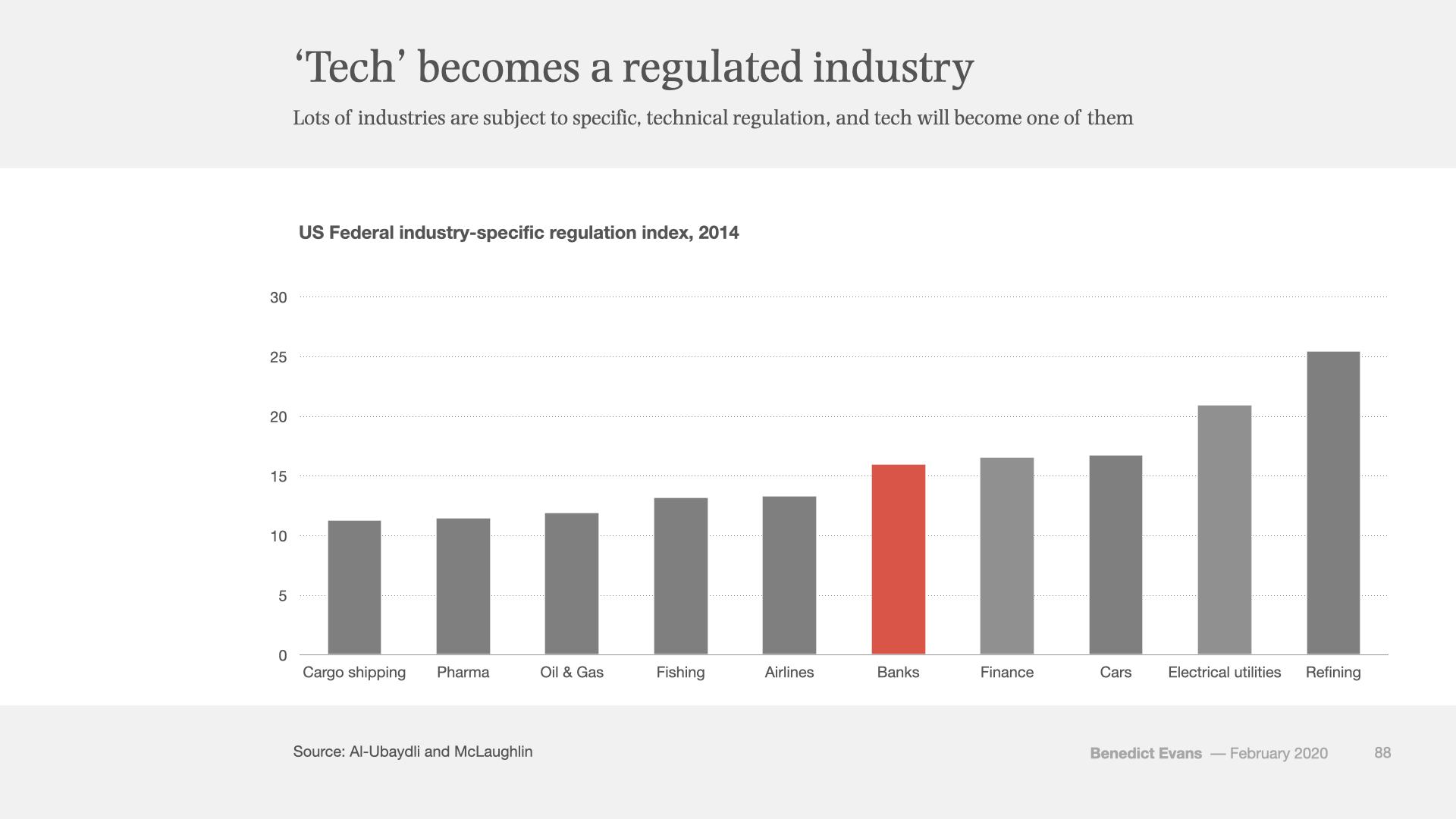
I don't understand the Tech Regulation chart [0]. What does the y-axis represent? [0] https://images.squarespace-cdn.com/content/v1/50363cf324ac8e...

RegData: A numerical database on industry‐specific regulations for all United States industries and federal regulations [1]

[1] https://onlinelibrary.wiley.com/doi/abs/10.1111/rego.12107

Re: Regulating Technology

#20

The challenges for regulation are two-fold, in my opinion: 1. It just doesn't work. Legal and regulatory solutions are too slow and poorly designed to be effective, see for example the EU browser consent decree applied to Internet Explorer. IE didn't fail because Microsoft was forced to offer a choice of browser; it stumbled because of other nimbler competitors (particularly Chrome) that were able to innovate despite…

I partially agree that regulations are slow or even atrocious. But, on the web, what true game-changing innovations were there in the last ten or so years? By and large, we're doing just the same things (poorly) on the web we used to in the 2000s. But "network effects" now place barriers to entry on a medium that once was supposed to be an easy means for self-publishing (for example, why don't more musicians put thei…

It would be interesting to hear an insider story about the fall of AOL and Altavista.

It's clear that Google and Facebook are the problems and practically equivalent to the AOL walled garden.

I'm not sure that it would be impossible to disrupt them. What is lacking? Is it the fighting spirit?

Post reply on HN