Live data from Hacker News

Data Science Workflow: Overview and Challenges

cacm.acm.org

11–20 of 39 posts

Re: Data Science Workflow: Overview and Challenges

#11
post #9

> As an extreme example, my former officemate Cristian Cadar used to archive his experiments by removing the hard drive from his computer after submitting an important paper to ensure that he can re-insert the hard drive months later and reproduce his original results. Perhaps it would be an idea to use a virtual machine such as VirtualBox instead?

I have recently started to think about designing a good workflow for this kind of thing, based on tools like Docker, Nix, Camlistore, etc. The following questions will need to be addressed:

1. Setting up the requisite environment inside a container. Making all "hidden state" explicit -- by specifying the state of every object in the dependency tree (including specifying things like the seed for a random number generator, or a particular noise source).

2. Should the experimentation/improvements happen inside the container, or should it happen on a desktop, with a snapshot of the project (when committed) generating a container version? One could update a Docker image depending on git tags, with project diffs corresponding to container layers.

- It would be great if one could use a script to specify the "state" in a project to be able to move it into a container, at any point in the process.

3. Could one store the output files using some form of content-addressable-memory, so that each output file remembers the "context" in which it was generated?

Re: Data Science Workflow: Overview and Challenges

#12
Shameless plug: looking specifically at the Dissemination Phase part, I can't help but thinking he would love Code Ocean (https://codeocean.com). It addresses each of his points:

- distribute software (execute with a single click)

- reproduce results (published code & data - yours and others' - is archived with its environment)

- collaborate with colleagues (built-in to the system)

(Disclaimer: I work at Code Ocean. We're in beta.)

Re: Data Science Workflow: Overview and Challenges

#13
Lately I have been looking into data science workflows and tools. One of the most promising ones I have seen is https://pachyderm.io

Data is stored and versioned on a custom docker-like filesystem. Processes are defined by yaml and run based on incoming new data to the filesystem. The processes can be versioned with the data and results, written into the fs are also versioned. It seems like a very good approach to many of the difficulties.

I'm not affiliated with them, but vcs helped my programming so much that I am looking for the best applications of versioning to data management.

Edit: this is mainly concerned with the center box, analysis and records. For provenance you get a consistent snapshot of the incoming data, but that data is fixed. For my work consistency and repeatability is more important than accuracy with respect to an external source.

Re: Data Science Workflow: Overview and Challenges

#14
Full Disclosure, I am the Chief Data Scientist of Domino Data Lab (https://www.dominodatalab.com), a company that builds tools for collaboration/scaling of data science a quantitative research teams. I spoke about our view on data provenance at UseR! 2016 and if you're curious you can watch the video here https://blog.dominodatalab.com/providing-digital-provenance-.... The rest of this comment is not about reproducibility and provenance however, it's mostly about collaboration.

I really like this write-up. It's really quite prescient for a blog post from 2013! There have been amazing advances in the tooling for individual data scientists. RStudio, Jupyter, and Zeppelin notebooks have provided a really fluid REPL for data science. This has really compressed the workflows he discusses, and provides feedback and direction to data scientists much more quickly than the program oriented process. It’s interesting to note how an unexpected direction (notebooks) can impact praxis.

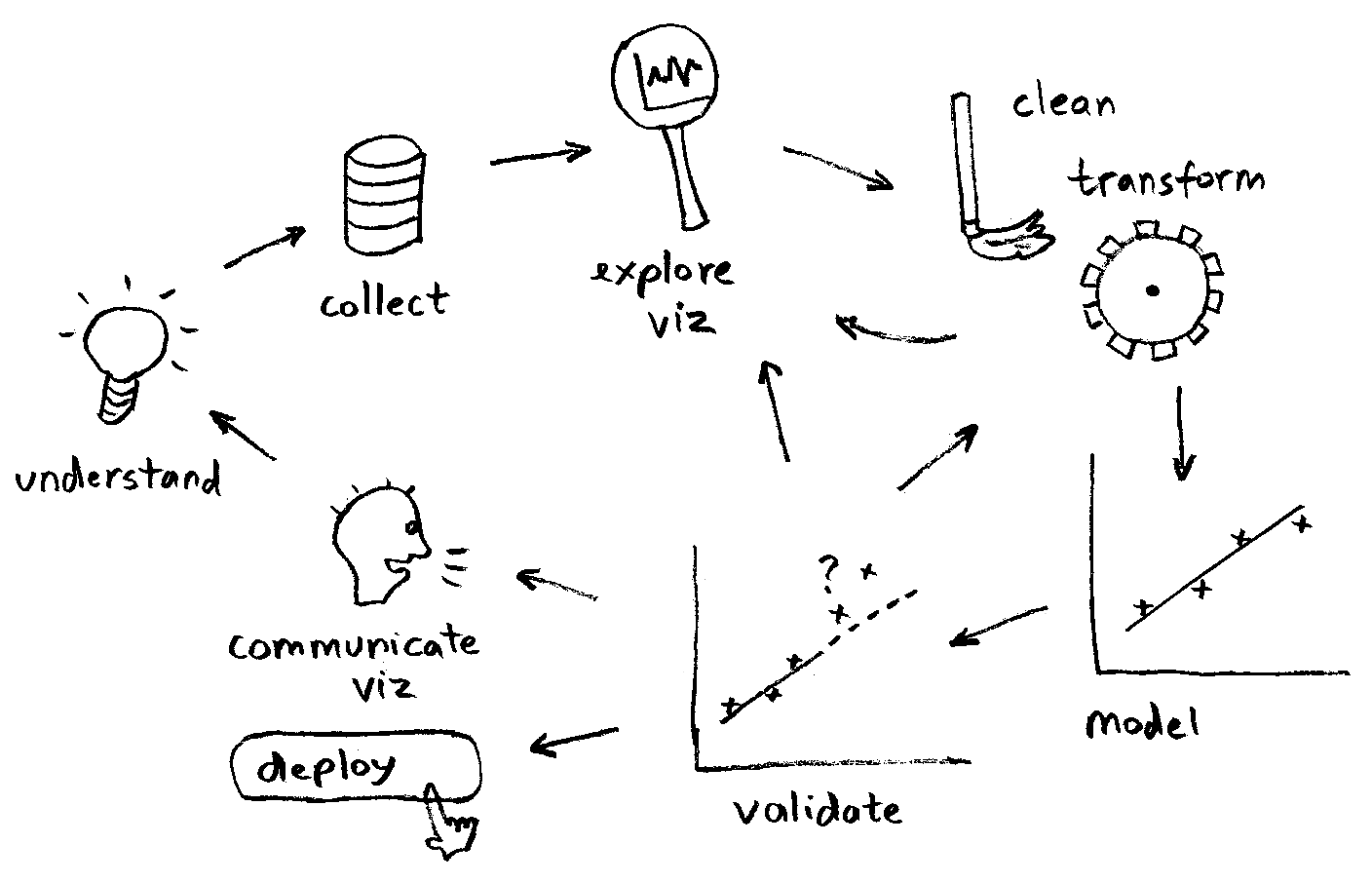
I refer to these two visualizations of the data science process often. The first is by Szilard Pafka, and it details the workflow he has experienced by having models in production for well over a decade at this point. It’s available here:

https://raw.githubusercontent.com/szilard/datascience-1slide...

What I really like about this is that it really shows the centrality of model validation. From model validation, you can often find yourself having to go back to exploration, cleaning/transformation, etc. Guo’s diagram calls this preparation, which only has an out-arrow. Preparation is not something that is one-and-done, you return to it often in the DS lifecycle.

I also really like this particular visualization, it’s from UC Berkley and it’s the “understanding science” model of the scientific process.

http://undsci.berkeley.edu/flowchart_noninteractive.php

Much like Guo’s or Szilard’s diagram, the centrality of testing/validation/analysis is telling. The nature of collaboration is more explicit in this model. In the post, Guo states:

Lastly, data scientists often collaborate with colleagues by sending them partial results to receive feedback and fresh ideas. A variety of logistical and communication challenges arise in collaborations centered on code and data sharing." I think this is particularly insightful. The challenges of scaling a data science team are different often than those of scaling a software team (for example), and I think he foresaw that before a lot of folks did.

I agree with this, but with two additional points. Often colleagues are from very different disciplines. Business stakeholders or subject matter experts that don’t understand the analysis, but they understand some feature/outcome with depth. In the Berkeley understanding science diagram, I really like that it’s explicitly called out as “community analysis and feedback.” I think that’s an important distinction that it’s not just other data scientists that provide feedback, the artifacts of the DS process have to be accessible to a wide assortment of backgrounds and skills.

It’s also interesting that from community analysis and feedback you can find yourself in any of the stages, exploration/discovery, testing, and benefits and outcomes. This is why organizations find themselves challenged to measure the progress of their DS teams, and why forecasting the amount of effort that will be required can be daunting without wide error bars. Data science is unique in that the data can be correct, the pipeline can be reproducible, the model perform perfectly in cross validation, but when it’s put into production it can be completely wrong. Prediction about prediction is hard.

I do like how all of these models, the Szilard model, the Understanding Science model, and Guo’s model share a lot in common. The loopbacks, the different phases, and the centrality of analysis/testing/validation are shared among all of them. My intuition is that getting that part of the process right, in a fluid way that scales beyond one researcher, is often the biggest roadblock to scaling quantitative research.
Re: Data Science Workflow: Overview and Challenges

#16
post #11
post #9

> As an extreme example, my former officemate Cristian Cadar used to archive his experiments by removing the hard drive from his computer after submitting an important paper to ensure that he can re-insert the hard drive months later and reproduce his original results. Perhaps it would be an idea to use a virtual machine such as VirtualBox instead?

I have recently started to think about designing a good workflow for this kind of thing, based on tools like Docker, Nix, Camlistore, etc. The following questions will need to be addressed: 1. Setting up the requisite environment inside a container. Making all "hidden state" explicit -- by specifying the state of every object in the dependency tree (including specifying things like the seed for a random number genera…

Perhaps a snapshotting filesystem could help too.

Re: Data Science Workflow: Overview and Challenges

#17
Nearly four years after this was written, there is still no satisfying solution to providence tracking in a data science workflow. The few solutions that do exist tend to be too opinionated to catch on.

I've gotten a lot of mileage out of hacking some provenance tracking into a plain-old-Makefile workflow, but it's hard to balance human-readable makefiles and the amount of hackery it takes.

Re: Data Science Workflow: Overview and Challenges

#18
post #17

Nearly four years after this was written, there is still no satisfying solution to providence tracking in a data science workflow. The few solutions that do exist tend to be too opinionated to catch on. I've gotten a lot of mileage out of hacking some provenance tracking into a plain-old-Makefile workflow, but it's hard to balance human-readable makefiles and the amount of hackery it takes.

Yeah I tend to be pretty meticulous about this too, but it takes a large amount of effort and there's no incentive for most people to do it unfortunately.

I've been writing Makefiles too, but I don't feel like I can explain with a straight face to others that they should do it too...

Re: Data Science Workflow: Overview and Challenges

#19
post #17

Nearly four years after this was written, there is still no satisfying solution to providence tracking in a data science workflow. The few solutions that do exist tend to be too opinionated to catch on. I've gotten a lot of mileage out of hacking some provenance tracking into a plain-old-Makefile workflow, but it's hard to balance human-readable makefiles and the amount of hackery it takes.

I would love to know what you think about Domino Data Lab's solution. I feel pretty strongly about provenance tracking, especially being able to go: artifact experiment code / data environment, and our solution implements those linkages.

Here's an older video describing it. https://www.dominodatalab.com/resources/data-science-experim... We now track things like git checkouts and dataset versions too.

Re: Data Science Workflow: Overview and Challenges

#20
post #17

Nearly four years after this was written, there is still no satisfying solution to providence tracking in a data science workflow. The few solutions that do exist tend to be too opinionated to catch on. I've gotten a lot of mileage out of hacking some provenance tracking into a plain-old-Makefile workflow, but it's hard to balance human-readable makefiles and the amount of hackery it takes.

You should also check out Pachyderm, github.com/pachyderm/pachyderm. Pachyderm builds provenance tracking directly into your data so every results has provenance through every bit of data and code that was used to create it.
Post reply on HN