Live data from Hacker News

How to destroy special collections with social media

sarahwerner.net

21–30 of 37 posts

Re: How to destroy special collections with social media

#21
post #9
post #7

I bemoan the disaster that is happening with the BBC archive of radio and TV (about 1,000,000 hours of content!) - they didn't manage to place it online completely, thus, it is not shared, commented upon, put in collections, and integrated into this living fabric that is the social media. In the meantime cat videos, art videos and all sorts oddities flood youtube, FB and reddit, and get the lion share of attention.

That's a little different - isn't the problem there that the copyright for each individual programme is unclear and may not be wholly owned by the BBC? As a result, it is difficult and time consuming to track down the owner of each programme to secure the online archival permissions. With the book collections in the original article, copyright is very clear. Their books are out of copyright and the collections own th…

First - archival should be the ultimate fair use. Because the explicit deal of copyright is - temporary monopoly vs public domain after its expiry, any attempt to prevent or not aid archiving is equal to directly depraving the public of what it is owned in the future.
Re: How to destroy special collections with social media

#22
post #19
post #13

Earlier quoted context omitted.

>#000 on #FFF (or vice-versa) rarely ever occurs in nature. It also tends to strain eyes. Optimal contrast for most people tends to involve a dark grey, Is there actual scientific research that supports this? Most printed books have dark black ink instead of grey ink. (Although the paper of the pages may not be #FFF white but an off white.) In the office, the laser printers lay down dark black toner on crisp white pa…

But HN has a shaded background, which still reduces the contrast.

If the non-white background is an offsetting factor, why isn't the fact that #000 is actually realized on LCD/LED monitors as "dark grey" also an offsetting factor to reduce contrast?

Apparently, it looks like there's a difference of opinions (rather than scientific rigor) whether the "dark grey" of #000 is "light enough".

I'm fine with it ultimately boiling down to subjective aesthetics but sgk284's post made it sound like #000 eyestrain was scientific fact.

Re: How to destroy special collections with social media

#23
post #13
post #11

Earlier quoted context omitted.

Contrast tends to be a balance. #000 on #FFF (or vice-versa) rarely ever occurs in nature. It also tends to strain eyes. Optimal contrast for most people tends to involve a dark grey, as seen on her website. The easiest design trick to make a website more reader friendly is to move a black font to a grey font. (Obviously there are exceptions and personal preference involved, such as yours)

>#000 on #FFF (or vice-versa) rarely ever occurs in nature. It also tends to strain eyes. Optimal contrast for most people tends to involve a dark grey, Is there actual scientific research that supports this? Most printed books have dark black ink instead of grey ink. (Although the paper of the pages may not be #FFF white but an off white.) In the office, the laser printers lay down dark black toner on crisp white pa…

Paper doesn't shine into your eyes.

We also try to avoid staring into the sun, for the same reason.

Re: How to destroy special collections with social media

#24
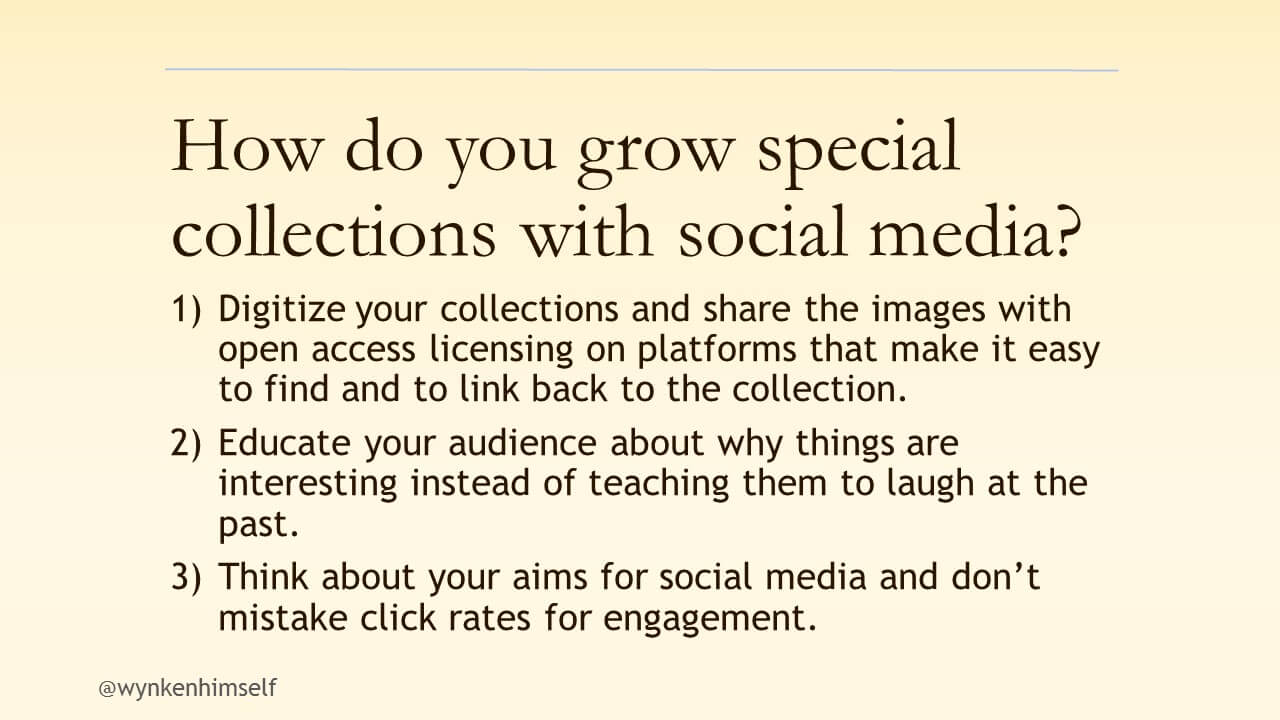
OK, for those who went tl;dr: http://sarahwerner.net/blog/wp-content/uploads/2015/07/Slide...

As a nonspecialist, I find only her first point compelling. Anything no longer under copyright is public domain. And for the rest there's fair use. I suppose that owners could seek to recover digitalization cost. But wouldn't Google be happy to help?

Re: How to destroy special collections with social media

#25
post #23
post #13

Earlier quoted context omitted.

>#000 on #FFF (or vice-versa) rarely ever occurs in nature. It also tends to strain eyes. Optimal contrast for most people tends to involve a dark grey, Is there actual scientific research that supports this? Most printed books have dark black ink instead of grey ink. (Although the paper of the pages may not be #FFF white but an off white.) In the office, the laser printers lay down dark black toner on crisp white pa…

Paper doesn't shine into your eyes. We also try to avoid staring into the sun, for the same reason.

What objectively measurable difference is there between reflected and transmitted light?

Polarization might be different, but that's something that's only barely perceptible to humans. I don't think it's plausible that it could affect legibility or eye strain. ( https://en.wikipedia.org/wiki/Haidinger%27s_brush )

Re: How to destroy special collections with social media

#26
post #7

I bemoan the disaster that is happening with the BBC archive of radio and TV (about 1,000,000 hours of content!) - they didn't manage to place it online completely, thus, it is not shared, commented upon, put in collections, and integrated into this living fabric that is the social media. In the meantime cat videos, art videos and all sorts oddities flood youtube, FB and reddit, and get the lion share of attention.

A lot of the archive is online - see http://genome.ch.bbc.co.uk/search/0/20?adv=1&media=playable&...

Re: How to destroy special collections with social media

#27
post #7

I bemoan the disaster that is happening with the BBC archive of radio and TV (about 1,000,000 hours of content!) - they didn't manage to place it online completely, thus, it is not shared, commented upon, put in collections, and integrated into this living fabric that is the social media. In the meantime cat videos, art videos and all sorts oddities flood youtube, FB and reddit, and get the lion share of attention.

At least they're keeping it now. We lost many hours of stuff because they just recorded over the tape.

Re: How to destroy special collections with social media

#28
post #25
post #23

Earlier quoted context omitted.

Paper doesn't shine into your eyes. We also try to avoid staring into the sun, for the same reason.

What objectively measurable difference is there between reflected and transmitted light? Polarization might be different, but that's something that's only barely perceptible to humans. I don't think it's plausible that it could affect legibility or eye strain. ( https://en.wikipedia.org/wiki/Haidinger%27s_brush )

Energy transfer.

There's a big difference between absorbing reflected ambient light and having photons pumped into your retina.

Re: How to destroy special collections with social media

#29
post #9

Earlier quoted context omitted.

That's a little different - isn't the problem there that the copyright for each individual programme is unclear and may not be wholly owned by the BBC? As a result, it is difficult and time consuming to track down the owner of each programme to secure the online archival permissions. With the book collections in the original article, copyright is very clear. Their books are out of copyright and the collections own th…

First - archival should be the ultimate fair use. Because the explicit deal of copyright is - temporary monopoly vs public domain after its expiry, any attempt to prevent or not aid archiving is equal to directly depraving the public of what it is owned in the future.

Archival is not the (legal) problem. Making the archive publicly accessible for consumption is. (and note that most countries' version of "fair use" doesn't cover as much as the US one)

Re: How to destroy special collections with social media

#30
post #24

OK, for those who went tl;dr: http://sarahwerner.net/blog/wp-content/uploads/2015/07/Slide... As a nonspecialist, I find only her first point compelling. Anything no longer under copyright is public domain. And for the rest there's fair use. I suppose that owners could seek to recover digitalization cost. But wouldn't Google be happy to help?

"fair use" is a difficult topic, especially internationally. An explicit license (or being honest and declaring things as public domain when they are) makes it way easier to use content.
Post reply on HN