Live data from Hacker News

The old suburban office park is the new American ghost town

washingtonpost.com

31–40 of 371 posts

Re: The old suburban office park is the new American ghost town

#31
post #16

I would love to see stats on where these companies are moving to. Are many of them transitioning into remote teams? Did some go out of business? Are they moving elsewhere? Does anyone have stats on this? New business formations are on the decline ( http://www.futurepundit.com/archives/009854.html ) and more businesses are closing shop each year than are forming ( http://www.washingtonpost.com/blogs/wonkblog/wp/2014/0…

> I wonder if some of these can be turned into more modern co-working spaces that can be rented by the desk.

It would depend on where the commercial building is. WeWork locations in the city are convenient and fantastic, but even a very, very cool WeWork location with all the bells and whistles wouldn't get me to commute out of the city to some suburban hell. It's just not worth it.

Re: The old suburban office park is the new American ghost town

#32
post #10
post #5

Thomas Jefferson is to blame and not one mention of taxes? I would be really surprised that some research wouldn't find that many of these office parks are built outside of the borders of major cities to avoid paying taxes, or were provided incentives by neighbouring municipalities to build further out and pay lower tax. The lower cost is attractive and allows the company to operate in a big shiny building that immed…

You can also blame subsidies and zoning laws. Free highway and road construction counted as a massive subsidy for sprawl, and zoning laws force sprawl in many cases by outright prohibiting the location of any place of business where people live or any mixed-use development. Excessive sprawl is not a result of pure free market activity. The 'burbs are heavily subsidized, legally encouraged, and heavily regulated. My p…

Also as a way to racially and economically segregate the population. Office park connect to residential suburbs where little Johnny and Lisa can get good schools and other white upper middle-class friends to play with.

Re: The old suburban office park is the new American ghost town

#33
post #16

I would love to see stats on where these companies are moving to. Are many of them transitioning into remote teams? Did some go out of business? Are they moving elsewhere? Does anyone have stats on this? New business formations are on the decline ( http://www.futurepundit.com/archives/009854.html ) and more businesses are closing shop each year than are forming ( http://www.washingtonpost.com/blogs/wonkblog/wp/2014/0…

> I wonder if some of these can be turned into more modern co-working spaces that can be rented by the desk. It would depend on where the commercial building is. WeWork locations in the city are convenient and fantastic, but even a very, very cool WeWork location with all the bells and whistles wouldn't get me to commute out of the city to some suburban hell. It's just not worth it.

Great point! WeWork looks awesome.

Re: The old suburban office park is the new American ghost town

#34
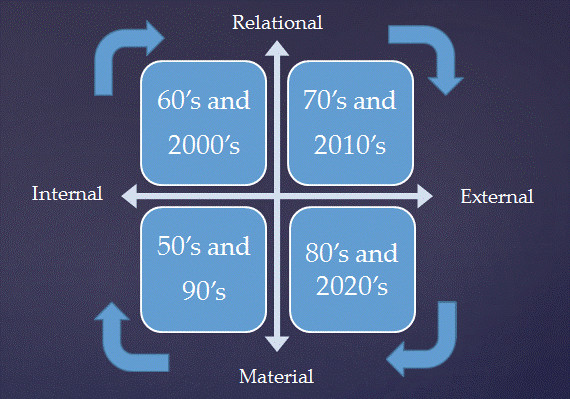
All of this works in cycles. There once was a time when people were flocking to the suburbs. Now, it is fashionable to live in the city. This too will pass when people (a generation maybe) comes to understand the little value obtained from all the chaos and activity.

What are people chasing? Technology has made it easier to be in touch and socialize w/ people beyond physical geography. Transportation is getting better. Yet, people are centered on cramming into cities. The concrete jungle... Living among all the action but having no time to enjoy it because you're too busy busting your ass to pay for the insane cost of the 'privilege'.

I used to live in Mountain View, CA and knew more about San Francisco and the cool things than most of my friends who lived in the city. Many times, I could get to places in the city faster than friends living in it.

What's the allure? When I think of California, I think of the beautiful outdoors and geography... Not cramming into a concrete jungle.

Hey look, I live in the city. I don't have a car. I pay a company to clean my place. I pay a company to do my laundry. There is no parking available for friends visiting me. I can't host anything at my place because its so small. I have to do all of my get together events 'out'.

The city generally provides the illusion that you are part of something that's bigger than you really are. Young people haven't formed a clear definition of this. So, they flock to the city which provides it in 'instant' form. This changes when a generation after realizes the cons of one thing and seeks out the pros in another. Or, when you get older and wiser.

As the saying goes, a smart investor is selling when everyone is buying and buying when everyone is selling. With all of the distractions of technology around me, I desire peace and quiet when i am at home. When I want noise and chaos, I go to the city. The big thing is, I have a choice in the matter and live by the beat of my own drum.

When you are young, you have no sense of this 'beat'. The city provides a steady one. Will the youth be able to maintain affordability of the city? How long will this cycle last?

https://resilienceeconomics.files.wordpress.com/2013/03/40-y...

Arcade Fire - Album (The Suburbs) 2010

Choice song (Suburban war)
Re: The old suburban office park is the new American ghost town

#35

All of this works in cycles. There once was a time when people were flocking to the suburbs. Now, it is fashionable to live in the city. This too will pass when people (a generation maybe) comes to understand the little value obtained from all the chaos and activity. What are people chasing? Technology has made it easier to be in touch and socialize w/ people beyond physical geography. Transportation is getting bette…

When I think of California, I think of the beautiful outdoors and geography...

Which an office park isn't, either.

Of course the outdoors and mountains are very attractive but they're not a viable workplace. While many of your city complaints are valid, it's not as if the suburbs solves all of them.

"There is no parking available for friends visiting me."

Sure, and if you live in the suburbs there is plenty of parking but nothing to do.

Re: The old suburban office park is the new American ghost town

#36
post #16

I would love to see stats on where these companies are moving to. Are many of them transitioning into remote teams? Did some go out of business? Are they moving elsewhere? Does anyone have stats on this? New business formations are on the decline ( http://www.futurepundit.com/archives/009854.html ) and more businesses are closing shop each year than are forming ( http://www.washingtonpost.com/blogs/wonkblog/wp/2014/0…

It's hinted at in the article:

"This past quarter, Northern Virginia gained more leases than it lost for the first time since 2013, mostly because of the magnetic powers of Metro’s new Silver Line, according to realty company CBRE Group."

There's much more demand for commercial properties in transit oriented developments.

Re: The old suburban office park is the new American ghost town

#37

I think suburbia might be a victim of its own success. As people moved out to more widely-dispersed communities, that caused commuting all the way downtown for work to be increasingly problematic. So of course that encouraged demand for business to also move out to the suburbs. Eventually things got so dispersed that people had to start driving everywhere. Roads got congested. It became increasingly common for people…

We've seen the reverse of this now. Everything I've seen has shown that newer generations are moving more into the cities, back to closer to their employers.

Re: The old suburban office park is the new American ghost town

#38
post #30

I think this article perhaps misses the real story. That being, office parks first built in 25+ years ago are reaching an age where their long term leases are expiring and they need to be renovated for the first time since being constructed to attract new tenants. While it makes sense to renovate an old factory and turn it into trendy office space with exposed brick and vintage architectural details from decades past…

Except there aren't tenants to renovate for which is why they are sitting empty and not being renovated. The long term tenants don't want new paint and carpeting, they want to be in the city.

Re: The old suburban office park is the new American ghost town

#39
post #37

I think suburbia might be a victim of its own success. As people moved out to more widely-dispersed communities, that caused commuting all the way downtown for work to be increasingly problematic. So of course that encouraged demand for business to also move out to the suburbs. Eventually things got so dispersed that people had to start driving everywhere. Roads got congested. It became increasingly common for people…

We've seen the reverse of this now. Everything I've seen has shown that newer generations are moving more into the cities, back to closer to their employers.

Have to factor in population density and massive increases in the population overall. US pop in 1950 was less than half of what it is now. So I could see why it would work out back then.

Re: The old suburban office park is the new American ghost town

#40
post #5

Thomas Jefferson is to blame and not one mention of taxes? I would be really surprised that some research wouldn't find that many of these office parks are built outside of the borders of major cities to avoid paying taxes, or were provided incentives by neighbouring municipalities to build further out and pay lower tax. The lower cost is attractive and allows the company to operate in a big shiny building that immed…

How does that explain that these low tax buildings are now being left empty in favor of options in the higher tax cities? If they were so desirable they wouldn't be sitting empty.
Post reply on HN