Live data from Hacker News

SSD Prices in a Free Fall

networkcomputing.com

141–150 of 336 posts

Re: SSD Prices in a Free Fall

#141

Earlier quoted context omitted.

The author commented that they've seen a 50% drop in price over the last 8 months (from 20x HDD to 10x HDD), so it's not outside the realms of probability with the increased yields of 3D NAND.

I doubt the 50% figure. Just as a test: I looked at the price history for a random 256GB SSD (from Crucial). The highest price in the last year? $115. The current price? $99. Not nearly a 50% drop. Link: http://camelcamelcamel.com/Crucial-MX100-2-5-Inch-Internal-C...

Now you are just cherry picking to prove a point. In a similar tone checkout the huge drop in prices for the Kingston Digital 240GB SSDNow[1]. It has dropped from about $400 to a mind blowing $78!!

I have been tracking the prices of HDD's for a while now. Although I do agree that HDDs are currently substantially cheaper than SSDs, HDDs have had much less drop in price or increase in capacity compared to the pre flood era. The bigger problem facing HDDs now is that almost all major manufactures are bought up by WD and Seagate and this is starting to show the ill effects of a duopoly. So it remains in their best interest to keep the prices high [2].

[1] http://camelcamelcamel.com/Kingston-Digital-SSDNow-SV300S37A...

[2] http://www.theinquirer.net/inquirer/news/2194549/western-dig...

Re: SSD Prices in a Free Fall

#142

Earlier quoted context omitted.

Are there technical limits to hard drive capacity? Is there a point at which they simply cannot get cheaper?

With the tech we're talking about, there are definitely limits per inch. They'll be able to fit a petabyte in a 2.5" SSD drive case before the SSD sunsets, at a cost of $300. At that time, your 100tb SSD might be $50 to $75. After SSD, what technology will take us to 100pb drives at $300? Is that even possible, while keeping the small size of the drive? No idea. It's going to require some amazing breakthroughs.

DNA storage[1]? It will be very interesting to watch computers become more "organic" over time. DNA for storage, processors that are correct "most of the time", deeper and more broad neural networks, etc.

1. https://en.wikipedia.org/wiki/DNA_digital_data_storage

Re: SSD Prices in a Free Fall

#143

Earlier quoted context omitted.

Yeah, 240SSD for The fact that it can take two internal drives (both SSD) is awesome - so having dual 240GB drives allows for plenty of space. I have a 1TB external that I glacerize my other stuff to. Also, get a Flickr account which can host your 1TB of pics for free (money for nothin')... and you wont consume space on your local box with pics.

> Also, get a Flickr account which can host your 1TB of pics for free (money for nothin')... and you wont consume space on your local box with pics. Just make sure you understand the privacy repercussions of hosting your data on Flickr.

Are there any things to know about settings images to 'private' on Flickr?

Re: SSD Prices in a Free Fall

#144

So does this mean Apple will finally stop shipping a 16GB iPhone as entry level?

Apple's storage pricing model would be unsustainable in a competitive environment. Entry level products with 16GB exist solely to establish a 'free' subsidized level while practical use requires a US$750 64GB model.

Ordinarily Samsung and Moto would make a phone of similar quality and charge the market rate of $8 for the 64GB upgrade to undercut Apple.

Unfortunately it's not a competitive market. Apple's 2013 iPhone 5S still has lower power use and more processing power the current Samsung phones because Apple invested in chip design and shipped an AArch64 chip Samsung can't match even with two years (1.33 Moore's Law cycles) of process upgrades and access to Apple's tapeouts.

Apple's screen process is still brighter with more faithful colors. Apple's case design is still more fashionable (even though I don't like the latest ones, they look slick). Apple's net software and services like maps and backup are catching up to Google and ahead of M'soft or anyone else. Apple still has better control over power consumption and background processing in its OS. Apple's user experience is still clearly better and easier than Samsung or Google.

A lot of that is Google losing interest in Motorola, the Nexus brand, and Android. The Nexus 5 was the last inexpensive high quality pure Android effort and it wasn't profitable. Motorola wasn't worth keeping. Android is good enough to keep Apple and Microsoft from squeezing Google off the net and that's all Google needs. Google hasn't even updated Android to take advantage of AArch64 which cripples all the Android phone makers against Apple.

Ultimately, Google knows that they can't compete against Apple because carriers have contempt for quality. No other maker but Apple has loyal and lucrative customers that will switch carriers to keep using Apple devices. Thus no other manufacturer has leverage to get the best quality devices it can make to users. Carriers want your phone crippled because they dream of controlling you and governments hand them monopolies so they can control your device maker.

The result is that only Apple can make a top flight device. And therefore they can use monopoly price discrimination tactics to bleed extra money from you for 64GB.

It beats the alternative which is carriers ruining all devices including Apple. I like Apple robbing me a lot more than AT&T or Telcel or Softbank or NT&T or China Mobile or Verizon.
Re: SSD Prices in a Free Fall

#145

Cheapest 1 TB SSD on Amazon: $350 Cheapest 1 TB HDD on Amazon: $40 Expecting a 10x drop in prices in 1 year is ludicrous. Even if the prices follow a pseudo Moore's law and fall by half every 18 months, you're looking at at least 5 years before they reach parity. And in the meantimg HDDs would have gotten cheaper; so expect even more time for parity. In other words: ain't happenin' in 2016.

Even if you factor in the performance difference, the cost still doesn't quite work out. On average, I don't think they are ~9x faster (more like 5x). Sure, SSDs max out disk interface speed and effectively have no seek time, but there are few workloads that are heavy on 4k random I/O (like booting and copying small files).

Really? For myself and everyone else I've talked to, using an SSD was by far the largest upgrade they've applied to their home computer for many years.

Re: SSD Prices in a Free Fall

#146
post #85

Cheapest 1 TB SSD on Amazon: $350 Cheapest 1 TB HDD on Amazon: $40 Expecting a 10x drop in prices in 1 year is ludicrous. Even if the prices follow a pseudo Moore's law and fall by half every 18 months, you're looking at at least 5 years before they reach parity. And in the meantimg HDDs would have gotten cheaper; so expect even more time for parity. In other words: ain't happenin' in 2016.

Cheapest new 250 GB HDD on NewEgg: $34.95 Cheapest new 256 GB SSD on NewEgg: $82.99

It's more interesting to me to compare cost/GB on the most frequently shipped or bought capacity for each media. At 250GB, the SSD is at close to (or maybe just ahead of) the most common size. 250GB HDDs are basically close to EOL which I imagine can skew the 'sweet spot' price up or down depending on the situation. Under that definition, SSD sweet spots are probably 128 or 256GB, and HDD is probably 1TB or 2TB?

Re: SSD Prices in a Free Fall

#147
post #5

In a side-note in the article, the author mentions that Amazon Glacier runs on tape. Although I'm not sure Amazon officially explained the technology, I heard (and read on Wikipedia) that they store data on conventional HDDs, that are however kept "offline". Has anyone here some more knowledge about that?

Tape is guaranteed for 10 years without data loss

Yet Google is using RAID-4 for their tape backups.

Re: SSD Prices in a Free Fall

#148

Earlier quoted context omitted.

The author commented that they've seen a 50% drop in price over the last 8 months (from 20x HDD to 10x HDD), so it's not outside the realms of probability with the increased yields of 3D NAND.

I doubt the 50% figure. Just as a test: I looked at the price history for a random 256GB SSD (from Crucial). The highest price in the last year? $115. The current price? $99. Not nearly a 50% drop. Link: http://camelcamelcamel.com/Crucial-MX100-2-5-Inch-Internal-C...

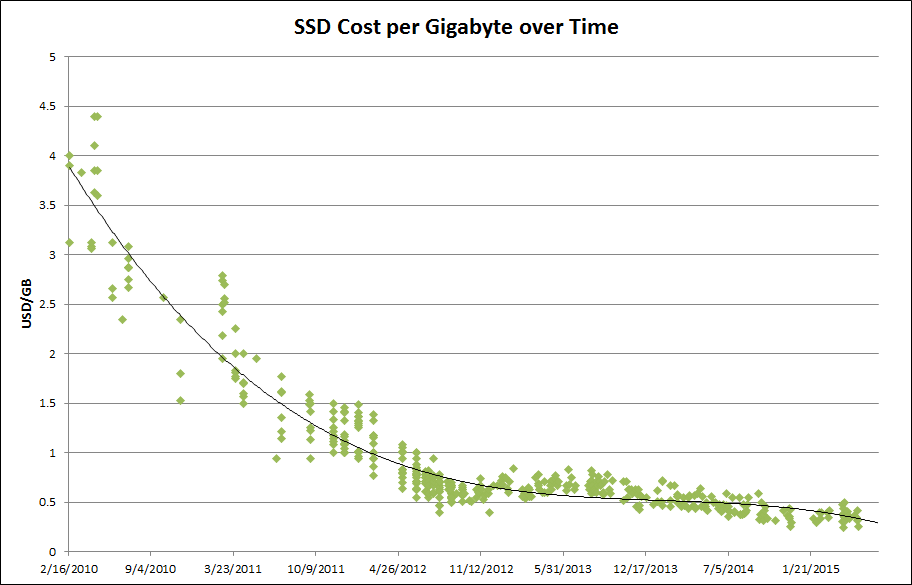
I have been (unscientifically) tracking the prices of consumer level SSDs that are on sale for a few years now, there isn't any massive drop: http://media.mmo-champion.com/images/news/2015/may/ssdgraph....

Re: SSD Prices in a Free Fall

#149

Cheapest 1 TB SSD on Amazon: $350 Cheapest 1 TB HDD on Amazon: $40 Expecting a 10x drop in prices in 1 year is ludicrous. Even if the prices follow a pseudo Moore's law and fall by half every 18 months, you're looking at at least 5 years before they reach parity. And in the meantimg HDDs would have gotten cheaper; so expect even more time for parity. In other words: ain't happenin' in 2016.

Great point, although we should also talk about the way storage use has shifted. I used to have some massive programs installed, a lot of digital media and video games at one point. Now Steam / GOG / Blizzard "stores" my games when not in use. Google / Apple / Pandora / Spotify "stores" my music. Amazon or Netflix "stores" my movies. When I ran an HDD, I wanted a TB. Now that I'm running SSDs, 80 GB seems to meet all…

> I used to have some massive programs installed, a lot of digital media and video games at one point. Now Steam / GOG / Blizzard "stores" my games when not in use. Google / Apple / Pandora / Spotify "stores" my music. Amazon or Netflix "stores" my movies.

How sustainable is this for the average consumer with most national ISPs moving towards bandwidth caps?

I had to switch to business service because Netflix alone was blowing through the data cap - in fact it was blowing through even the data cap they had for their top tier consumer service.

Re: SSD Prices in a Free Fall

#150

Cheapest 1 TB SSD on Amazon: $350 Cheapest 1 TB HDD on Amazon: $40 Expecting a 10x drop in prices in 1 year is ludicrous. Even if the prices follow a pseudo Moore's law and fall by half every 18 months, you're looking at at least 5 years before they reach parity. And in the meantimg HDDs would have gotten cheaper; so expect even more time for parity. In other words: ain't happenin' in 2016.

Even if you factor in the performance difference, the cost still doesn't quite work out. On average, I don't think they are ~9x faster (more like 5x). Sure, SSDs max out disk interface speed and effectively have no seek time, but there are few workloads that are heavy on 4k random I/O (like booting and copying small files).

As a desktop user tasks like booting and copying small files make a hell of a difference for the perceived speed of a system, because they feel like they should be fast. This is where SSDs shine. On the other hand, most tasks that involve sequential I/O with bigger files are expected to take some time. Have you ever tried unzipping eclipse on different systems?
Post reply on HN