Live data from Hacker News

Relicensing Dolphin: The long road to GPLv2+

dolphin-emu.org

11–20 of 71 posts

Re: Relicensing Dolphin: The long road to GPLv2+

#11
post #8
post #2

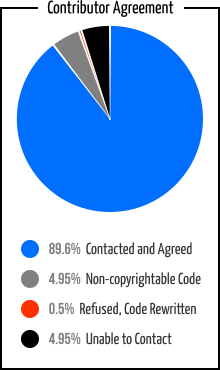
I'm wondering about those 0.5% who refused to relicense. What would be the rational behind refusing such a change. I can understand refusing for a project to be relicensed under a very different license but not between GPLv2 and GPLv2+...

If you're talking about Dolphin, read the article again. Nobody refused, but a few people couldn't be contacted - unlike Linux, Dolphin has never required real names from contributors, so this mostly consisted of a few people who contributed under an alias a few years ago before utterly vanishing from the Internet. EDIT: disregard; didn't see the graph, and wasn't previously aware of the one person who refused. See h…

> read the article again. Nobody refused, but a few people couldn't be contacted

No. Ten were uncontactable, and one refused.

"Refused and Code Rewritten - 1/202"

"Unable to Contact - 10/202"

From the descriptions of the red and black slices of the pie chart - https://dolphin-emu.org/m/user/blog/relicensing/relicensepie...
Re: Relicensing Dolphin: The long road to GPLv2+

#12
post #8
post #2

I'm wondering about those 0.5% who refused to relicense. What would be the rational behind refusing such a change. I can understand refusing for a project to be relicensed under a very different license but not between GPLv2 and GPLv2+...

If you're talking about Dolphin, read the article again. Nobody refused, but a few people couldn't be contacted - unlike Linux, Dolphin has never required real names from contributors, so this mostly consisted of a few people who contributed under an alias a few years ago before utterly vanishing from the Internet. EDIT: disregard; didn't see the graph, and wasn't previously aware of the one person who refused. See h…

I read it. And it's still confusing because of this graph (from the article):

https://dolphin-emu.org/m/user/blog/relicensing/relicensepie...

Note: "0.5% Refused. Code Rewritten"

If you mouse over that graphic in the article it says 1 person refused. However, the article otherwise completely ignores that 1 person... (unless I missed it, both times ;) )

Re: Relicensing Dolphin: The long road to GPLv2+

#13
post #6
post #2

I'm wondering about those 0.5% who refused to relicense. What would be the rational behind refusing such a change. I can understand refusing for a project to be relicensed under a very different license but not between GPLv2 and GPLv2+...

Licensing GPLv2+ means you'll accept any future "GPLv4", "GPLv5" etc without having any idea what those licenses will look like. You might end up not liking having them apply to your code. What if control of FSF is taken over as if like a coup and a nasty "GPLv4" is released?

The worst that could happen is that there is a future GPL version that removes copyleft. If there is a future GPL version that is horrible for the receipient, then at worst that receipient can simply opt for GPLv3.

https://www.gnu.org/licenses/old-licenses/gpl-2.0-faq.html#V...

Clause 14 of GPL 3 also clarifies what later licenses can do. They must be "similar in spirit" and they cannot impose any additional requirements on any author or copyright holder.

edit: Okay, after seeing clause 14, I don't even see how a judge would interpret a GPL version without copyleft to be "similar in spirit", so I can't even imagine how that would happen. I think you're ok in accepting newer versions of GPLv3.

Re: Relicensing Dolphin: The long road to GPLv2+

#14
post #9
post #3

> In practice, GPLv3 only adds more restrictions to the license Not at all. They say so themselves: GPLv3 adds compatibility with Apache v2, which GPLv2 lacks. This thus removes a restriction. GPLv3 also clarifies some things from GPLv2, such as being explicit about being applicable not only to software, and giving a clearer meaning of what distributing software means. GPLv3 calls this "conveying".

That's not true at all. Read up on the different licenses. The reason v3 was created was to fight tivoization, where the code is realeased, but the hardware prevents loading updated copies. From the point of view of a company licensing their source, v3 is much more restrictive. It requires a lot more things than a more free license. Linux is famous for rejecting it because of that. Yes, there's a benefit that you are…

The statement "GPLv3 only adds more restrictions" is false, because it also removes some restrictions.

Whether you think you should allow Tivoisation or not is a different matter to the plain fact that there are things that GPLv3 allows which GPLv2 does not allow.

Re: Relicensing Dolphin: The long road to GPLv2+

#15
post #8
post #2

I'm wondering about those 0.5% who refused to relicense. What would be the rational behind refusing such a change. I can understand refusing for a project to be relicensed under a very different license but not between GPLv2 and GPLv2+...

If you're talking about Dolphin, read the article again. Nobody refused, but a few people couldn't be contacted - unlike Linux, Dolphin has never required real names from contributors, so this mostly consisted of a few people who contributed under an alias a few years ago before utterly vanishing from the Internet. EDIT: disregard; didn't see the graph, and wasn't previously aware of the one person who refused. See h…

Hm? The graph on the page shows 4.5% of contacts being marked as "Unable to contact", while it shows a very small 0.5% as "Refused, Code Rewritten". Or is this graph wrong?

Re: Relicensing Dolphin: The long road to GPLv2+

#16
post #2

I'm wondering about those 0.5% who refused to relicense. What would be the rational behind refusing such a change. I can understand refusing for a project to be relicensed under a very different license but not between GPLv2 and GPLv2+...

The only person I know that opposed the change was Scott Moreau, and from my understanding he only did it to be an annoyance (I have IRC logs that indicate this pretty clearly). Given his history with other projects[1,2] it's not a big surprise. This was solved by removing the broken and mostly unused Wayland support from Dolphin.

[1] https://lwn.net/Articles/544543/ [2] http://www.phoronix.com/scan.php?page=news_item&px=MTM0MTM

Re: Relicensing Dolphin: The long road to GPLv2+

#17
post #8
post #2

I'm wondering about those 0.5% who refused to relicense. What would be the rational behind refusing such a change. I can understand refusing for a project to be relicensed under a very different license but not between GPLv2 and GPLv2+...

If you're talking about Dolphin, read the article again. Nobody refused, but a few people couldn't be contacted - unlike Linux, Dolphin has never required real names from contributors, so this mostly consisted of a few people who contributed under an alias a few years ago before utterly vanishing from the Internet. EDIT: disregard; didn't see the graph, and wasn't previously aware of the one person who refused. See h…

[deleted]

Re: Relicensing Dolphin: The long road to GPLv2+

#18
post #2

I'm wondering about those 0.5% who refused to relicense. What would be the rational behind refusing such a change. I can understand refusing for a project to be relicensed under a very different license but not between GPLv2 and GPLv2+...

GPLv2+ means you are accepting the terms of GPLv5. What's in GPLv5? I have no idea. No one has any idea. It might never get written. As long as RMS is in charge, I'm not worried about the contents of the next GPL dramatically differing from the current spirit. However, there is no guarantee that I will agree with future versions of the GPL. I'd like to judge them as they come. It's actually really strange to sign up…

> As long as RMS is in charge, I'm not worried about the contents of the next GPL dramatically differing from the current spirit.

You don't have to trust RMS. You can trust lawyers interpreting clause 14 of GPLv3 correctly. This clause says that later GPL versions must be "similar in spirit". It also says that newer versions cannot impose any more obligations or restrictions on authors or copyright holders.

Re: Relicensing Dolphin: The long road to GPLv2+

#19
post #13
post #6

Earlier quoted context omitted.

Licensing GPLv2+ means you'll accept any future "GPLv4", "GPLv5" etc without having any idea what those licenses will look like. You might end up not liking having them apply to your code. What if control of FSF is taken over as if like a coup and a nasty "GPLv4" is released?

The worst that could happen is that there is a future GPL version that removes copyleft. If there is a future GPL version that is horrible for the receipient, then at worst that receipient can simply opt for GPLv3. https://www.gnu.org/licenses/old-licenses/gpl-2.0-faq.html#V... Clause 14 of GPL 3 also clarifies what later licenses can do. They must be "similar in spirit" and they cannot impose any additional requirem…

If FSF turned truly malicious, they could remove the "no warranty" section.

Re: Relicensing Dolphin: The long road to GPLv2+

#20
post #4
post #2

I'm wondering about those 0.5% who refused to relicense. What would be the rational behind refusing such a change. I can understand refusing for a project to be relicensed under a very different license but not between GPLv2 and GPLv2+...

Some people (Linus Torvalds is a notable example) think that GPLv3's provisions that forbid things like locked down hardware are too much. They would rather be "permissive" and allow hardware that restricts what the user can do with it. What good is modifiable software if the hardware will refuse to run software if it's modified? Tell me, Mr Anderson, what good is a phone call when you are unable to speak?

Keep in mind that Linus's reasons behind licensing are often selfish ones: he simply wants as many people as possible contributing code to him.
Post reply on HN