Live data from Hacker News

Remote Kernel Code Execution Via HTTP Request In IIS On Windows

ma.ttias.be

11–20 of 201 posts

Re: Remote Kernel Code Execution Via HTTP Request In IIS On Windows

#11
post #8

Earlier quoted context omitted.

Sounds like the author understands the bug but does not understand why it allows remote code execution (which I don't understand either; once details are released it should be clarified).

That's a good point, because in the example we can clearly see how to check if a system is or not patched and that, using this attack, we can crash a Windows Server. The remote execution part is completely missing (fortunately), but I was wondering if this gives the admin rights on machine (I have absolutely no experience on Windows Server machines, so I don't know how it works in terms of services, permissions and r…

It would allow the same privileges as the user which is running IIS, usually a "system" account - which equals Administrative privileges.
Re: Remote Kernel Code Execution Via HTTP Request In IIS On Windows

#13

The interesting take-away is the .sys suffix on the filename: Yes, Windows contains a device driver running in Kernel mode that cares about (IIS) HTTP traffic.

goodness me yes. It appears to be a kernel-mode http parser:

http://www.microsoft.com/technet/prodtechnol/WindowsServer20...

is that really the only way MS could make IIS fast enough?

See also https://en.wikipedia.org/wiki/TUX_web_server

Re: Remote Kernel Code Execution Via HTTP Request In IIS On Windows

#14
post #12

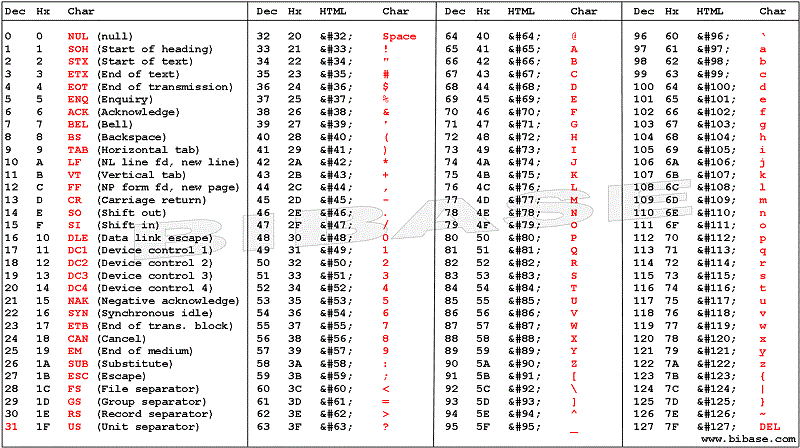
From the exploit code: memset(&serv_addr, '0', sizeof(serv_addr)); That doesn't seem to be correct. The digit character 0 is not the same as the null character ('\0'). Just write 0 or use `struct sockaddr_in serv_addr = { 0 };`.

ASCII NUL is indeed 0x0.

http://en.m.wikipedia.org/wiki/Null_character http://www.bibase.com/images/ascii.gif

Re: Remote Kernel Code Execution Via HTTP Request In IIS On Windows

#15
post #11
post #8

Earlier quoted context omitted.

That's a good point, because in the example we can clearly see how to check if a system is or not patched and that, using this attack, we can crash a Windows Server. The remote execution part is completely missing (fortunately), but I was wondering if this gives the admin rights on machine (I have absolutely no experience on Windows Server machines, so I don't know how it works in terms of services, permissions and r…

It would allow the same privileges as the user which is running IIS, usually a "system" account - which equals Administrative privileges.

You two seem to not understand still, please re-read my comment.

The point is this is allowing code execution within the kernel of windows. It doesn't even reach the IIS userland process.

Re: Remote Kernel Code Execution Via HTTP Request In IIS On Windows

#16
post #12

From the exploit code: memset(&serv_addr, '0', sizeof(serv_addr)); That doesn't seem to be correct. The digit character 0 is not the same as the null character ('\0'). Just write 0 or use `struct sockaddr_in serv_addr = { 0 };`.

ASCII NUL is indeed 0x0. http://en.m.wikipedia.org/wiki/Null_character http://www.bibase.com/images/ascii.gif

But '0' is not ascii NUL (0x00), it's ascii 0 (0x30).

Re: Remote Kernel Code Execution Via HTTP Request In IIS On Windows

#17
post #12

From the exploit code: memset(&serv_addr, '0', sizeof(serv_addr)); That doesn't seem to be correct. The digit character 0 is not the same as the null character ('\0'). Just write 0 or use `struct sockaddr_in serv_addr = { 0 };`.

ASCII NUL is indeed 0x0. http://en.m.wikipedia.org/wiki/Null_character http://www.bibase.com/images/ascii.gif

'0' != '\0'

'0' == 48

Re: Remote Kernel Code Execution Via HTTP Request In IIS On Windows

#18
post #4

Here the Microsoft Security Bulletin: https://technet.microsoft.com/library/security/ms15-034 I think the title is downplaying the severity of the bug. It's a remote code execution vulnerability in http.sys which is a webserver component running inside the kernel (yea right, great idea!) so you can get remote root via HTTP request. The blog quotes this correctly but I get the feeling the author didn't communicate it…

> webserver component running inside the kernel (yea right, great idea!)

Actually an idea shared among many OS, including GNU/Linux.

http://en.wikipedia.org/wiki/In-kernel_web_server

Re: Remote Kernel Code Execution Via HTTP Request In IIS On Windows

#19
post #4

Here the Microsoft Security Bulletin: https://technet.microsoft.com/library/security/ms15-034 I think the title is downplaying the severity of the bug. It's a remote code execution vulnerability in http.sys which is a webserver component running inside the kernel (yea right, great idea!) so you can get remote root via HTTP request. The blog quotes this correctly but I get the feeling the author didn't communicate it…

To be fair, http://en.wikipedia.org/wiki/TUX_web_server. Having said that, this is huge. This is way worse than Heartbleed for the IIS crowd.

Re: Remote Kernel Code Execution Via HTTP Request In IIS On Windows

#20

Earlier quoted context omitted.

ASCII NUL is indeed 0x0. http://en.m.wikipedia.org/wiki/Null_character http://www.bibase.com/images/ascii.gif

But '0' is not ascii NUL (0x00), it's ascii 0 (0x30).

Additionally there are a bunch of other things very wrong with the exploit code.

If the connect() fails, it will use file descriptor 1 which is usually stdout and write the request to it and try to read from it.

And there is a problem with strstr() not getting a null terminated string (if the stack memory for recvBuff wasn't automatically zero'd out which some compilers can do).

Why do these people bother writing the exploit in C? A curl one liner is good enough.

Also the check for 'The request has an invalid header name' seems dubious to me because a proxy in front would likely return a different error (the header name is not invalid but rather the range not satisfyable).

Post reply on HN