Live data from Hacker News

Why the sun is a poor dumping ground for nuclear waste (2010)

csicop.org

31–40 of 176 posts

Re: Why the sun is a poor dumping ground for nuclear waste (2010)

#31
post #5

This is why you'd use gravity braking to do the work for you... You just have to change direction, not slow yourself down, as long as your path intersects the sun you're done... we have sent spacecraft to the sun... it's not beyond our technical capabilities. Basically, it's like flying into a banked curve... as long as you're pointed at the Sun when you exit the curve you're going to hit the sun with out needing to…

> "If it was difficult to hit things with large gravitational forces we wouldn't see very many comets in the night sky..."

The difficulty does not come from the mass of the Sun. It comes from Earth's velocity around it. The waste starts out with that velocity as well. Basically the waste is already in a stable orbit around the sun, and getting it out of that is difficult.
Re: Why the sun is a poor dumping ground for nuclear waste (2010)

#32
> To reach the Sun you need to subtract 100 percent of Earth’s orbital velocity; to reach solar escape velocity you need only add 41 percent to it.

You could send the waste with near solar escape velocity to travel on a really long ellipsis trajectory, at the furthest point you can get rid of the remaining kinetic energy with minimal fuel and let the waste fall back straight into the Sun. Subtracting Earth's orbital velocity is by far not the optimal method to reach the Sun.

Re: Why the sun is a poor dumping ground for nuclear waste (2010)

#33
We can make it to Mercury. In fact, putting a spacecraft in orbit around Mercury is made more difficult because of the need to decelerate against the Sun's gravity.

If you look at the Wikipedia page for the MESSENGER mission, you'll see they tackled that problem by using gravity assists from Earth, Venus, and Mercury to reduce MESSENGER's relative velocity with Mercury and allow it to go into orbit. These gravity assists greatly reduced the propulsion requirements.

Re: Why the sun is a poor dumping ground for nuclear waste (2010)

#34
post #3

Is there any way to use drag to decay the orbit? We don't have to reach the sun quickly . The solar wind is blowing past, is it possible to "sail" against that at an angle and - over time - dump orbital velocity and so end up in the sun?

From my understanding, solar wind can only push the payload further away from the sun and there is no noticeable drag in space or the earth wouldn't orbit for very long.

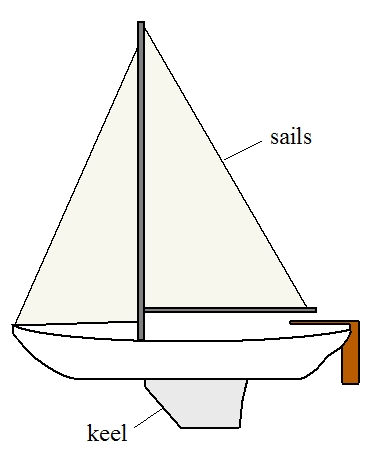
You are probably thinking that you can sail upwind on a sail boat but it isn't the same in space. The boat's keel [1] and general shape keep it going straight which is necessary to sail upwind. That doesn't work in space.

Another factor is that a sail works much like an airplane's wing and isn't really 'pushed' by the wind. This allows the force to be perpendicular to the sail in some cases. To my knowledge (take this part with a grain of salt), solar sails works by receiving momentum as the photons hit. This could only push it away from the sun.

http://www.real-world-physics-problems.com/images/physics_sa...

Re: Why the sun is a poor dumping ground for nuclear waste (2010)

#35
post #30
post #21

Earlier quoted context omitted.

The ~30km/s figure is what you'd need to drop it straight into the sun, no spiraling involved. Gravitational assists can help, but they can also help you get other places. Getting to the sun would still be ridiculously hard compared to the alternatives.

But that's is expending a whole lot of energy to "remove" earth's orbital velocity[1]. Why remove it when you can just deflect the rocket by the gravity of Venus and redirect the rocket directly towards the sun? Or are we missing something more fundamental? 1. http://www.wolframalpha.com/input/?i=orbital%20velocity%20of...

> "Gravitational assists can help, but they can also help you get other places."

Without gravitational assists, you need ~30km/s to drop into the sun, and far less to go other places. With gravitational assists both can be easier, but going to the sun will still be one of the harder places to go.

That aside, if you are going to loop it around Venus, why not just hit Venus? I'm sure Venus wouldn't mind.

Re: Why the sun is a poor dumping ground for nuclear waste (2010)

#37

Even if it were actually difficult to get to the sun, there are other options that are nearly as effective. Jupiter would be just as good of a dump or we could just launch on an extra solar trajectory. Hell, we could just put it on a large, non-equatorial orbit around the Earth and it would be effectively gone with the added benefit of being able to recover it should we find a reason to. Space is a big enough place t…

Ehhh, orbit's not a great idea, especially lower-earth orbit. There's already enough space junk in our orbit right now that we're running the risk of an orbital chain-reaction. The chain reaction could take out most of our satellites. I'm sure radioactive waste in our upper atmosphere wouldn't be a good thing, either.

http://en.wikipedia.org/wiki/Kessler_syndrome

Re: Why the sun is a poor dumping ground for nuclear waste (2010)

#38
This is all assuming that we don't have a space elevator.

tldr; it costs a lot of money to launch mass into space.

Sending 1 pound of water into space costs $50,000. This is more than the price of gold on earth. A space elevator changes the economics dramatically.

Re: Why the sun is a poor dumping ground for nuclear waste (2010)

#40
post #3

Is there any way to use drag to decay the orbit? We don't have to reach the sun quickly . The solar wind is blowing past, is it possible to "sail" against that at an angle and - over time - dump orbital velocity and so end up in the sun?

From my understanding, solar wind can only push the payload further away from the sun and there is no noticeable drag in space or the earth wouldn't orbit for very long. You are probably thinking that you can sail upwind on a sail boat but it isn't the same in space. The boat's keel [1] and general shape keep it going straight which is necessary to sail upwind. That doesn't work in space. Another factor is that a sai…

The force will be perpendicular to the surface light reflects from, not perpendicular to the light arriving at the surface. Therefore if the sail was mounted at a 45 degree angle to the Sun, there would be a force that reduces angular momentum and puts the object in a spiral towards the Sun.
Post reply on HN