Live data from Hacker News

Global warming is now slowing down the circulation of the oceans

washingtonpost.com

51–60 of 70 posts

Re: Global warming is now slowing down the circulation of the oceans

#51
post #48

Earlier quoted context omitted.

I have a number of questions that I've never been able to find satisfactory answers to, and if I got them I could be convinced. But first, let me say, that this may well be moot. I think solar energy is the way to go. I think the sooner human beings stop burning things they find in the ground for energy, the better. I'll happily give my vote or my money to an elegant solution to make this happen. Next, my nutshell un…

Can you please give me the link to your "Every carbon-temperature hockey stick chart I've seen" which "starts in 1750"? We actually know the concentration in the last 400 thousand years and it was never so high during that time as it is now: http://climate.nasa.gov/system/content_pages/main_images/203...

From my fourth paragraph above:

For as far back as we can measure (many millennia when using ice cores), atmospheric temperate has been stable along with CO2 concentrations (about 280ppm)

Re: Global warming is now slowing down the circulation of the oceans

#52
post #38

Earlier quoted context omitted.

Subsidies don't recover the investment, they just make other people pay for it.

... or potentially pay for their own negative externalities.

Other people pay, regardless of whether they produce negative externalities or not.

Re: Global warming is now slowing down the circulation of the oceans

#53
post #48

Earlier quoted context omitted.

Can you please give me the link to your "Every carbon-temperature hockey stick chart I've seen" which "starts in 1750"? We actually know the concentration in the last 400 thousand years and it was never so high during that time as it is now: http://climate.nasa.gov/system/content_pages/main_images/203...

From my fourth paragraph above: For as far back as we can measure (many millennia when using ice cores), atmospheric temperate has been stable along with CO2 concentrations (about 280ppm)

Then you agree that we actually know the CO2 concentrations in last 400000 years and that they are now extraordinary high?

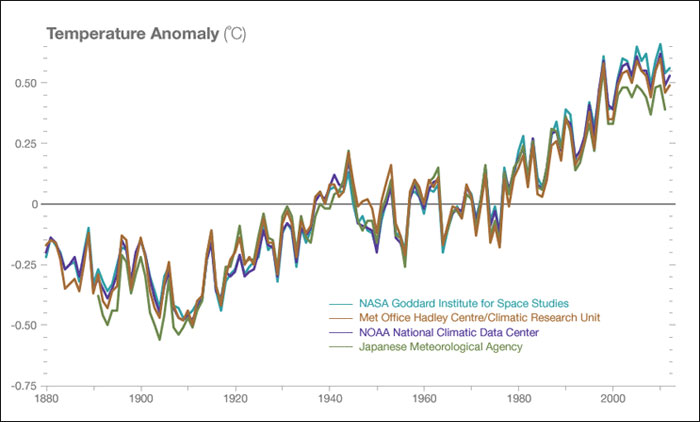
I'd still like to see that "every carbon-temperature hockey stick chart I've seen starts in 1750." We agreed that we know CO2 for much longer. Regarding the temperature, I know this one:

http://climate.nasa.gov/system/content_pages/main_images/232...

Which starts at 1880 not at 1750, and it just shows that it's mostly (note: it's not straight sometimes over some decade it's different) getting warmer during the last 100 years which certainly matches with most of humanity's use of fossil fuels.

http://en.wikipedia.org/wiki/Peak_oil#/media/File:US_Crude_O...

http://en.wikipedia.org/wiki/Peak_coal#/media/File:US_coal_p...

Re: Global warming is now slowing down the circulation of the oceans

#54
post #27

Earlier quoted context omitted.

The planet isn't an organism with an immune system reacting to infections. It's a ball of rock that "couldn't care less" if there are beings living on it. The systems that exist on the surface of the planet are just physical processes reacting to other physical processes. Nothing more. Ocean currents aren't changing as part of a process of "healing" they are changing because they are governed by the laws of physics.

That is not completely true, virtually all the oxygen on Earth came from bacteria. Life interacts with physics.

The bacteria weren't attempting to seed life or "heal" the Earth by producing oxygen. It was a by-product, that by coincidence other organisms were able to develop to use.

Re: Global warming is now slowing down the circulation of the oceans

#55
post #22

Earlier quoted context omitted.

Rather than looking at the politics perhaps you could look at the science? What would it take to convince you? Seriously - if nothing can then we have departed from rational debate, but if there is evidence that would sway you then it would be great to identify it.

>What would it take to convince you? Not speaking specifically to this issue, but I've lost a lot of my trust in science after reading a great deal of literature in psychology and paying attention to how funding impacts results. To reference XKCD, if I really wanted to and had enough funds, I could produce findings that a given candy causes acne. And if the opposition side is too politically unpopular to have compara…

Yeah, but if you were to speak specifically to this issue, the exact opposite is the case. If someone could poke a scientific hole in the AGW theory, they'd be set for life. Maybe they're all too risk-averse and want to stick with their guaranteed poverty-level postdoc wage?

Re: Global warming is now slowing down the circulation of the oceans

#56
post #22

Earlier quoted context omitted.

Rather than looking at the politics perhaps you could look at the science? What would it take to convince you? Seriously - if nothing can then we have departed from rational debate, but if there is evidence that would sway you then it would be great to identify it.

>What would it take to convince you? Not speaking specifically to this issue, but I've lost a lot of my trust in science after reading a great deal of literature in psychology and paying attention to how funding impacts results. To reference XKCD, if I really wanted to and had enough funds, I could produce findings that a given candy causes acne. And if the opposition side is too politically unpopular to have compara…

Science on the tv and radio works this way (also, sadly Science as a career as well) but Science proper doesn't. You could do a study that showed candy causing acne, but if I falsified your hypothesis with a single cheap study showing that I fed the candy to another group of people and saw no effect (double blind etc), and other people reproduced that - then Science would move on (chewing the sweeties and spot free!) The trouble is that nothing like enough of this behaviour (checking, falsifying) goes on - because it doesn't make a career.

Re: Global warming is now slowing down the circulation of the oceans

#57

Earlier quoted context omitted.

I have a number of questions that I've never been able to find satisfactory answers to, and if I got them I could be convinced. But first, let me say, that this may well be moot. I think solar energy is the way to go. I think the sooner human beings stop burning things they find in the ground for energy, the better. I'll happily give my vote or my money to an elegant solution to make this happen. Next, my nutshell un…

I am sorry for not addressing all of your points, but I was staring at the graph in #2 and wanted to complain about how useless it is. First, there is the small annoyance that the one number is in parts-per-million and the other in million metric tons; why not convert the atmospheric concentration of CO2 to the corresponding number of metric tons in the atmosphere? But worse, it is comparing the annual CO2 emissions…

It seems we burn more than the atmosphere concentration increases at the moment:

https://micpohling.wordpress.com/2007/03/30/math-how-much-co...

The oceans absorb some of CO2, but that raises their acidity, destroying corals etc.

http://en.wikipedia.org/wiki/Ocean_acidification

Re: Global warming is now slowing down the circulation of the oceans

#58

Earlier quoted context omitted.

I have a number of questions that I've never been able to find satisfactory answers to, and if I got them I could be convinced. But first, let me say, that this may well be moot. I think solar energy is the way to go. I think the sooner human beings stop burning things they find in the ground for energy, the better. I'll happily give my vote or my money to an elegant solution to make this happen. Next, my nutshell un…

I don't know the answers to your questions. I do know they are natural questions and that it appears you are not an expert in these matters. Thus it is almost surely the case the experts have thought about these questions and have answers. What makes you think the experts in this area have their beliefs and knowledge skewed by politics? Do you believe this for other areas of science? I'm old enough to remember the de…

Thus it is almost surely the case the experts have thought about these questions and have answers.

A great example is nutritional science. It was widely accepted that a diet high in fat was bad for you. If you had stood up and said "I disagree, fat is good for you!" you'd be regarded as a kook.

Look at where we are now with regards to nutrition and fat.

Re: Global warming is now slowing down the circulation of the oceans

#59
post #53

Earlier quoted context omitted.

From my fourth paragraph above: For as far back as we can measure (many millennia when using ice cores), atmospheric temperate has been stable along with CO2 concentrations (about 280ppm)

Then you agree that we actually know the CO2 concentrations in last 400000 years and that they are now extraordinary high? I'd still like to see that "every carbon-temperature hockey stick chart I've seen starts in 1750." We agreed that we know CO2 for much longer. Regarding the temperature, I know this one: http://climate.nasa.gov/system/content_pages/main_images/232... Which starts at 1880 not at 1750, and it just…

I'll retract my sentence at the beginning of question 1.

What I meant was, greenhouse gas concentrations have been increasing since the beginning of the industrial revolution in 1750. I can cite this here: http://en.wikipedia.org/wiki/Greenhouse_gas#Changes_since_th... and here: http://www.epa.gov/climatechange/pdfs/CI-greenhouse-gases-20...

But I don't think your response answers my question. The middle 18th century seems to be the beginning of a natural shift in CO2 concentrations, according to figure 1 here:

http://www.epa.gov/climatechange/pdfs/CI-greenhouse-gases-20...

In that figure, we see that CO2 levels naturally move between 200ppm and 300ppm over hundreds of thousands of years. Which now leads me to another question:

Have human beings exacerbated what was a naturally occurring rise in CO2 concentrations? If so, will the natural causes that reduced CO2 concentrations from 300ppm overcome that exacerbation?

Re: Global warming is now slowing down the circulation of the oceans

#60
post #53

Earlier quoted context omitted.

Then you agree that we actually know the CO2 concentrations in last 400000 years and that they are now extraordinary high? I'd still like to see that "every carbon-temperature hockey stick chart I've seen starts in 1750." We agreed that we know CO2 for much longer. Regarding the temperature, I know this one: http://climate.nasa.gov/system/content_pages/main_images/232... Which starts at 1880 not at 1750, and it just…

I'll retract my sentence at the beginning of question 1. What I meant was, greenhouse gas concentrations have been increasing since the beginning of the industrial revolution in 1750. I can cite this here: http://en.wikipedia.org/wiki/Greenhouse_gas#Changes_since_th... and here: http://www.epa.gov/climatechange/pdfs/CI-greenhouse-gases-20... But I don't think your response answers my question. The middle 18th century…

Your first link doesn't have any graph with 1750, your second, which is same as the third, also. The figure 1 in the pdf is specifically "Figure 1. U.S. Greenhouse Gas Emissions by Gas, 1990–2012" So I still don't see any graph since 1750. You probably wanted to paste something else?

Humans have burned so much of C that CO2 concentration is alarmingly high, all the "natural" events during the last 400000 years simply didn't produce that much as fast as we do now, so we also can't expect anything to magically save us now. The oceans do get something that doesn't end in the air, but that's it. It happened before, it won't get better easy, that's what happened some 50 million years ago:

http://en.wikipedia.org/wiki/Paleocene%E2%80%93Eocene_Therma...

"Model simulations of peak carbon addition to the ocean–atmosphere system during the PETM give a probable range of 0.3–1.7 Pg C yr−1, which is much slower than the currently observed rate of carbon emissions.[60]"

"Recovery: The δ13C record records a duration of around 120,000[22] to 170,000[1][61] years, slightly faster than the residence time of carbon in the modern atmosphere (100,000 to 200,000 years). A feedback system[62] would explain this slightly more rapid recovery time."

There will be the way back, but in the scale of 100 thousand years. And now the increase happens much, much, faster than even that event 50 million years ago.

Edit: maybe you mean this? http://cdiac.ornl.gov/trends/co2/graphics/lawdome.gif ("Historical CO2 Records from the Law Dome DE08, DE08-2, and DSS Ice Cores")

As you see, 1750 is not a relevant point at all (just as 1250 and 1500 aren't, it's just that the increments of 250 years are printed): the concentration values are something like 283 ppm around the year 1300, 286 around the year 1850. It's obvious that it really started (visibly more than what was around year 1300) with our higher use of coal in the 19th century (and oil in 20th). Before that it's effectively an oscillation (an order of a percent or two), after that it already reached the levels never seen during the last 600 thousand years - like 30% more since 1850 but also since at least 400000 years ago.
Post reply on HN