One of the interesting things was the 'white noise' which was identified as various animals. I reminded me of people looking at noise and "seeing" data. Which for me suggests that at some level this isn't completely an artifact. If the algorithms developed are so closely modeled on human perception are susceptible to this sort of thing, humans probably are too. Perhaps that explains reports of people seeing things in the electronic 'snow' pattern of a disconnected TV?
Images that fool computer vision raise security concerns
131–140 of 220 posts
Re: Images that fool computer vision raise security concerns
#132Very interesting. First of all here's a youtube video associated with the paper -- https://www.youtube.com/watch?v=M2IebCN9Ht4 . Second some on here have posted about the Svegedy, Goodfellow, and Shlens paper http://arxiv.org/abs/1412.6572 which discusses the opposite effect. The Svegedy research is mentioned in the Nguyen paper and specifies that given an image that is correctly classified in a DNN, you can alter that image in a way imperceptible to a human to create a new image that will be INCORRECTLY classified. The Nguyen, Yosinski, et al. work that's the subject of this post states that given a DNN that correctly classifies a particular image, you can construct a gibberish image that the DNN will classify as the same image.
Both results are interesting from the point of DNN construction, and there have been some papers suggesting ways to counter the effects specified in the Svegedy research. In practice (as others have mentioned) in order to construct an exploit similar to the one described in this post, you'd need to have a lot of knowledge about the DNN (e.g. weights) that an external attacker wouldn't have.
What this does leave open, though is a disturbing way for someone with internal access to a DNN doing important work (e.g. object recognition in a self-driving car) to cause significant damage.
Re: Images that fool computer vision raise security concerns
#133Earlier quoted context omitted.
This always frustrates me when discussions of plea bargaining and the right to trial come up, and the argument is given that plea bargaining is a necessity because the courts would be horribly overloaded if every case went to trial. If the system doesn't have the resources to give every accused criminal a fair trial, then either you're making too many criminals, the system doesn't have enough resources, or both. Bypa…
This is a big issue in the US and it actually goes back to the Warren court. They issued a long series of rulings making it difficult to prosecute cases, without worrying about the consequences. By the 70s crime had skyrocketed and it was clear that they had gone too far. But instead of issuing a mea culpa and reexamining past rulings, the various courts started allowing prosecutors to claim broad new powers and take…
Do you know of any good sources to read up on this? I'd always thought that the rise of plea dealing was linked to minimum sentencing guidelines.
Re: Images that fool computer vision raise security concerns
#134Earlier quoted context omitted.
We can't help but build real models of what we see - our retina/optic nerve are already doing this before our brain even receives the 'image'! I can't help but believe some of the image recognition mentioned in your article, especially of icons, is built through previous experience with similar iconic images. Symbols for things become associated with the real things. Its a modern adaptation of a much older processing…
OK... but how is that pattern-matching different from what the computer is doing? Why is human pattern-matching "understanding" and computer patter-matching is not?
Its the 2nd state of cognitive engagement that makes humans different. Of course a field of static isn't a panda. The computer has no capacity to recognize the context.
Re: Images that fool computer vision raise security concerns
#135Earlier quoted context omitted.
OK... but how is that pattern-matching different from what the computer is doing? Why is human pattern-matching "understanding" and computer patter-matching is not?
Its the 2nd state of cognitive engagement that makes humans different. Of course a field of static isn't a panda. The computer has no capacity to recognize the context.
I think I get your point now. It's OK if a human momentarily mistakes a random blob for a panda, but they should be able to figure out from other visual cues and context that it's not a panda. And it's that second part that's missing from the computer models?
Re: Images that fool computer vision raise security concerns
#136This work has led to some unfortunate misconceptions. In particular, this weakness has nothing to do with Computer Vision and also nothing to do with deep learning. They only break ConvNets on images because images are fun to look at and ConvNets are state of the art. But at its core, the weakness is related to use of linear functions. In fact, you can break a simple linear classifier (e.g. Softmax Classifier or Logi…
> This work has led to some unfortunate misconceptions.
Agreed; the weaknesses reported should definitely not be taken to affect only convnets or only deep learning. Ian's "Explaining and Harnessing Adversarial Examples" paper (linked by @Houshalter) should be required reading :).
> backpropagation allows us to efficiently compute (with dynamic programming, basically) exactly the single most damaging noise pattern out of all billions.
True. By using backprop, one can easily compute exact patterns of pixelwise noise to add to an image to produce arbitrary desired output changes. However, it's an important detail that that most of the images in the paper (all except the last section) were produced without knowledge of the weights of the network or by using backpropagation at all. This means a would-be-adversary need not have access to the complete model, only a method of running many examples through the network and checking the outputs.
> ...there are billion tiny noise patterns you could add to the input.
Perhaps because the CPPN fooling images were created in a different way (without using backprop), they seem to fool networks in a more robust way than one might think. Far from being a brittle addition of a very precise, pixelwise noise pattern, many fooling images are robust enough that their classification holds up even under rather severe distortions, such as using a cell phone camera to take a photo of the pdf displayed on a monitor and then running it through an AlexNet trained with a different random seed (photo cred: Dileep George):
http://s.yosinski.com/jetpac_digitalclock.jpg http://s.yosinski.com/jetpac_greensnake.jpg http://s.yosinski.com/jetpac_stethoscope.jpg

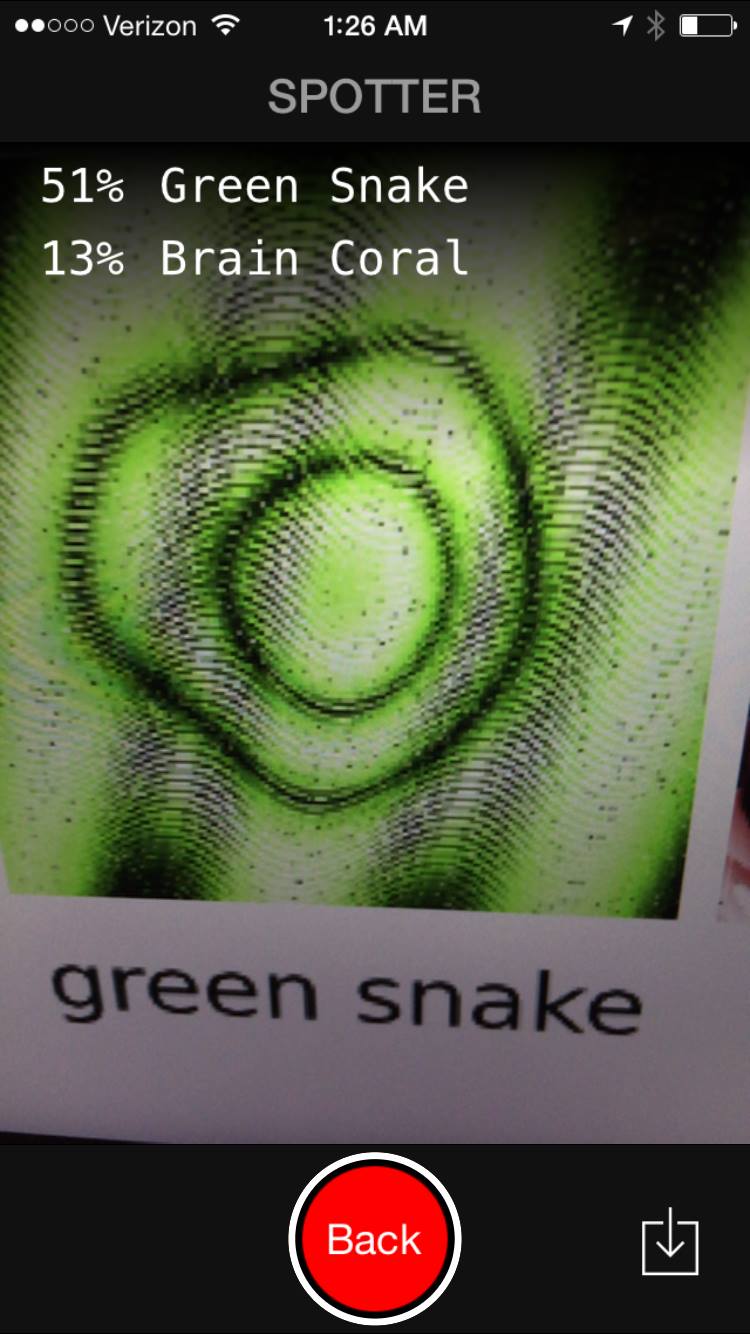

I thought this was surprising the first time I saw it.
Re: Images that fool computer vision raise security concerns
#137Earlier quoted context omitted.
Its the 2nd state of cognitive engagement that makes humans different. Of course a field of static isn't a panda. The computer has no capacity to recognize the context.
I think I get your point now. It's OK if a human momentarily mistakes a random blob for a panda, but they should be able to figure out from other visual cues and context that it's not a panda. And it's that second part that's missing from the computer models?
That's it. Both consciously and subconsciously - lots of image filtering going on unaware.
Re: Images that fool computer vision raise security concerns
#138Cool! Reminds me of "Shazam Decoys" where barely audible or inaudible energy can be added to a signal to fool Shazam into identifying it as the wrong track.
I've often thought there would be an awesome opportunity in there to make a hilarious app that catches cheaters during the music round of Pub Quiz.
Re: Images that fool computer vision raise security concerns
#139This work has led to some unfortunate misconceptions. In particular, this weakness has nothing to do with Computer Vision and also nothing to do with deep learning. They only break ConvNets on images because images are fun to look at and ConvNets are state of the art. But at its core, the weakness is related to use of linear functions. In fact, you can break a simple linear classifier (e.g. Softmax Classifier or Logi…
> This work has led to some unfortunate misconceptions. Agreed; the weaknesses reported should definitely not be taken to affect only convnets or only deep learning. Ian's "Explaining and Harnessing Adversarial Examples" paper (linked by @Houshalter) should be required reading :). > backpropagation allows us to efficiently compute (with dynamic programming, basically) exactly the single most damaging noise pattern ou…
Wait - they didn't use knowledge of the neural network internal state to calculate these patterns? Does that mean they could create equivalent images for human beings? What would those look like!
Re: Images that fool computer vision raise security concerns
#140This work has led to some unfortunate misconceptions. In particular, this weakness has nothing to do with Computer Vision and also nothing to do with deep learning. They only break ConvNets on images because images are fun to look at and ConvNets are state of the art. But at its core, the weakness is related to use of linear functions. In fact, you can break a simple linear classifier (e.g. Softmax Classifier or Logi…
Hi Andrej,
I agree with most of what you say, but note that nearly all of the images in the paper were generated without the gradient. I.e. all the images produced by evolution did not use the gradient, only the output of the network regarding its prediction confidence. There are some images that use the gradient, but only to show a 3rd class of "fooling images".
PS. It's nice to see our work (both this paper and the NIPS paper on transfer learning) in your class. Thanks for including it. I wish I could have my students take your course!